Oil jumps as the Bank of England meets. Past oil shocks mostly left rates alone.
The Bank of England's rate-setters announce at noon on Thursday 17 September with Brent oil above $100 after Saudi Arabia shut its East-West pipeline.
What happened
Saudi Arabia shut its 1,200km East-West crude pipeline on Friday after drone attacks it blamed on militants in Iraq, closing the route it has used to bypass the blocked Strait of Hormuz while Brent crude traded above $100 a barrel.
The drones hit the pipeline in the Riyadh and Medina regions. The line runs from Abqaiq to Yanbu on the Red Sea. According to the International Energy Agency, exports through Yanbu had more than doubled since the war on Iran began. Iraq confirmed the drones were launched from its territory, dismissed the commander for Maysan province and opened an investigation.
Brent crude, the main world oil price, crossed $100 a barrel on and reached $107 on . It eased slightly on Friday.
The Bank of England announces its rate at noon on . The rate has been 3.75 per cent since December. In July the Monetary Policy Committee, which sets the rate, kept it there by six votes to three. The three wanted 4 per cent. Brent was then $84, and the minutes said energy prices were more likely to rise than fall.
Inflation rose to 2.9 per cent in July, and core inflation, which leaves out energy and food, was 2.6 per cent. The August figure comes out on , the day before the vote.
Governor Andrew Bailey told MPs on that the bigger risk was higher inflation and that it came from energy. Thomas Pugh of RSM expects no change, with minutes that lean towards a rise. Markets now expect four rate rises over the next twelve months, up from three before the latest oil move.
Households feel the cost before the decision. Heating oil has gone from about 60p a litre before the conflict to about 97p, and 41,000 homes in Devon and 34,500 in Cornwall heat with oil. Petrol averaged 166.2p a litre on , the highest in four years. A charity in the chancellor’s own constituency says working families just above the benefit threshold face one new cost after another.
Other central banks decide this month too. The US Federal Reserve decides on , with its rate at 3.50 to 3.75 per cent. In July three of its members voted for a rise, and the president is demanding cuts, while US inflation is unchanged at 3.4 per cent. The European Central Bank raised its rate to 2.5 per cent on , and the Bank of Japan is expected to move to 1.25 per cent on Friday.
Sources: Guardian (2, 3, 4), BBC, Bank of England (2), ONS, BBC (2), Federal Reserve
The Pattern
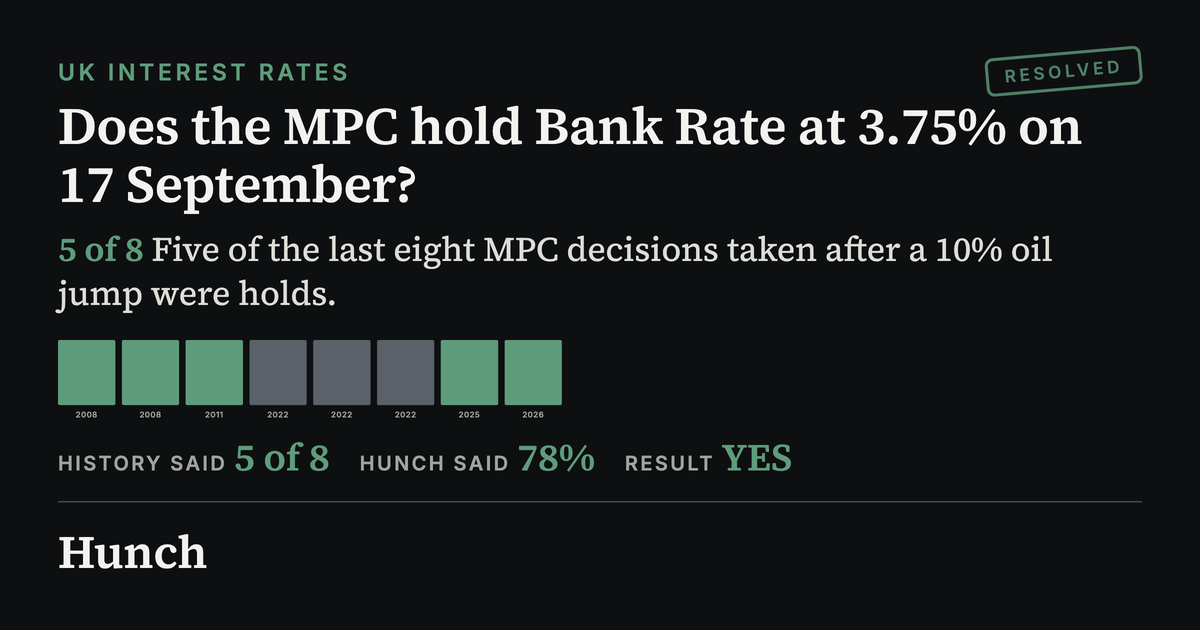
We found eight rate decisions made just after oil jumped. They come from the six oil price spikes named in the Bank of England’s own minutes since 2008: the run towards $147 in 2008, Libya in 2011, the attack on Abqaiq in 2019, Ukraine in 2022, the Israel–Iran war in 2025 and the Iran war in 2026. In each decision the minutes show Brent up 10 per cent or more since the meeting before. We checked whether the Bank left its rate unchanged, which is what the first market asks about . Newest first.
Show the other 6 cases
The Read
History points to no change. In five of the eight past decisions after an oil jump, the Bank left its rate where it was. The three rises, all in 2022, came when the Bank had already been raising rates since . Today the rate is where a run of cuts left it in . The job market is also weakening, and vacancies in the latest ONS count were the lowest since 2014 outside the pandemic. Bailey has said higher mortgage rates have done some of the work of a rise. The likeliest result is no change, with more members voting for a rise.
The doubt is that this is the second stage of the same war, and the committee has already watched six months of higher energy prices feed through. Three members voted for 4 per cent in July, and the July minutes promised to guard against price rises spreading further. The European Central Bank raised again on into the same energy shock, and markets expect four UK rises within a year. Ten-year government borrowing costs passed 5.37 per cent on , the highest since 2007, seven weeks before John Healey’s first Budget on . He has promised to control borrowing to bring inflation down.
The August inflation figure on matters most. A figure well above 2.9 per cent, with two members joining the minority, would break the pattern. The US Federal Reserve decides a day before the Bank. Three of its members wanted a rise in July while the president demands cuts, and US inflation of 3.4 per cent with strong hiring could push it to move first. The minority at the Bank could also shrink to two after Bailey’s calm words on mortgage rates.
Sources: Bank of England (2), ONS (2), Guardian (2), Federal Reserve
Disclaimer
Hunch works only from sources that are publicly available, and publishes on the basis of analysis of that material. We do not form an editorial opinion or take sides, we give a simpler and wider view of news that already exists. If information in a source we used was inaccurate, distorted, or later disputed but had already entered our analysis, Hunch accepts no liability for that. Predictions are not advice. Phase 1 markets use Hunch Points, not money.
Published by Hunch under the Editorial Code. Complaints and corrections: /contact/.