Britain's grid asked for more power on 9 November. Will it ask again by New Year?
NESO, which runs Britain's electricity system, warned it was short of spare power for the morning of 9 November. It lifted the warning at 9:11.
What happened
NESO, Britain’s grid operator, asks for more power for a Monday morning as wind drops across Europe.
On NESO warned that spare power was running short. NESO, the National Energy System Operator, runs Britain’s electricity system. Its notice on Sunday evening said spare power for 6:00 to 11:00 on Monday was 1,388 megawatts (MW) short, and asked power stations and cables from Europe to offer more.
By Monday morning the gap had closed. Before dawn the shortfall was 500 MW, at 8:24 it was 200 MW, and at 9:11 NESO cancelled the notice. A NESO spokesperson called it “a routine and precautionary measure” and said: “This is not a warning of power cuts”.
This time the warning was for a still morning. In the past such notices usually came on cold winter evenings, when Britain uses the most electricity. This time wind power was low across Europe. On Friday NESO paid £2,500 per megawatt-hour, a unit of energy, for power through the cables from Europe, energy consultant Kathryn Porter said.
It was the seventh such notice since June. NESO issued none from to . Since there have been notices in every month from June to November, the first ones in summer heat.
NESO expects tight days this winter. Its winter report, revised on , says such notices “are a normal part of operating the electricity system”. It puts spare power at the coldest peak at 5.9 gigawatts, about 9.5% above demand, “broadly in line with recent winters”.
An ELECTRICITY MARGIN NOTICE has been issued by the National Energy System Operator to encourage market actions to increase System Margins.
NESO notice, 8 November 2026
Sources: The Guardian, Elexon (2, 3, 4), NESO
The Pattern
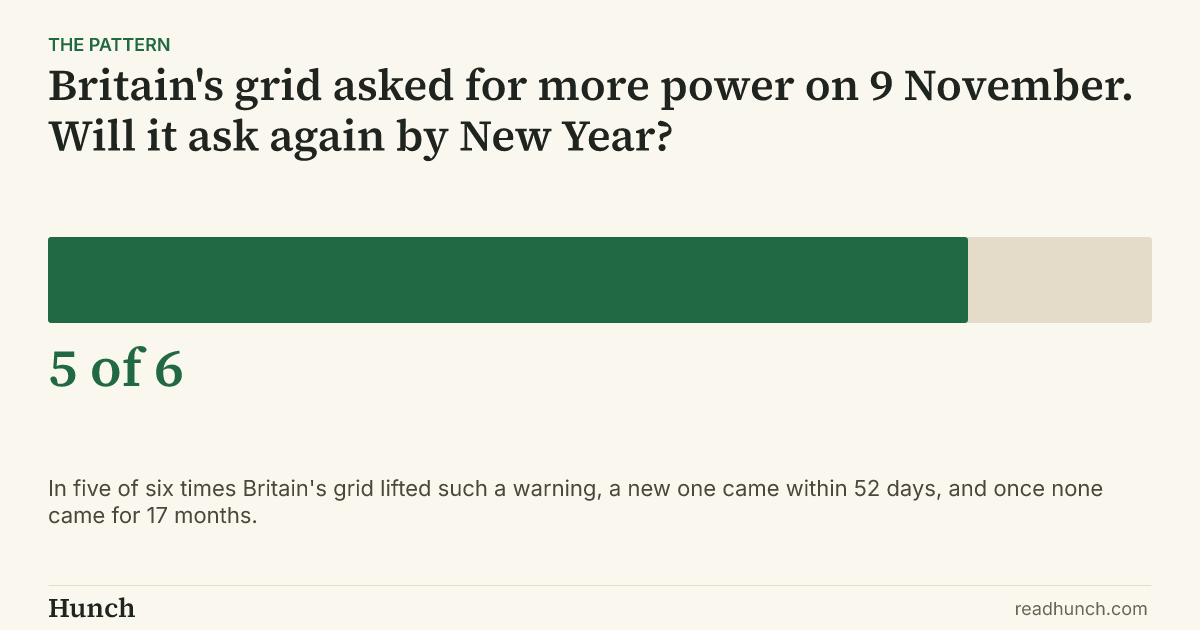
We looked for cases where Britain’s grid operator lifted a warning that spare power was short, and whether a new one came within 52 days, the time from to . The public list of each notice starts in . It shows seven before this one. We left out the warning of , when the next came two days later, as more than two quiet days have already passed now. (Elexon; Elexon; Elexon)
Show the other 4 cases
The Read
Five of the six past warnings were followed by another within 52 days, after 7 to 47 days, so a new notice before looks more likely than none. Only two of the six came back within 12 days, and NESO’s winter report expects tight days “most likely in December or January”. Every new warning from June to October was for the evening, between 15:00 and 23:00. The one on was the first for a morning.
There are reasons for doubt. Five of the six warnings came in one run that began in , and the same NESO control room decided each time. Winters have been quieter: NESO’s report shows one notice or none in six of the last seven winters, none last winter, and spare power this winter close to last year’s. Public lists of each notice start only in , so earlier years, such as ten notices in 2005, cannot show when the next one came.
Sources: Elexon (2, 3), NESO, The Guardian
Disclaimer
Hunch works only from sources that are publicly available, and publishes on the basis of analysis of that material. We do not form an editorial opinion or take sides, we give a simpler and wider view of news that already exists. If information in a source we used was inaccurate, distorted, or later disputed but had already entered our analysis, Hunch accepts no liability for that. Predictions are not advice. Phase 1 markets use Hunch Points, not money.
Published by Hunch under the Editorial Code. Complaints and corrections: /contact/.