Norway's central bank is ready to raise rates. Before, those words meant a wait.
Norges Bank, Norway's central bank, kept its rate at 4.5% on 5 November and said it was ready to raise it. It decides next on 17 December.
What happened
Prices in Norway rose 3.6% in the year to October, while prices without energy and tax changes rose 2.7%, down from 3.0% in September.
Prices in Norway rose 3.6% in the year to October, up from 3.4% in September, Statistics Norway said on . Costs of housing, water, electricity and fuel rose 5.1%, and transport 5.4%. Prices without energy and tax changes, which Statistics Norway uses to show the underlying trend, rose 2.7%, down from 3.0% in September.
Norges Bank kept its main interest rate at 4.5% at its meeting on , and all five members of its rate committee agreed. It had raised the rate twice this year, from 4% to 4.25% in May and to 4.5% in September. Governor Ida Wolden Bache said: “Inflation is too high.”
The Committee’s current assessment of the outlook implies that it will likely be necessary to keep the policy rate elevated for a time. The Committee is prepared to raise the policy rate if warranted by the inflation outlook.
Norges Bank, monetary policy statement, 4 November 2026
Before both rises this year, the bank used a stronger word. In March it said a rise would “likely be appropriate” at one of the next meetings, and it raised the rate in May. In June it said a rise would “likely be necessary”, and it raised the rate in September. In November it said only that it was ready. Its September forecast keeps the rate close to 4.5% for a while and then a little lower.
The bank points both ways. It says prices of goods and services made in Norway are rising faster than it expected, and gas and electricity prices have gone up. The Norwegian krone is stronger than it assumed, which makes imports cheaper. The bank says markets expect a rise by the end of .
The next decision comes at 10:00 Oslo time on , with a new forecast for the rate. Statistics Norway publishes November prices on .
Sources: Statistics Norway, Norges Bank (2, 3, 4, 5, 6)
The Pattern
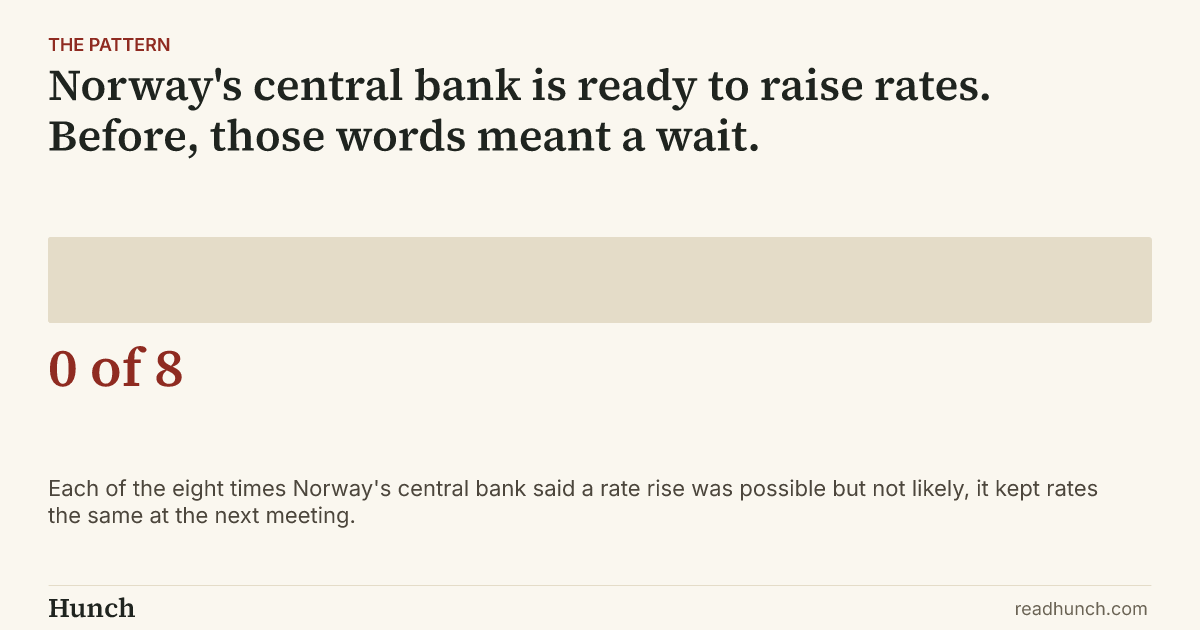
We looked for cases where Norges Bank had raised its rate, then kept it the same at the next meeting, and said a rise was possible but not that it was likely. We found eight such times since 2001, one in 2002, one in 2008 and six in 2024. At the meeting that followed, the bank kept the rate every time. (Norges Bank)
A higher policy rate than currently envisaged may then be required. Its forecast showed the rate falling from early 2025. On it kept 4.5%.
the policy rate may be set higher, but also that it may be lowered earlier. On it kept 4.5%.
Show the other 6 cases
there may be a need to raise the policy rate. Its forecast kept 4.5% to the end of the year, then lower. On it kept 4.5%.
prepared to raise the policy rate againif a rise was needed. On it kept 4.5%.
prepared to raise the policy rate again. Its forecast kept 4.5% until the autumn, then lower. On it kept 4.5%.
prepared to raise the policy rate again. On it kept 4.5%.
or perhaps somewhat higher. On it kept 5.75%, then cut it on .
The Read
Eight times since 2001 Norges Bank said a rise was possible but not that it was likely, and each time the rate stayed the same at the next meeting. Each of those pauses ended with a cut, the last one in . Since 2001 the bank has raised the rate 20 times after it had paused following a rise, and each time it had first said a rise was likely or shown one in its forecast.
There are reasons for doubt. Six of the eight meetings came during one pause in 2024, with the same committee deciding, and none of the eight was in December. In the bank said the rate would stay the same “or perhaps somewhat higher”, which can be read as a hint of a rise. This time prices overall are rising faster than in September, and November prices come out a week before the decision.
Sources: Norges Bank (2, 3), Statistics Norway
Disclaimer
Hunch works only from sources that are publicly available, and publishes on the basis of analysis of that material. We do not form an editorial opinion or take sides, we give a simpler and wider view of news that already exists. If information in a source we used was inaccurate, distorted, or later disputed but had already entered our analysis, Hunch accepts no liability for that. Predictions are not advice. Phase 1 markets use Hunch Points, not money.
Published by Hunch under the Editorial Code. Complaints and corrections: /contact/.