UK energy bills rise in October. The cap after it has almost always gone up again.
Ofgem set the October energy price cap at £1,723 a year for a typical household on direct debit. The 4% rise comes almost entirely from gas.
What happened
Ofgem set the energy price cap at £1,723 a year for a typical dual-fuel direct debit household from to , a 4% rise on the current £1,663.
The new cap starts on . Ofgem, the energy regulator, sets the price cap, a limit on what suppliers can charge households on standard tariffs. It covers around 22 million households on these default tariffs. Roughly 11 million households on fixed deals are not covered.
The rise is almost all gas. Gas bills go up 8 per cent while electricity stays about the same, so homes without gas see a rise of less than 1 per cent. Ofgem says wholesale gas prices, what suppliers pay for gas, rose 11 per cent over three months because of the conflict in the Middle East.
The government’s removal of VAT from electricity is holding bills down. Without it, Ofgem says, the cap would have been about £45 higher. Prices are 52 per cent below the 2022 peak in cash terms. After inflation, though, this cap is 7 per cent higher than in .
The next cap covers January to March, when the heating is on. The Chancellor’s first Budget, on , falls between the two announcements.
The Pattern
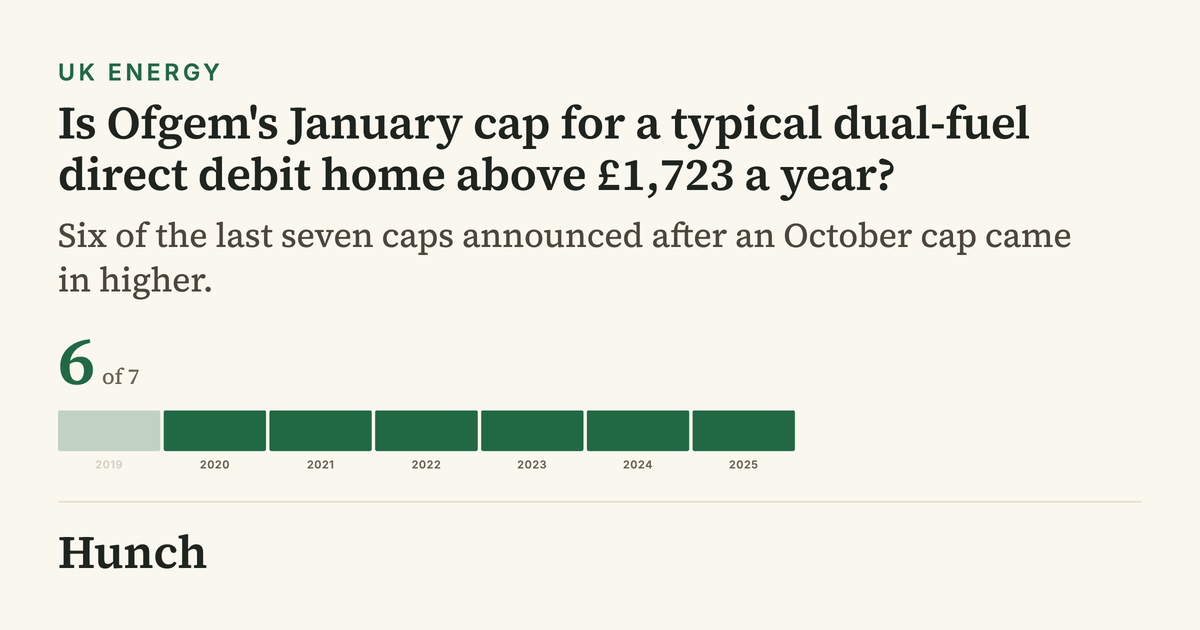
We found seven October caps, from 2019 to 2025. For each one we looked at the next cap Ofgem set after it. Until 2021 the cap lasted six months, so the next one was April’s. Since 2022 it changes every three months, so the next one is January’s. We checked whether the next cap for a typical household paying by direct debit was higher than October’s, using Ofgem’s own figures and its comparable figures when it changed how it measures a typical home. Newest first.
Show the other 5 cases
The Read
History points to another rise. The October rise is mostly gas, and gas is the bigger part of a January bill. Ofgem’s reason, an 11 per cent rise in wholesale gas over three months on Middle East supply worries, has not gone away. The January cap is based on prices over the autumn, when Europe refills its gas storage just as heating demand starts. Six of the seven caps after an October cap went up. The two smallest rises, into 2025 and 2026, came when wholesale prices were flat or falling.
The doubt is the government. It has shown it will spend to keep the headline figure down. Removing VAT from electricity took about £45 off the October cap, and £150 of policy costs came off bills in April. The Budget on gives the Chancellor one more chance before the November announcement, and a winter cap starting with 16 is a better political number than one starting with 18.
Ofgem’s January cap, announced by , settles it. A rise becomes less likely if the Treasury moves more charges off bills, or if a deal over the Strait of Hormuz pulls wholesale gas prices down during the autumn.
Disclaimer
Hunch works only from sources that are publicly available, and publishes on the basis of analysis of that material. We do not form an editorial opinion or take sides, we give a simpler and wider view of news that already exists. If information in a source we used was inaccurate, distorted, or later disputed but had already entered our analysis, Hunch accepts no liability for that. Predictions are not advice. Phase 1 markets use Hunch Points, not money.
Published by Hunch under the Editorial Code. Complaints and corrections: /contact/.