Britain's grid struggled in June's heat. Will the regulator say it broke the rules?
Ofgem, Britain's energy regulator, aims to say by 31 January whether the power grid stayed safe in June's heatwave.
What happened
NESO, Britain’s grid operator, warns it is short of spare power for a Monday morning as wind drops across Europe.
Ofgem aims to rule on June’s heatwave by . Ofgem, Britain’s energy regulator, is checking how the National Energy System Operator (NESO), the state-owned company that runs the power grid, handled the week from . It aims to say by whether the grid stayed secure and its safety rules were kept.
Ofgem has set out what it will judge. It will ask whether all the relevant security standards were met, “and if not, whether the reasons for this were justified”. If it finds “material reason to believe” a company broke the terms of its licence to operate, it says it will consider a formal investigation.
No homes lost power in June. The grid’s frequency, its steady rhythm of 50 cycles a second, stayed inside the legal limits. But on the evening of it was below NESO’s normal range for long periods, and on 23 and power flows on parts of the network went over NESO’s own limits.
The grid was tight again on . On NESO warned it was almost 1,400 megawatts short of spare power for the next morning, then lifted the warning soon after 9am. A report in October found problems in the culture of its control room.
NESO’s own review team reports first. It sends its final report to Ofgem by . Energy minister Michael Shanks said the government expects “significant action without delay” from NESO.
We aim to publish our conclusions on whether the GB electricity system remained secure during the events and whether security standards were maintained, as soon as possible after receiving the final report and no later than .
Ofgem, 19 October 2026
Sources: The Guardian (2), Ofgem (2)
The Pattern
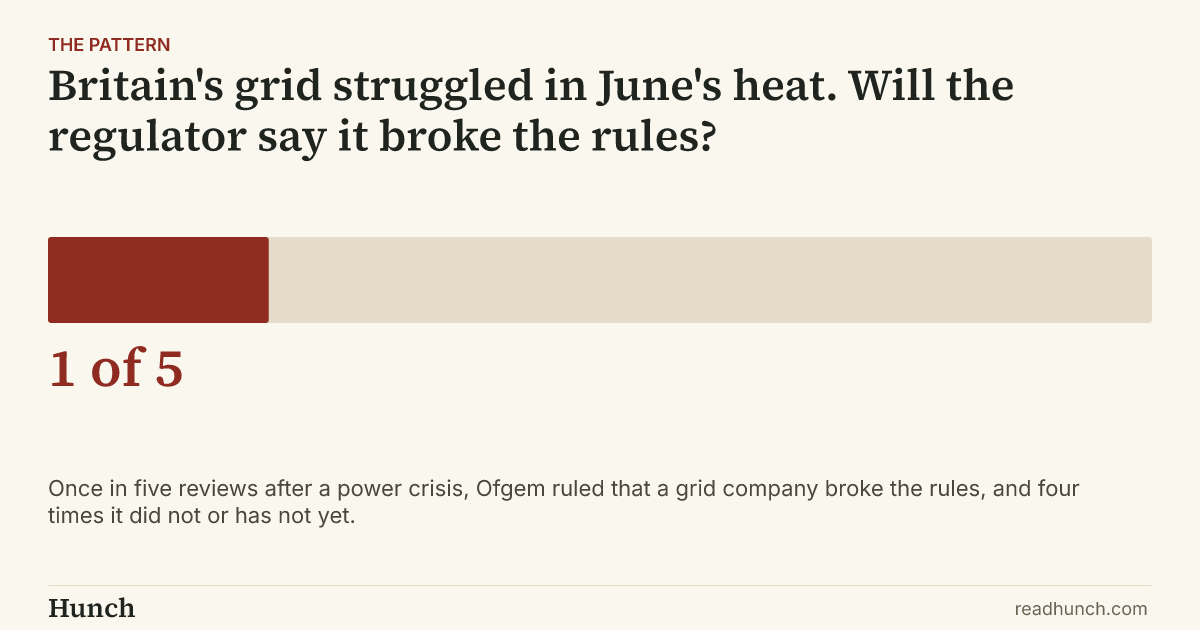
We looked for cases where Britain’s energy regulator reviewed how a company running the power grid behaved during a crisis, and then published its findings. We found five such reviews since 2003. Each followed a crisis that cut power to homes, and each looked at private companies. (Ofgem; Ofgem; Ofgem; Ofgem; Ofgem)
Show the other 3 cases
The Read
Four of the five past reviews found no breach by the company running the grid, or have not found one yet. Three times Ofgem named failings in plain words instead, such as “could have been better” in 2014. Three of the five published findings within 223 days of the crisis, the same time as from to , and in two of those three Ofgem named failings but found no breach. Ofgem wrote that NESO’s first report points to a mix of extreme weather, problems across the whole system and changing markets in Europe, but added that “there are still important questions to be answered regarding system security”.
There are reasons for doubt. The same regulator decided each time, and every past review followed power cuts at a private company. In June no homes lost power, and NESO has belonged to the state since 2024. The 2025 investigation into the North Hyde fire is still open after 601 days, so it may yet end in a breach. NESO’s own report already shows the frequency below its normal range on , which gives Ofgem facts to judge either way.
Disclaimer
Hunch works only from sources that are publicly available, and publishes on the basis of analysis of that material. We do not form an editorial opinion or take sides, we give a simpler and wider view of news that already exists. If information in a source we used was inaccurate, distorted, or later disputed but had already entered our analysis, Hunch accepts no liability for that. Predictions are not advice. Phase 1 markets use Hunch Points, not money.
Published by Hunch under the Editorial Code. Complaints and corrections: /contact/.