Missiles hit Kuwait before OPEC+ meets. After past Gulf attacks, output often rose.
Iranian missiles and drones hit bases in Kuwait, Bahrain, Jordan and Iraq on 2 September, 4 days before 7 OPEC+ oil producers set October output.
What happened
After US strikes on dozens of targets along Iran’s southern coast, Iran fired ballistic missiles and drones at US bases in Jordan, Bahrain, Kuwait and Iraq’s Erbil, the biggest exchange in more than a month.
On the United States struck Iran’s southern coast. It hit dozens of military targets, with explosions reported at Konarak, Bandar Abbas, Jask, Asaluyeh and Qeshm Island. Iran answered with ballistic missiles and drones fired at US bases in Jordan, Bahrain, Kuwait and Erbil in Iraq.
By Thursday Kuwait’s military said Iranian attacks were continuing and its air defences were in action again. For the oil market, this is an attack on the land of a Gulf oil producer a few days before OPEC+ decides how much oil to pump.
OPEC+ makes that decision on Sunday . On the seven countries behind the voluntary cuts agreed to add 188,000 barrels a day from September. It was the sixth monthly increase in a row since April, and it completed the return of the cuts they made in .
Oil prices have already reacted to this war once. On the US struck Iran after attacks on three ships in the Strait of Hormuz, and Brent, the main world oil price, rose more than 3% to $76.48. Before that it had been sliding back to its pre-war level.
In July the group itself said attacks on oil sites and shipping make prices swing more. Before the summer fighting grew, members had also signalled a pause in increases for the last three months of the year. Sunday will show whether missiles over Kuwait change what the group usually does after Gulf attacks, which is mostly to keep adding oil.
Sources: Al Jazeera (2, 3, 4), OPEC
The Pattern
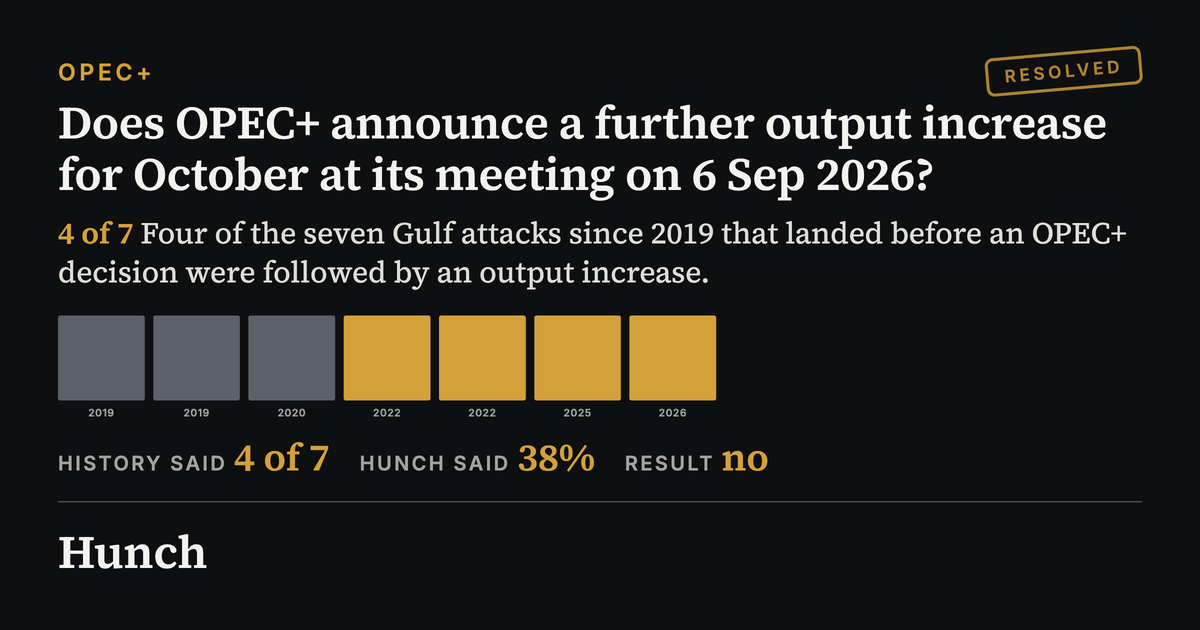
We found seven attacks since that fit. Each hit Gulf oil sites or military bases in the weeks before OPEC+ decided how much oil to pump. For each one we checked whether the group’s next decision raised output, the same question the first market asks about .
Show the other 5 cases
The Read
The past record shows more increases than not, four of the seven. But those four all came while the group was following a published plan to give back its cuts. That plan ended on , when the last of the cuts was returned, and in July, before the latest fighting, members were already signalling a pause. The group seems to follow its own timetable and the market, and not the news from Kuwait. With the timetable finished, a pause is what is left, which is why the pause is priced above the increase.
The strongest case against this is the two most recent attacks, in 2025 and 2026. Both were followed by increases, because Saudi Arabia’s plan to win back market share has lasted through every crisis so far. The pause call is wrong if Riyadh sees high prices, with Hormuz in dispute, as the moment to add oil. The record is also small, and the two 2022 increases came from one plan, so the seven cases are closer to six separate decisions.
A cut is the other way it could go. If the group decides, after six increases and a war, that it wants to protect the price as it did after Abqaiq in 2019, the October meeting could bring a cut for November.
Disclaimer
Hunch works only from sources that are publicly available, and publishes on the basis of analysis of that material. We do not form an editorial opinion or take sides, we give a simpler and wider view of news that already exists. If information in a source we used was inaccurate, distorted, or later disputed but had already entered our analysis, Hunch accepts no liability for that. Predictions are not advice. Phase 1 markets use Hunch Points, not money.
Published by Hunch under the Editorial Code. Complaints and corrections: /contact/.