OPEC+ adds oil, Brent is at $72. Past oil spikes faded fast only half the time.
OPEC+ agreed a fifth monthly rise in oil output on 5 July. Shipping through the Strait of Hormuz is recovering and Brent oil has fallen back to $72.
What happened
OPEC+ countries said they will expand monthly oil production by 188,000 barrels per day from August, the fifth increase in as many months, as Hormuz exports recover.
OPEC+ will pump 188,000 more barrels a day from August. Seven members, Saudi Arabia, Russia, Iraq, Kuwait, Kazakhstan, Algeria and Oman, agreed this at an online meeting on . It is the fifth monthly increase in a row. Since April the group has raised its output limits by almost 800,000 barrels a day as it reverses cuts first announced in 2023.
Oil is back to its price before the war. Brent, the main world oil price, has fallen four weeks in a row and trades near $72 a barrel. It is down from peaks above $120 and level with its last close before the strikes on Iran on , $72.50.
Ships are moving through the Strait of Hormuz again under the deal signed by Tehran and Washington. Saudi oil exports are back to 90% of their pre-war level, and exports from the UAE are recovering too.
The group says it is returning to normal because shipping has improved and demand is steady. Analysts are less sure. Oil that the war kept off the market is coming back at the same time as the extra OPEC+ barrels, and they now ask openly whether the shortage has turned into a glut, meaning too much oil. The seven meet again in early August to set September output.
Sources: Al Jazeera (2), Bloomberg
The Pattern
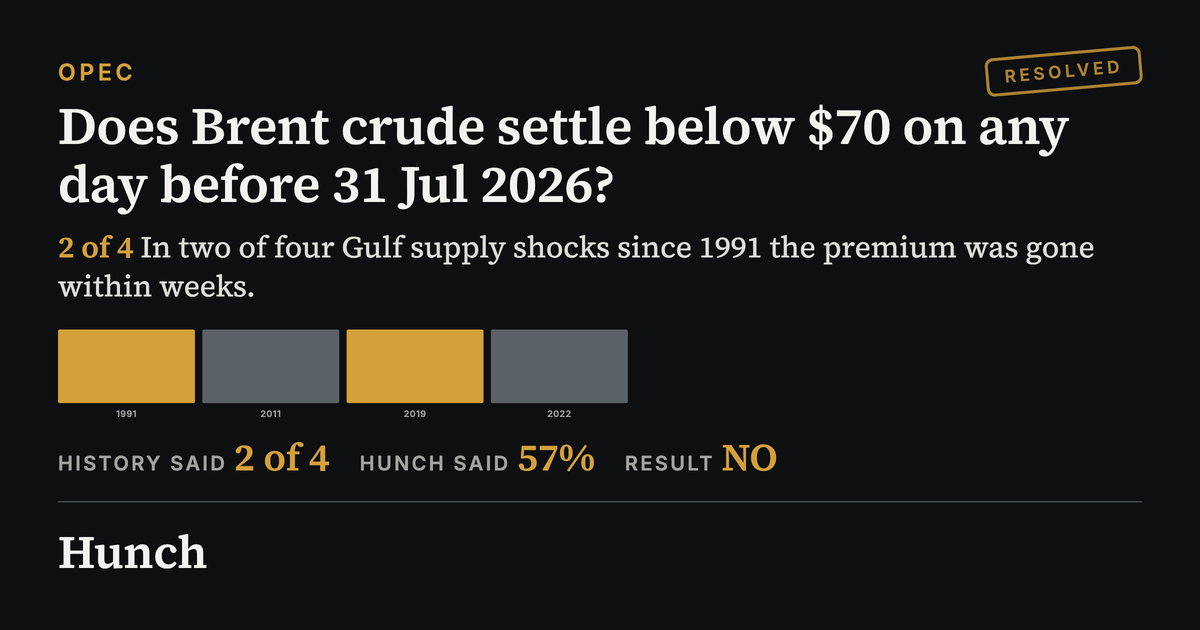
We looked at four big oil supply shocks since 1991. In each one the lost oil later started to come back. We asked how fast the price then fell back to where it was before the shock. The record is split. Twice the extra price caused by the crisis was gone within weeks. Twice it stayed for months or more, because the lost oil never fully came back.
Show the other 2 cases
The Read
History is split evenly, and this time looks more like the fast cases. As in 2019 and 1991, the oil is really coming back. Saudi exports are already at 90% of normal, and OPEC+ is adding more on top. When prices keep falling while supply keeps growing, they often fall too far, and $72 is only $2 above the $70 line. That is why the market puts a fall below $70 at slightly more likely than not.
There are good reasons for doubt. $72 is already the pre-war price, so the extra price from the war may already be gone and what is left is a fair price. China is reported to be buying oil for storage at these levels, and OPEC+ could pause at its August meeting as soon as prices turn. Only two of the four past cases, 1991 and 2019, really match this one, because in 2011 and 2022 the oil did not come back in the same way.
Those two cases also warn that recoveries stall. One missile strike on the reopened shipping lane would push prices back up in an afternoon, and both the $70 market and the pre-war price market would fail on that one event.
Disclaimer
Hunch works only from sources that are publicly available, and publishes on the basis of analysis of that material. We do not form an editorial opinion or take sides, we give a simpler and wider view of news that already exists. If information in a source we used was inaccurate, distorted, or later disputed but had already entered our analysis, Hunch accepts no liability for that. Predictions are not advice. Phase 1 markets use Hunch Points, not money.
Published by Hunch under the Editorial Code. Complaints and corrections: /contact/.