Paramount seeks to settle with 12 US states. Most such cases ended in a ruling.
Paramount is in advanced talks to settle the antitrust case that twelve US states brought to stop its $81bn purchase of Warner Bros. Discovery.
What happened
The Financial Times reported on that Paramount is in advanced talks to settle the antitrust case brought by twelve state attorneys general against its purchase of Warner Bros. Discovery.
Paramount is in advanced talks to settle with twelve US states. The states brought an antitrust case, a case under competition law, to stop Paramount buying Warner Bros. Discovery.
Twelve state attorneys general, the top lawyers of their states, filed the case on in the federal district court in Oakland, led by Rob Bonta of California. It is now the only thing standing between the two companies and a deal worth about $81bn. The federal government never sued at all.
Two days before the report, the Federal Communications Commission approved the foreign investment in the merged company. That cleared the last regulator in the way.
The court has set settlement talks for 14 and . Magistrate Judge Thomas Hixson ordered both sides to a two-day settlement meeting in San Francisco, closed to the public.
Before that, on , Judge Araceli Martínez-Olguín hears Paramount’s request that the states put up a bond of $1.88bn. It would cover the $7m a day that Paramount starts paying Warner Bros. Discovery shareholders on while the case is open. If nothing settles, the final pre-trial hearing is on and the trial starts on .
Both companies filed their answer to the complaint on , which is what a party does when it is getting ready for trial. Eight days later came the report of settlement talks. Both things can be true at the same time.
Sources: Financial Times, Reuters, court register, order of
The Pattern
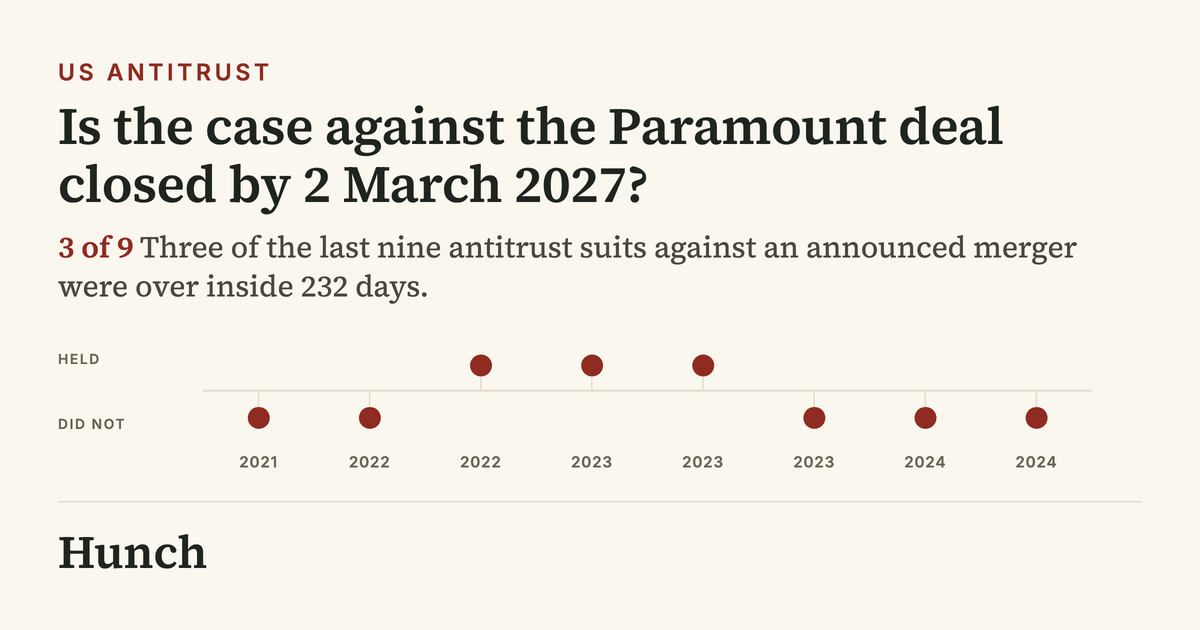
We found nine cases since 2019 like this one. In each, a US competition authority, the Federal Trade Commission, the Justice Department or a group of state attorneys general, went to a federal court to stop a merger that had already been announced. We counted the days from the filing to the day the court closed the case, whatever closed it: a settlement, a ruling for either side, or the companies walking away. We checked whether each was over within 232 days, the gap here between the filing and the first day of trial.
Show the other 7 cases
The Read
History points to a long case. Only three of the nine were over within 232 days. The two fastest, at 108 and 119 days, both ended with the buyer accepting conditions. The next took 207 days, and all but one of the cases after it ended with a judge’s ruling. So the real question is whether Paramount and the states settle now, in the window the court has built for talks, or spend the winter getting ready for a trial on .
This case is different in two ways. Waiting has a price: from Paramount pays Warner Bros. Discovery shareholders $7m a day while the case is open. And nobody else is left to please. The Federal Communications Commission signed off on and the federal government never sued, so twelve state attorneys general are holding up an $81bn deal on their own.
That is also where the record is weakest. Only one of the nine cases was brought by states, T-Mobile and Sprint, and the states took it all the way to a ruling and lost. Some of the other cases came from the same agency at the same time, so the nine are closer to six separate decisions, and four of those six came from federal agencies under one president. There is no market on the bond hearing, because these cases show when cases close and say nothing about how judges rule on bonds.
Disclaimer
Hunch works only from sources that are publicly available, and publishes on the basis of analysis of that material. We do not form an editorial opinion or take sides, we give a simpler and wider view of news that already exists. If information in a source we used was inaccurate, distorted, or later disputed but had already entered our analysis, Hunch accepts no liability for that. Predictions are not advice. Phase 1 markets use Hunch Points, not money.
Published by Hunch under the Editorial Code. Complaints and corrections: /contact/.