Paramount settles with 12 US states. Can the Warner deal close before 1 October?
Paramount has settled the antitrust case brought by twelve states, the last barrier to its $111bn purchase of Warner Bros. Discovery.
What happened
Variety and The Hollywood Reporter reported on that Paramount Skydance and the twelve state attorneys general suing to stop its purchase of Warner Bros. Discovery had agreed terms to settle the case.
Paramount Skydance has settled with twelve US states. The states had brought an antitrust case, a case under competition law, against its purchase of Warner Bros. Discovery.
The group is led by Rob Bonta, the attorney general of California, and includes Arizona, Colorado, Connecticut, Massachusetts, Minnesota, Nevada, New Jersey, New Mexico, New York, Oregon and Washington. It sued in the federal court in Oakland on .
The terms have not been filed yet. Reports on the agreement describe limits on how Paramount may run CNN, money penalties tied to David Ellison’s promise of thirty cinema releases a year, and running the two studios apart for a time. The Writers Guild of America case is folded into the same agreement.
A day earlier at least four attorneys general, among them New York and Connecticut, were still pushing for stronger conditions. Bonta had said in public that he would accept only structural remedies, meaning sales of parts of the combined business.
Everything else was already cleared. Warner Bros. Discovery shareholders approved the sale on .
The Justice Department reviewed the deal and did not sue, and the Federal Communications Commission approved the foreign investment on .
From Paramount pays about $7m a day. It owes Warner Bros. Discovery shareholders about $650m a quarter for as long as the deal is open. What is left is paperwork: the settlement filed with the court, the states’ case dismissed, and the closing itself.
Sources: Variety, Al Jazeera, Deadline, The Hollywood Reporter, BBC, Reuters
The Pattern
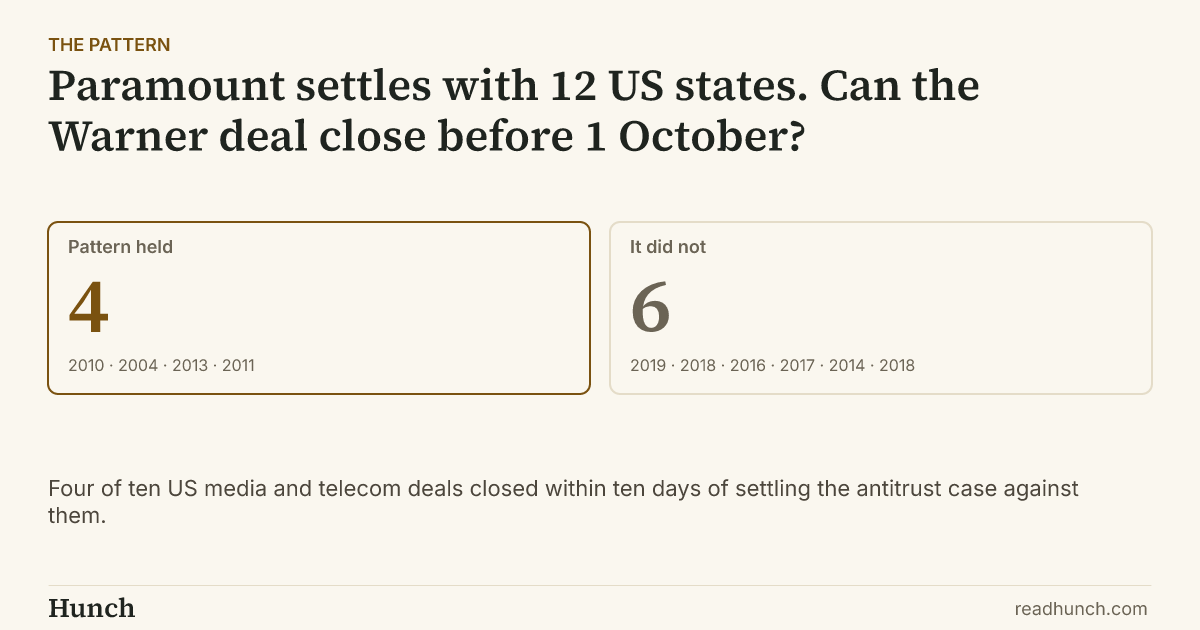
We found ten deals like this since 2004. Each was a large US media or telecom merger where a competition case against it ended in a settlement. We counted the days from the settlement being filed in court to the day the buyer reported the deal complete. We checked whether that took ten days or less, the gap between this settlement and , when the daily payment starts. We picked the ten cases closest to this one, not the newest. One caution: the Justice Department settled all ten, so the same body set the terms every time.
Show the other 8 cases
The Read
History says the deal will close, and the open question is when. In all ten cases the buyer completed the purchase after the settlement was filed. Four of the ten closed within ten days and eight within fifty. The two that took most of a year each had another problem still open. T-Mobile still faced a group of states in court, and Disney still had foreign regulators to satisfy and twenty-two sports networks to sell. Neither applies here.
The record is weaker than it looks. The Justice Department settled all ten cases, while here twelve elected attorneys general must each sign, and only four of the ten past cases had state attorneys general involved at all. Two of the ten, Live Nation and Gannett, were much smaller deals than this one.
The second market asks what the settlement contains. Eight of the same ten settlements ordered the buyer to sell something. The two that did not, Comcast with NBCUniversal and Charter with Time Warner Cable, set rules on how the buyer behaved instead. Every report of Monday’s agreement points that way: promises about CNN, a film count with money attached, and the two studios run apart for a while. If the document filed in Oakland orders a sale after all, Rob Bonta got the terms he said he would insist on.
Disclaimer
Hunch works only from sources that are publicly available, and publishes on the basis of analysis of that material. We do not form an editorial opinion or take sides, we give a simpler and wider view of news that already exists. If information in a source we used was inaccurate, distorted, or later disputed but had already entered our analysis, Hunch accepts no liability for that. Predictions are not advice. Phase 1 markets use Hunch Points, not money.
Published by Hunch under the Editorial Code. Complaints and corrections: /contact/.