Quebecor v Telus: will the smaller company raise its C$31bn offer or walk away?
Quebecor offered about C$31bn for its larger rival Telus on 16 November. The Telus board says the price is too low and Quebecor would get control.
What happened
The Board is not satisfied that the consideration offered under the Proposal adequately reflects the value of TELUS.
C$31bn is what Quebecor offered for Telus on . Each Telus share would get C$6.35 in cash and 0.17 of a Quebecor share, which Quebecor says is about 60% more than the market price. Quebecor is the smaller company: it is worth C$14.77bn on the stock market, and Telus C$21.72bn.
This is Quebecor’s second offer since June. The first came on . The second, on , added the health business TELUS Health, which the first offer left to be sold on its own, and raised the share part from 0.16 to 0.17. On the Telus board wrote that the price is too low and that Quebecor would take control of the joined company while Telus owners brought most of its value. It also invited Quebecor to a meeting on with the finance chiefs of both companies.
C$10bn of new borrowing would pay for the cash part. Quebecor chief executive Pierre Karl Péladeau told The Globe and Mail he would not give up his special voting shares: “Certainly not”. He called the offer opportunistic but not wrong.
Three government bodies must approve the deal: the Competition Bureau, the telecoms regulator CRTC and the industry ministry. Industry Minister Mélanie Joly said the offer will be reviewed “independently and rigorously”. On Prime Minister Mark Carney said the government will choose more competition and lower prices.
The Board is not satisfied that the consideration offered under the Proposal adequately reflects the value of TELUS.
TELUS board letter to Quebecor, 15 November 2026
Sources: TELUS, CBC, The Globe and Mail (2)
The Pattern
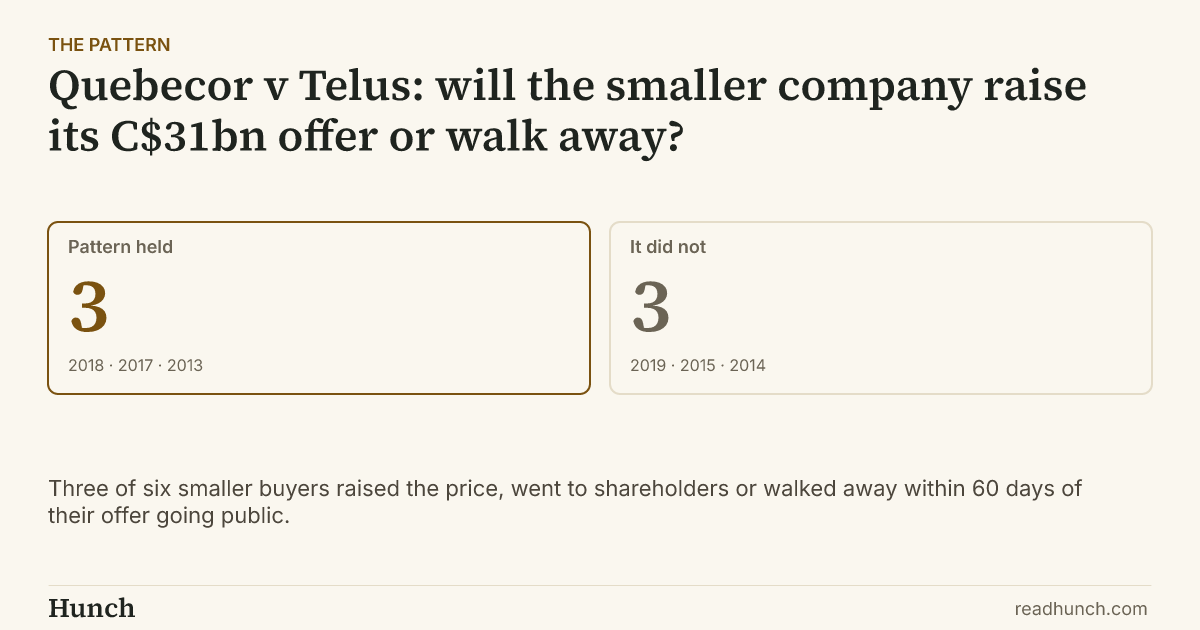
We looked for cases where a company made a public offer for a larger listed company, measured by stock market value, and the target’s board turned it down. We found six such offers since 2013, in the US, Britain and Canada. In each, we counted the days until the buyer raised its price, made a formal offer straight to shareholders or walked away.
Show the other 4 cases
The Read
Three of the six buyers moved within 60 days: Kraft Heinz walked away after two days, Melrose went to GKN shareholders within 27 days and Jos. A. Bank ended its offer on day 37. The other moves came on day 95 or later. Only two buyers ever raised their price, and both did it together with a formal offer to shareholders. In four of six the buyer walked away in the end.
There are reasons for doubt. The two buyers that moved fastest were bidding for British companies, and British takeover rules give a buyer a deadline to make a firm offer or walk away. Canada has no such deadline for Quebecor. Outside Britain, one of four buyers moved within 60 days. In Canada a formal offer must stay open for at least 105 days, or 35 if the target’s board agrees, so a vote by Telus owners before is unlikely.
Sources: The Guardian (2, 3), SEC (2), Ontario Securities Commission
Disclaimer
Hunch works only from sources that are publicly available, and publishes on the basis of analysis of that material. We do not form an editorial opinion or take sides, we give a simpler and wider view of news that already exists. If information in a source we used was inaccurate, distorted, or later disputed but had already entered our analysis, Hunch accepts no liability for that. Predictions are not advice. Phase 1 markets use Hunch Points, not money.
Published by Hunch under the Editorial Code. Complaints and corrections: /contact/.