Australia's central bank raises rates again. Will it pause in November?
The Reserve Bank of Australia raised its main rate to 4.6% on 29 September, the fourth rise this year. Its governor said more may not be needed.
What happened
On the Reserve Bank of Australia raised its main interest rate from 4.35% to 4.6%, the highest since 2011, and said it could raise it again if needed.
The Reserve Bank of Australia raised its main interest rate, the cash rate, from 4.35% to 4.6% on . It is the highest level since 2011 and the fourth rise this year. The board voted for it without dissent.
The bank’s statement said it would do what is needed to bring inflation back to target, including raising the rate further if needed. It pointed to higher energy prices since the conflict in the Middle East widened, and to firms passing on costs.
At her press conference the governor, Michele Bullock, said the board would raise rates again if that is what it takes. She also said that perhaps no more rises would be needed, if the rises so far prove enough. She would not say where rates might peak.
Bullock said inflation had been too high for most of the last six years. Underlying inflation, which leaves out the most volatile prices, was expected at 3.6% a year for the third month in a row in August. The bank’s target is 2% to 3%.
Forecasters are split. ANZ and UBS expect another rise in November, while Commonwealth Bank, NAB and AMP expect the rate to stay where it is. Markets read Bullock’s words as a sign there would not be many more rises.
The board meets next on 2 and . Bullock said it would watch the job market and the quarterly inflation figures due in October.
The Pattern
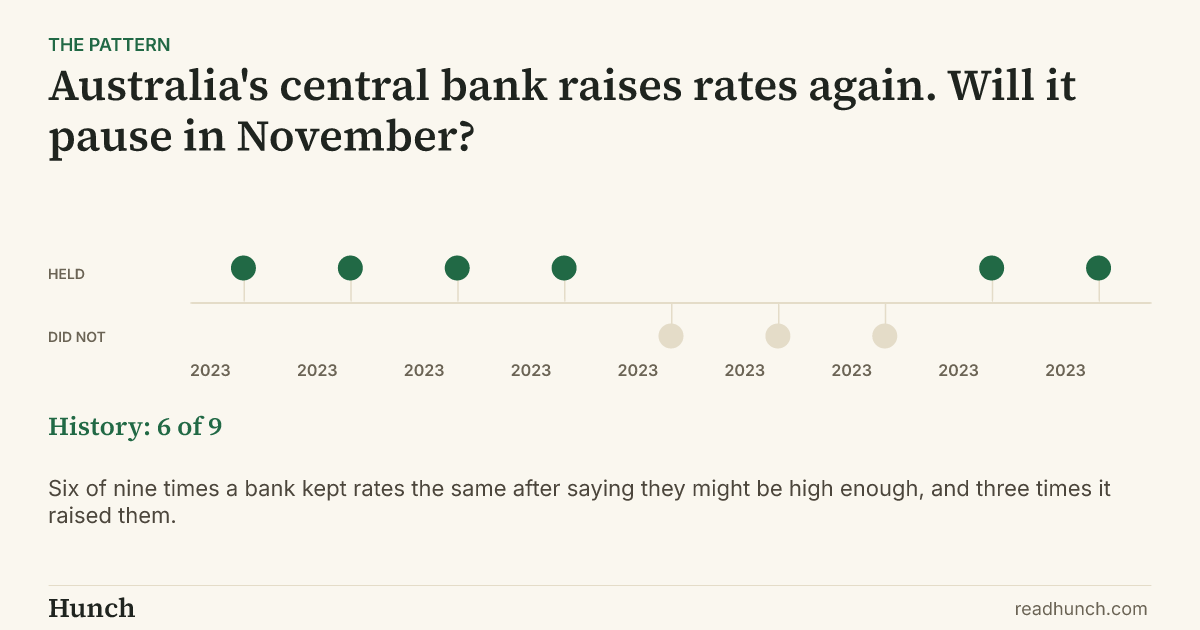
We looked for cases where a central bank with an inflation target raised rates for at least the third time without a cut in between, said a further rise was possible but not expected, and its head said in public that no more rises might be needed. We found nine, all from 2023. In six the next meeting brought a pause.
Show the other 7 cases
The Read
History points to a pause, with a clear limit. All nine cases come from one global run of rises in 2022 and 2023. No earlier run qualified, because statements then did not say whether a further rise was possible, or the bank had no number for its target. In two cases, England in and Australia in , the head spoke before the rise, not on the day.
The pauses came where the head named a pause, a peak or no need for more. The three further rises came where the head only warned in both directions or spoke of tighter bank lending. Bullock’s words on are closer to the first group, but she tied them to an if. A pause was also not always the end: in two of the three cases where later meetings were checked, rises started again.
Australia’s own case from ended in a pause. This time forecasters are split, and higher fuel prices from the war in the Middle East are still feeding into other prices.
Disclaimer
Hunch works only from sources that are publicly available, and publishes on the basis of analysis of that material. We do not form an editorial opinion or take sides, we give a simpler and wider view of news that already exists. If information in a source we used was inaccurate, distorted, or later disputed but had already entered our analysis, Hunch accepts no liability for that. Predictions are not advice. Phase 1 markets use Hunch Points, not money.
Published by Hunch under the Editorial Code. Complaints and corrections: /contact/.