UK Budget watchdog reports on 7 July. After summer warnings, taxes usually went up.
Budget watchdog OBR reports on risks to UK public finances on 7 July. It is the last big check before Rachel Reeves sets her autumn Budget.
What happened
The OBR confirms its 2026 Fiscal Risks and Sustainability report will be published on , updating 50-year debt projections weeks before the Chancellor sets her autumn Budget strategy.
The OBR reports on the risks to UK public finances on . The Office for Budget Responsibility is the government’s independent budget watchdog. Its Fiscal Risks and Sustainability report is its yearly stress test of the public finances, and it updates long-term forecasts for debt, an ageing population and climate costs.
The report comes at a delicate moment. In March the OBR cut its growth forecast for 2026 to 1.1% from 1.4%. It also forecast borrowing falling from 4.3% of GDP this year to 3.6% next year.
At the Spring Statement in March, Rachel Reeves kept her rule of one big tax and spending event a year and announced no new tax or spending measures. She pointed to the OBR’s better borrowing path, £8bn lower by 2030-31 than the autumn forecast, as proof that her plan works. In January she said her £26bn tax-raising Budget had likely drawn a line under further rises.
Markets have given her little room. The yield on ten-year gilts, the interest the government pays to borrow, was back near 4.8% in late June as talk of a leadership change grew. That keeps the cost of the debt billions of pounds a year higher than in similar countries. Next come the ONS figures on June borrowing in late July, then the naming of a Budget date.
Sources: OBR (2), Bloomberg, The Guardian
The Pattern
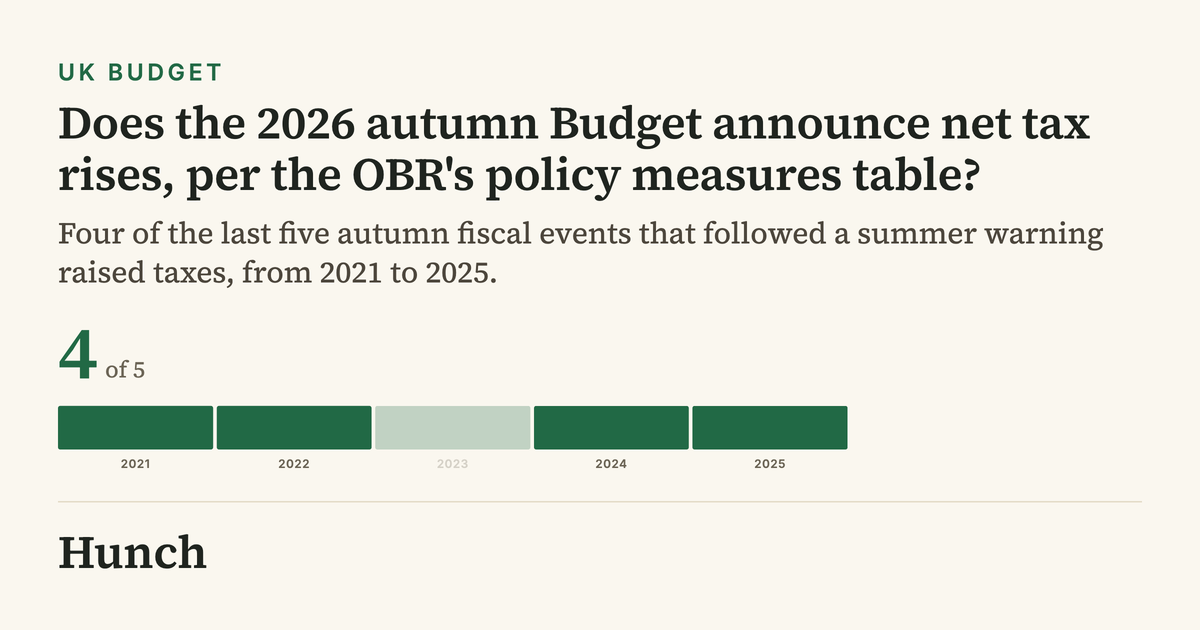
We looked at summer warnings on the UK’s public finances since 2021. Each was a report from the OBR or a Treasury review of spending saying the finances were on a path that could not last. We asked whether the next Budget or Statement raised taxes, the question the first market asks about this year. The OBR has published a summer risks report in most years since 2017, and each one warned about long-term debt. The recent record leans one way, but not every year.
Show the other 3 cases
The Read
History leans towards tax rises. In four of the last five years the autumn answer to the summer warning was more tax, and this year looks like 2024 and 2025. The OBR’s long-term forecasts are unlikely to improve enough to change the message. UK debt is among the highest in the rich world, with the third-highest borrowing costs of 36 rich economies. June borrowing above £20bn would add to the pressure before the Chancellor even stands up.
There are reasons for doubt. The OBR’s March update cut expected borrowing by £8bn by 2030-31, and Reeves has said in public that she does not plan more big tax rises. If the July report reads as a long-term paper and not a near-term alarm, and June borrowing comes in under £20bn, the summer could pass without the pressure that forced earlier chancellors to act. In 2023 Jeremy Hunt had improving numbers and cut national insurance instead.
The pattern follows the Budget itself, so a new Chancellor before the autumn would not break it. It would still change the politics around it.
Disclaimer
Hunch works only from sources that are publicly available, and publishes on the basis of analysis of that material. We do not form an editorial opinion or take sides, we give a simpler and wider view of news that already exists. If information in a source we used was inaccurate, distorted, or later disputed but had already entered our analysis, Hunch accepts no liability for that. Predictions are not advice. Phase 1 markets use Hunch Points, not money.
Published by Hunch under the Editorial Code. Complaints and corrections: /contact/.