Isabel Schnabel quits Europe's central bank early. Her seat may be filled in weeks.
Isabel Schnabel, one of six people who run the European Central Bank, leaves on 3 January for the IMF. Euro area ministers must pick her successor.
What happened
Isabel Schnabel, a member of the European Central Bank’s Executive Board, told President Christine Lagarde she will step down on to take a senior role at the International Monetary Fund.
Schnabel is leaving a year before her eight-year term ends. From she will head the IMF department that deals with central banks and financial markets. The ECB said her successor will be appointed by EU leaders under the EU treaty, and that her work may be shared among the other board members for a while after she leaves.
The Executive Board is the small group that runs the ECB from day to day, led by the president. Each member serves one term and cannot be reappointed. The choice starts with the Eurogroup, the meeting of finance ministers from the countries that use the euro. They back one candidate. EU governments then recommend that person, the ECB and the European Parliament give their views, and EU leaders make the appointment.
Germany, France and Italy each keep a seat by custom. Reuters wrote that the three countries “have a de facto permanent seat on the board”, meaning it is not a written rule. Two more seats open soon: chief economist Philip Lane is due to leave in , and Christine Lagarde will leave the presidency by at the latest.
People familiar with the talks told Reuters that the choice for Schnabel’s seat will probably be tied to the other two. “If Germany would simply replace Schnabel with another candidate, it would mean Berlin is essentially giving up on contesting Lagarde’s seat.” For the top job, Spain backs Pablo Hernández de Cos and the Netherlands backs Klaas Knot. Germany has considered Joachim Nagel, but its interest appears to have weakened. France wants the chief economist post.
The last seat to open went to an open contest. Six countries put forward candidates for vice-president in , and ministers chose Boris Vujčić of Croatia; he took the post on . The ministers meet next on , and .
Sources: European Central Bank, Reuters, Council of the EU (2, 3)
The Pattern
We looked at every member of the ECB’s Executive Board who left before the end of the term while holding a seat their country keeps by custom. We found five since 1998. For each we counted the days from the announcement to the day ministers backed a successor, and noted where that successor came from.
Show the other 3 cases
The Read
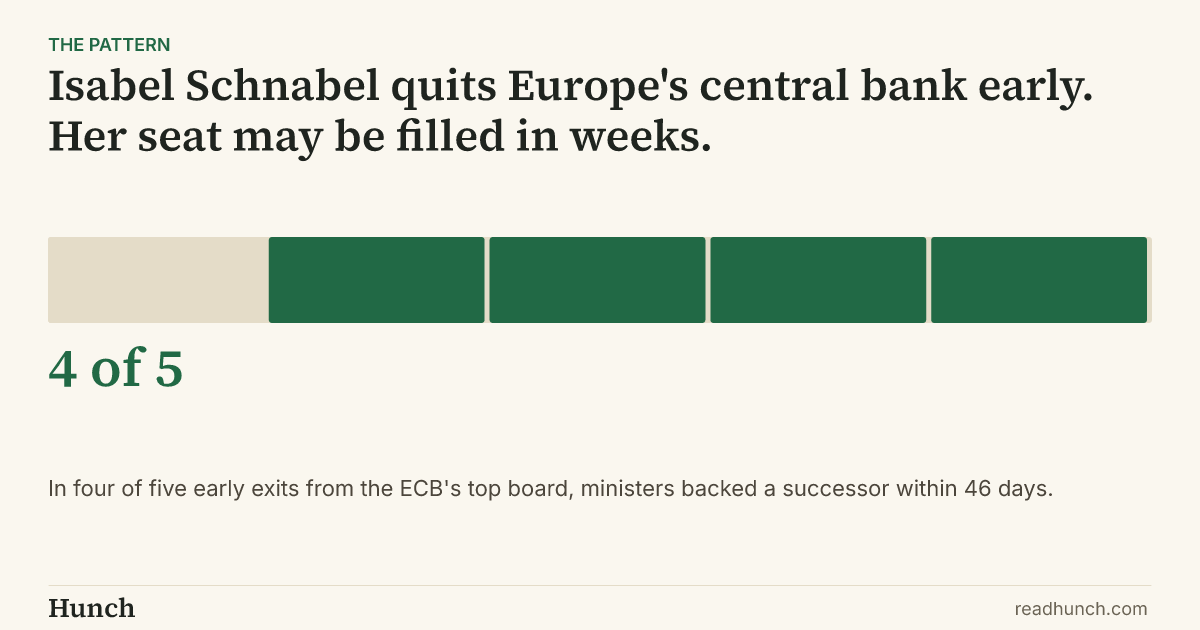
History points to a quick choice and a German successor. In four of the five early exits, ministers backed someone within 21 to 43 days, and in four of five the seat stayed with the same country. Germany kept its seat all three times a German member left early.
The weak spot is the deal Reuters describes. In none of the fast cases did ministers have to fill three top seats within a year. The one time a seat changed country, in 2011, the exit itself was part of a deal over the presidency. The record is also small: five cases, all decided by the same euro area governments.
The and meetings will tell. A candidate backed there means Germany is taking the seat on its own; no candidate by December would point to a wider deal on Lagarde’s and Lane’s posts.
Disclaimer
Hunch works only from sources that are publicly available, and publishes on the basis of analysis of that material. We do not form an editorial opinion or take sides, we give a simpler and wider view of news that already exists. If information in a source we used was inaccurate, distorted, or later disputed but had already entered our analysis, Hunch accepts no liability for that. Predictions are not advice. Phase 1 markets use Hunch Points, not money.
Published by Hunch under the Editorial Code. Complaints and corrections: /contact/.