Spain orders olive mills to hold back 12% of their oil. Will farm prices rise?
Spain ordered olive oil mills on 6 November to store 12% of this season's oil. The farm price has fallen to about €3 a kilo.
What happened
Spain’s farm ministry ordered olive oil mills to keep 12% of the 2026/2027 crop, about 188,000 tonnes, in storage until .
Spain’s farm ministry ordered olive oil mills on to keep 12% of their new oil off the market. That is about 188,000 tonnes, stored until . This season’s crop of 1.6 million tonnes is 23% bigger than last year’s, and with the oil left from last season it passed the level that switches the order on. It is the first time Spain has used this power. Spain makes about 45% of the world’s olive oil, according to the ministry.
The farm price of extra virgin olive oil fell every week for the four weeks before the order. It was €316.51 per 100 kilos in the week to , against €448.49 in the first week of 2026. El País puts the price at about €3 a kilo, while farmers need about €5 to make a profit.
Each mill must always hold at least 12% of the oil it has made since . Oil left from last season and oil made in October count toward that share. The tanks are not sealed, and the stored oil can be swapped for other oil. Each mill chooses which grade of oil to keep. The state pays nothing for the storage.
Farmers’ groups asked for the order, and the companies that bottle the oil are against it. Farm minister Luis Planas said on that the aim is for the whole sector to make a profit, and his ministry reports that he said shop prices will not change. The bottlers’ group Anierac will appeal, and the appeal goes to the farm ministry itself. The competition regulator, the CNMC, warned that limiting supply risks higher prices for buyers.
From the ministry can change the order, but only to make the 12% smaller. The first check of the mills’ stocks covers the end of November.
La resolución podrá ser modificada a partir del 31 de diciembre de 2026, en función de la evolución de la producción.
Spanish farm ministry, 6 November 2026. In English: the order can be changed from 31 December 2026, depending on how production develops
Sources: Spanish farm ministry (2, 3, 4, 5, 6), El País (2, 3), BOE
The Pattern
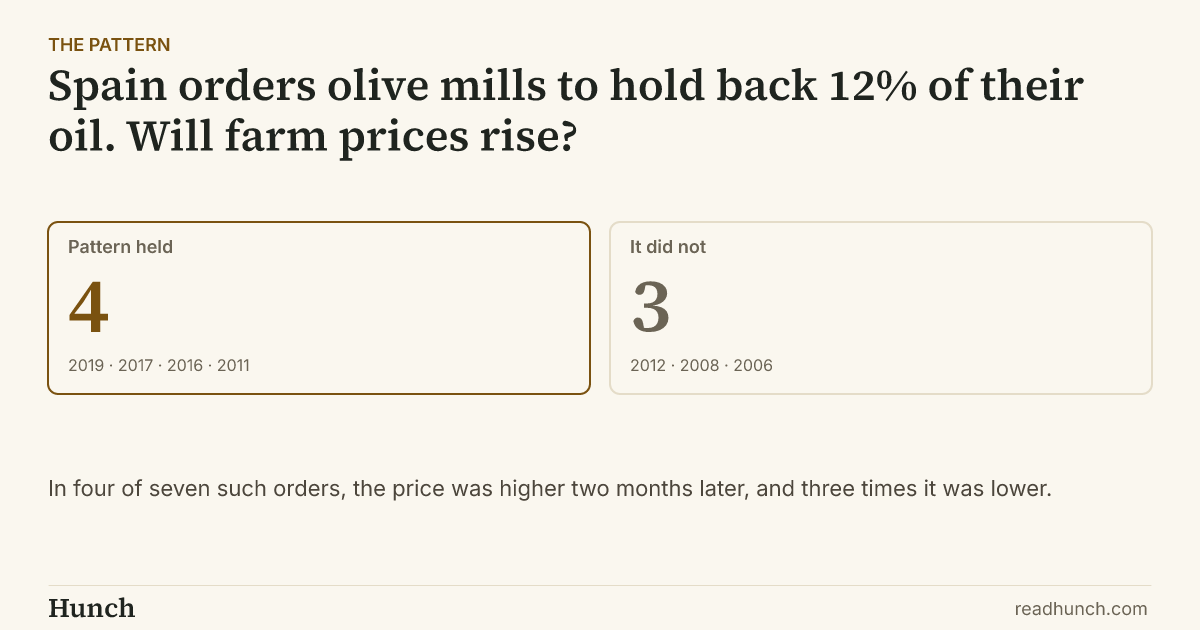
We looked for cases where a government, or a group of producing countries, ordered producers to keep part of a product already made off the market for a set time. We found seven such orders from 2006 to 2019. Five were rubber export cuts by Thailand, Indonesia and Malaysia. (World Bank; The Jakarta Post; Al Jazeera; EUR-Lex)
Show the other 5 cases
The Read
Spain’s order differs from all seven past ones in one way: old oil counts. Mills may count oil left from last season and oil made in October toward the 12%. Spain began the season with 357,040 tonnes of old oil, kept by mills and other firms. The price also came into the order falling for four weeks in the middle of the harvest. In the ministry’s tables for 2019 to 2025, the farm price at Christmas was above the end of October in six of seven years. The exception was 2024, when the price fell 5% over October. In three other years, most recently 2025, it slipped about 1% in October and still rose by Christmas. This year it fell almost 8%. In past orders where the price rose, the highest month came one to three months after the order, which is December to February this time.
There are reasons for doubt. Five of the seven orders were rubber export cuts by the same three countries, agreed in the same council. The prices are world prices by month, while Spain’s is a weekly farm price. The order most like Spain’s, EU sugar in 2006, is measured with the world sugar price, because no open page gives an EU factory price for that year. Without it the count is four of six. Adding three more orders that fit less well gives five of ten. In one of them, coffee in Brazil in 2000, the state helped pay for storage with cheap loans.
Sources: Spanish farm ministry (2, 3, 4, 5, 6, 7), World Bank, EUR-Lex (2, 3), IPS
Disclaimer
Hunch works only from sources that are publicly available, and publishes on the basis of analysis of that material. We do not form an editorial opinion or take sides, we give a simpler and wider view of news that already exists. If information in a source we used was inaccurate, distorted, or later disputed but had already entered our analysis, Hunch accepts no liability for that. Predictions are not advice. Phase 1 markets use Hunch Points, not money.
Published by Hunch under the Editorial Code. Complaints and corrections: /contact/.