Canada threatens to sue Stelco's US owner. Will 175 workers be back by Christmas?
Canada says Cleveland-Cliffs broke a promise to keep jobs at its Stelco steel plant. Its chief executive hopes to bring back 175 workers by Christmas.
What happened
Canada’s industry minister asked the competition watchdog to look at Cleveland-Cliffs’ purchase of Stelco, as her 15-day deadline for reversing 175 layoffs ran out.
Canada’s industry minister, Mélanie Joly, says the US company Cleveland-Cliffs is breaking a promise it gave Canada. When it bought the steelmaker Stelco in Hamilton, Ontario, in 2024, it agreed to keep union jobs at the 2024 level until 2029, the government says. Stelco has laid off 175 workers so far, blaming US tariffs and weak demand. The company says it fully keeps its promises.
Ottawa first warned of court in a letter on . On Joly gave the company 15 days to reverse the layoffs before going to court. A court can make a company keep its promise or sell the business. The 15 days ran out on with no lawsuit. That day Joly asked Canada’s competition watchdog to look at the purchase, and a lawyer told The Globe and Mail that such a check could take months or even years.
On the chief executive of Cleveland-Cliffs, Lourenco Goncalves, wrote that he wants to bring back all 175 workers before Christmas. He said it depends on Canadian customers buying more Stelco steel. A day earlier he told CBC that he bought Stelco to stop it “flooding the market here in the United States”.
US tariffs of up to 50% already hit Canadian steel. Washington plans 50% tariffs on all Canadian cars, car parts and steel from . Goncalves wants Canada to close its border to foreign steel so that he can bring the workers back. Canada’s finance minister, François-Philippe Champagne, said a country this size needs a mix of steel made at home and abroad. If neither side moves, the 175 workers stay at home over Christmas.
If a non-Canadian or any other person or entity fails to comply with a demand under section 39, an application on behalf of the Minister may be made to a superior court for an order under subsection (2) or (2.1).
Investment Canada Act, section 40(1), Justice Laws Website
Sources: CBC (2, 3, 4, 5), The Globe and Mail (2)
The Pattern
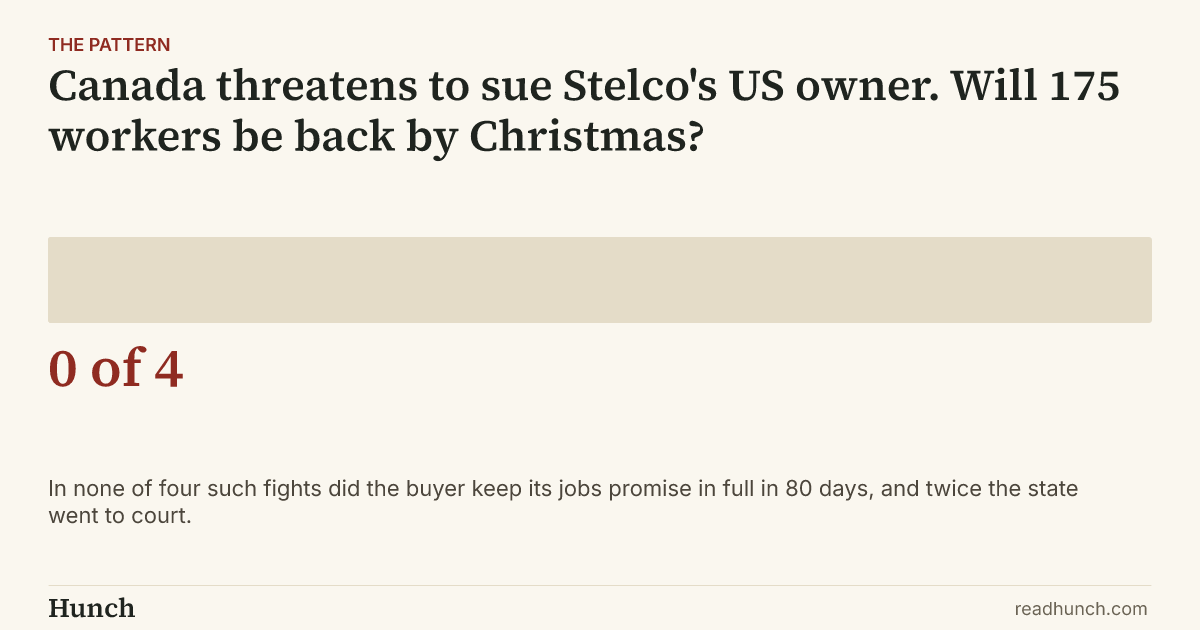
We looked for cases where a government demanded that a foreign buyer keep a jobs promise it gave to win approval for a purchase. We found four such fights from 2009 to 2019. The first was Stelco itself, under its earlier US owner. The other three were in France and Italy. (CBC; CBC; franceinfo; franceinfo; ANSA)
Show the other 2 cases
The Read
This fight differs from the four past ones in one way: the owner has named a date himself. Goncalves wrote that he intends to bring back all 175 workers before Christmas, and the company calls the layoffs temporary. In 2009 U.S. Steel also called its shutdown temporary, and only some workers were back before Ottawa went to court. But Goncalves tied the promise to Canadian customers buying more Stelco steel, and The Globe and Mail wrote that it is unclear how demand can grow that fast. In Italy the state-appointed managers of the steelworks went to court on day 11, and in Canada in 2009 Ottawa did so on day 73. Day 73 this time is .
There are reasons for doubt. A lawyer told CBC that, as far as public records show, Canada has gone to court over such a promise only once, against U.S. Steel 17 years ago. Since then it has changed the law to make deals easier and raised the daily fine. Two of the other three fights were in France with the same ministry. General Electric’s promise came with a fine for each missing job, so the state did not need a court to get money. In Italy the court step came from the state-appointed managers of the steelworks.
Sources: The Globe and Mail (2), CBC (2, 3, 4), Il Post, France 24
Disclaimer
Hunch works only from sources that are publicly available, and publishes on the basis of analysis of that material. We do not form an editorial opinion or take sides, we give a simpler and wider view of news that already exists. If information in a source we used was inaccurate, distorted, or later disputed but had already entered our analysis, Hunch accepts no liability for that. Predictions are not advice. Phase 1 markets use Hunch Points, not money.
Published by Hunch under the Editorial Code. Complaints and corrections: /contact/.