Keir Starmer quits and the pound slips. Will it be higher three months from now?
The pound fell to $1.3181 as Keir Starmer resigned as prime minister on 22 June. That is close to its lowest level of 2026.
What happened
The pound fell to $1.3181, near its 2026 low of $1.3159, as Keir Starmer announced his resignation after a by-election defeat.
The pound’s fall on the day was small. It had already lost about 3% since February as the threat to Keir Starmer’s leadership grew. Analysts at Rathbones said gilts, which are UK government bonds, and the pound had moved mostly with world markets and less with UK politics.
Pressure comes from both sides of the Atlantic. In June the US Federal Reserve turned towards higher interest rates, and markets began to price a possible rise instead of a cut. June’s early survey of UK service businesses showed them shrinking at the fastest rate in nearly three and a half years.
Against that, the Bank of England’s rate-setting committee held its rate at 3.75% on , with two members voting for an immediate rise. So UK interest rates could push the pound either way.
The big open question is who comes next. Currency traders will judge the next prime minister, and even more whoever becomes Chancellor and sets the rules on borrowing. For now the dollar is winning by default. Forecasters see the pound moving between $1.30 and $1.40 for the rest of 2026, starting from the bottom of that range.
Sources: Bloomberg, The Guardian
The Pattern
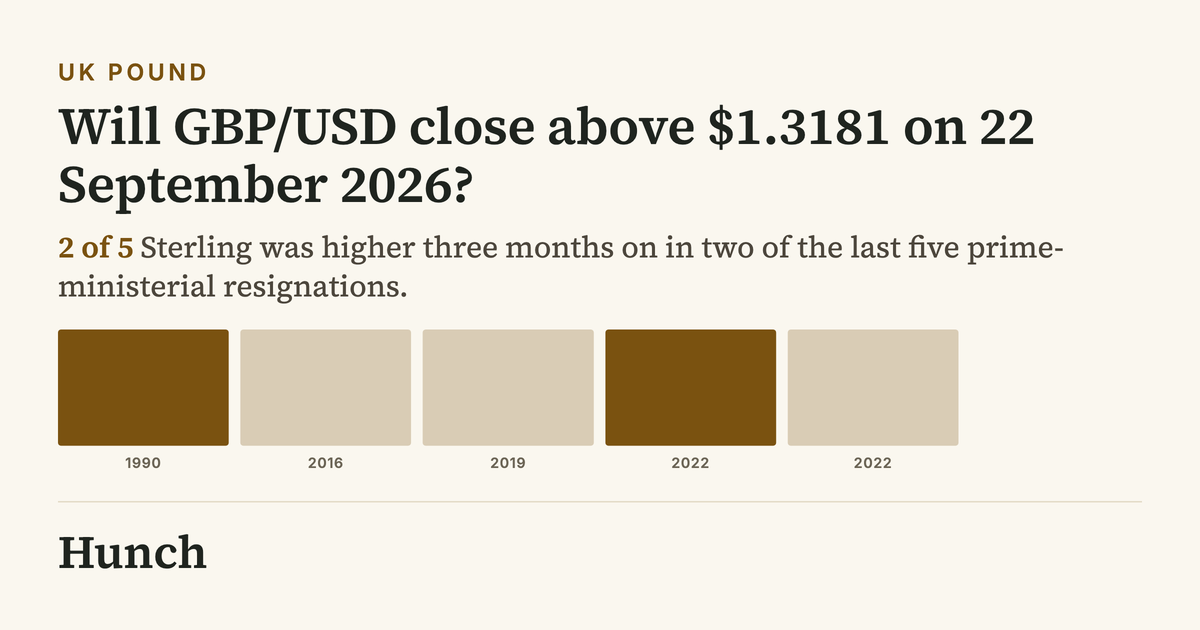
We looked at every UK prime minister who quit mid-term since 1990. There are five, whatever the reason they left, and all five are shown. We asked one thing: was the pound higher against the dollar three months after the resignation day than on it? The first market asks the same about . The day itself is usually quiet, because the damage comes before it. The three months after are split, and they depend on whether the next leader looks like stability or more risk.
Show the other 3 cases
The Read
History leans slightly against the pound: it was lower three months later in three of the last five cases. A fall below $1.30 is a bigger step. This resignation was expected for months, and the first move was a fraction of a cent. In 1990 and late 2022 a quick handover to a trusted successor lifted the pound off its lows. If the Labour contest ends cleanly, and the June votes for a rate rise lead to higher UK rates, the pound gets help.
The case for a weaker pound is still strong. Both causes of the fall are still there: the Federal Reserve leans towards higher rates, and UK service businesses shrank at their fastest rate in three and a half years. In all three past cases where the pound ended lower, the handover added risk. A messy contest, or a new Chancellor loosening the borrowing rules while bond investors are already nervous, would look like 2019, and that path ends with $1.30 giving way.
Five cases is a small record, and each one turned on who came next. The names of the next prime minister and Chancellor, and what they say about borrowing, will decide most of this.
Disclaimer
Hunch works only from sources that are publicly available, and publishes on the basis of analysis of that material. We do not form an editorial opinion or take sides, we give a simpler and wider view of news that already exists. If information in a source we used was inaccurate, distorted, or later disputed but had already entered our analysis, Hunch accepts no liability for that. Predictions are not advice. Phase 1 markets use Hunch Points, not money.
Published by Hunch under the Editorial Code. Complaints and corrections: /contact/.