Thames Water lenders name a board. Will the government have to take over?
London & Valley Water, holder of more than £17 billion of Thames Water's senior debt, named its first 4 proposed non-executive directors on 24 August.
What happened
The consortium names Mike McTighe, Liz Barber, Clive Selley and Dame Bernadette Kelly as the first proposed non-executive directors of Thames Water Utilities, subject to its acquisition proceeding, the turnaround plan being adopted and Ofwat’s onboarding process for directors.
Thames Water’s lenders have named four directors for its board. London & Valley Water is a group of around 100 financial institutions holding more than £17 billion of Thames Water’s most senior debt, the loans paid back first. On it named the first four non-executive directors, board members from outside the company, that it would put in at Thames Water Utilities.
The appointments only go ahead if the group’s takeover and new funding proceed, its turnaround plan is adopted and Ofwat, the water regulator, finishes its checks on directors. The group says it is finishing a revised proposal after feedback from Defra, the environment department, and Ofwat, and wants to meet the new ministers.
The Environment Secretary has objected to the plan itself. In June she wrote to Ofwat that she was not yet convinced the proposal protected customers enough. The revised proposal now being drafted is the group’s answer to her letter.
Her letter objected to an unprecedented level of rule changes that customers would be expected to pay for, to bill rises in the current price period and more in the next, to weaker performance standards and to investment put off, in some cases by up to a decade.
The other option is special administration, a state-run rescue in which a court-appointed administrator runs the company while services continue. Thames Water has tested that line once already. The High Court approved its interim restructuring plan on .
The Court of Appeal threw out the appeals, including one arguing that customers and the public would be better off under special administration. The Supreme Court refused permission to appeal on . Neither the Secretary of State nor Ofwat supported special administration in that case.
Sources: London & Valley Water, Defra, UK Supreme Court Maynard v Thames Water Utilities Holdings
The Pattern
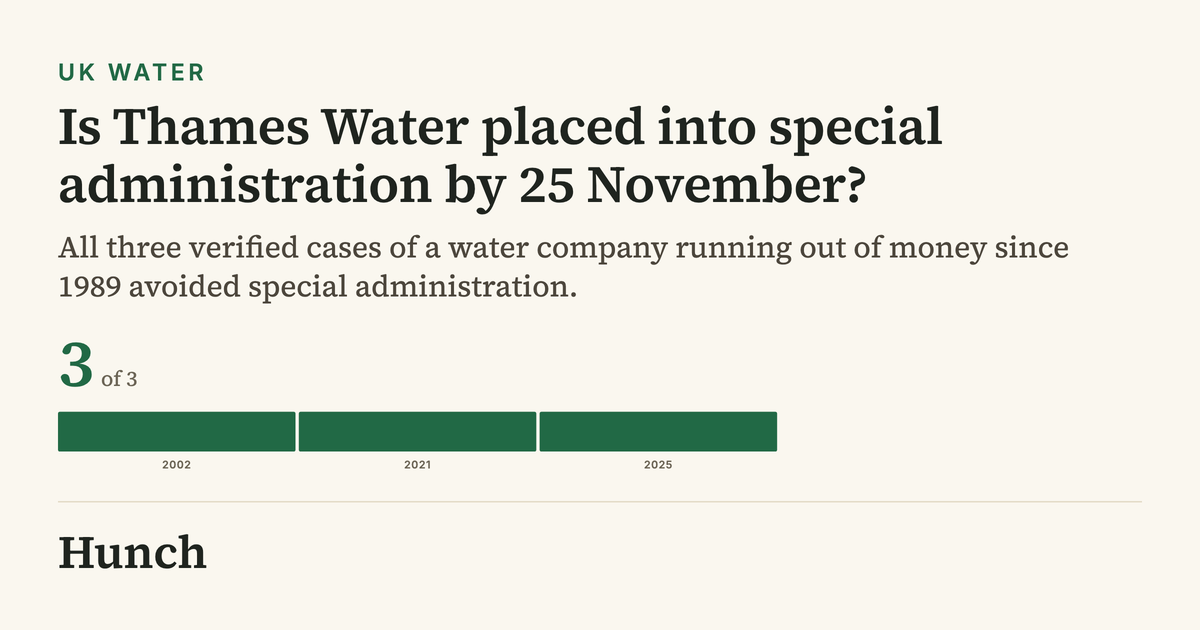
We found three water companies in the same position since 1989. We looked at every water and sewerage company in England and Wales since privatisation whose owner could no longer carry its debt, and where control was forced to change or a court approved a restructuring. We asked whether it went into special administration or was solved another way. A fourth case, Welsh Water in 2001, fits but could not be confirmed on sources we trust, so it is left out. Three cases are too few for us to show a History figure.
Show the other 1 cases
The Read
History points to the lenders’ group. In every confirmed case a buyer or a group of lenders took the company on terms the regulator could accept, so the state never had to step in. Naming four directors while the plan is being rewritten tells the regulator and ministers that the group means to stay. It holds more than £17 billion of senior debt, so it controls the only funded option other than a court-run process. In 2025 both Ofwat and the Secretary of State declined to back special administration when a court was asked to prefer it.
The record is thin, only three cases, and this time the government spoke first. The June letter objected to bill rises, weaker performance standards and investment put off by up to a decade, and those are the things the group needs to make its numbers work. A regulator that agrees owns the political cost. One that refuses may find the group walks away.
That is how the first special administration in the sector’s history could happen, and it is why the market sits closer to one in five than to the zero the past record suggests. Ofwat’s decision on the revised proposal will settle most of it.
Disclaimer
Hunch works only from sources that are publicly available, and publishes on the basis of analysis of that material. We do not form an editorial opinion or take sides, we give a simpler and wider view of news that already exists. If information in a source we used was inaccurate, distorted, or later disputed but had already entered our analysis, Hunch accepts no liability for that. Predictions are not advice. Phase 1 markets use Hunch Points, not money.
Published by Hunch under the Editorial Code. Complaints and corrections: /contact/.