UK regulators now oversee four cloud firms. Such lists rarely grew in three months.
Amazon, Google, Microsoft and Oracle came under Bank of England and financial regulator oversight on 13 July. The 90-day mark falls on 11 October.
What happened
HM Treasury designated Amazon Web Services EMEA SARL, Google Cloud EMEA Limited, Microsoft Ireland Operations Limited and Oracle Corporation UK Limited as the first Critical Third Parties, and the Bank of England, the PRA and the FCA began jointly overseeing them on Monday .
HM Treasury says UK finance depends on these four technology suppliers, so three regulators now watch them directly: the Bank of England, the Prudential Regulation Authority and the Financial Conduct Authority. They use powers added to the Financial Services and Markets Act 2000.
The regulators do not license the four firms. They can make rules for them, ask them for information and act against them only for the services they supply to banks and other regulated firms.
The Treasury calls the four a first group. Its press notice describes a rolling system in which more providers may be named over time, if that is needed to protect the UK. The Bank’s notice says the list will keep changing as more names are considered. In both, the Treasury decides, usually on the regulators’ advice. Neither names a date or a candidate for a second group.
Adding a name is a change in the law, which makes it easy to check. Each new firm needs a further statutory instrument, a type of law made by ministers, that changes the Critical Third Parties (Designation) Regulations 2026. The regulators’ rules apply to a firm only after the Treasury has named it.
The last UK case moved slowly. Vocalink, the last technology supplier put under direct Bank supervision, was named in and faced its first enforcement action only in 2025.
Sources: Bank of England (2, 3), GOV.UK
The Pattern
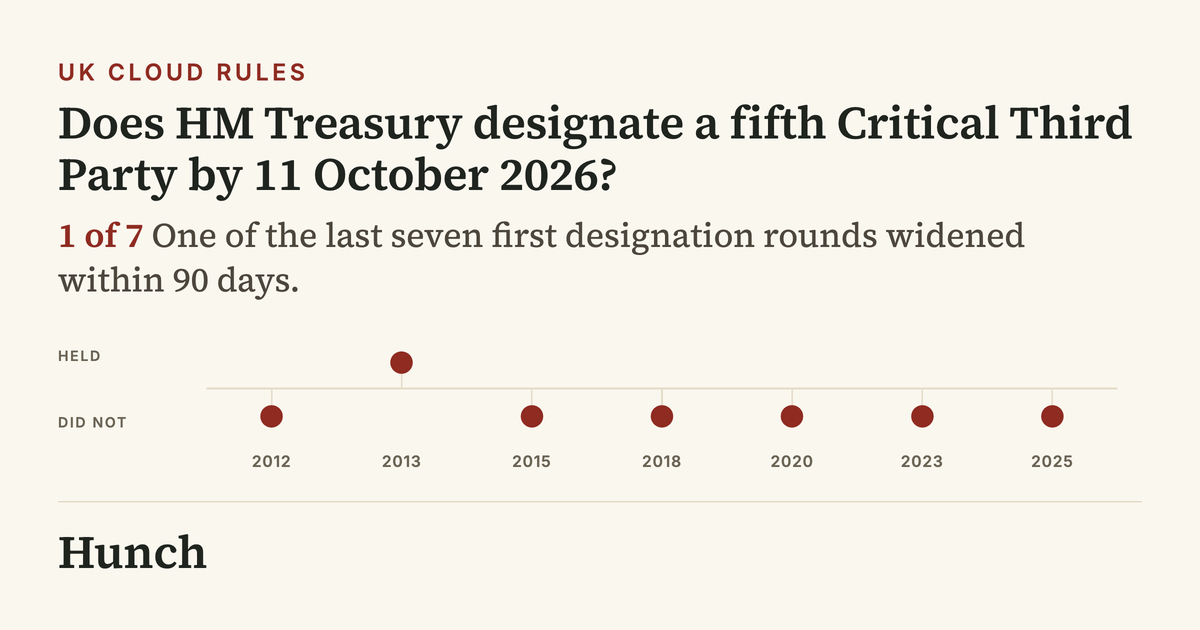
We looked for first lists of this kind: a national or EU authority used a new legal power to name specific financial firms as critical to the system and to supervise them directly. We checked whether at least one more firm was added to the list within 90 days of the start. We found seven first lists since 2012, and only one grew in that time.
Show the other 5 cases
The Read
History points to the list staying at four. Six of the seven first lists went 90 days without a new name. The one that grew was the US Financial Stability Oversight Council in 2013, which added Prudential Financial from a queue of companies it had already put on formal notice a year earlier. In the UK, a new name needs a new law made by ministers, and the Treasury has named no candidate.
The doubt comes from the Treasury’s own words. It and the Bank both called this a rolling system whose scope will change, and the regulators can recommend more names at any time. Cloud is also not the only service UK finance depends on heavily. The prediction fails if a second instrument is laid quickly, most likely for a payments or market-data provider the regulators have already assessed.
The second market, a new document from the regulators, is an easier test, but the record there is slow too. The Bank’s existing rules and guidance for these firms came out in , 20 months before anyone was named.
Disclaimer
Hunch works only from sources that are publicly available, and publishes on the basis of analysis of that material. We do not form an editorial opinion or take sides, we give a simpler and wider view of news that already exists. If information in a source we used was inaccurate, distorted, or later disputed but had already entered our analysis, Hunch accepts no liability for that. Predictions are not advice. Phase 1 markets use Hunch Points, not money.
Published by Hunch under the Editorial Code. Complaints and corrections: /contact/.