Trump backs a US diesel export ban. Such threats usually worked within two months.
Donald Trump said on 22 September that he supports a ban on US diesel exports. His Treasury Secretary said a full or partial ban is being studied.
What happened
Donald Trump said on that he supports a ban on US diesel exports, and Treasury Secretary Scott Bessent said officials were examining whether a full or partial ban would work.
US diesel cost $6.53 a gallon on , a record, and more than 75% above a year earlier. That day Donald Trump told reporters: “I’ve said let’s not send out the diesel. We make a lot of diesel … I’ve called for it within my people.” No order has been signed.
Treasury Secretary Scott Bessent said officials were “examining whether it’s feasible in terms of the overall refining capacity and whether a full or partial ban would work”.
This is the first time the president has backed the idea in public. His own team turned down an export ban more than once this year. In March the government said it was not considering an oil export ban. In May Interior Secretary Doug Burgum and Energy Secretary Chris Wright both said the White House was not considering one. On Burgum said an oil export ban was unlikely to lower prices.
Republicans in close races before the midterm elections are pushing for a ban. Senator Dan Sullivan of Alaska asked for a “temporary pause” of diesel exports.
The oil industry is against it. The refiners’ trade group, the American Fuel and Petrochemical Manufacturers, said a ban would “backfire”. The American Petroleum Institute said it “would wreak havoc at home and abroad”.
The US exports about 1.3 million barrels of diesel a day, nearly a quarter of what its refineries make. The UK and the Netherlands rely on it.
Sources: The Guardian, BBC, Financial Times, The Independent, Reuters, American Petroleum Institute, The Telegraph
The Pattern
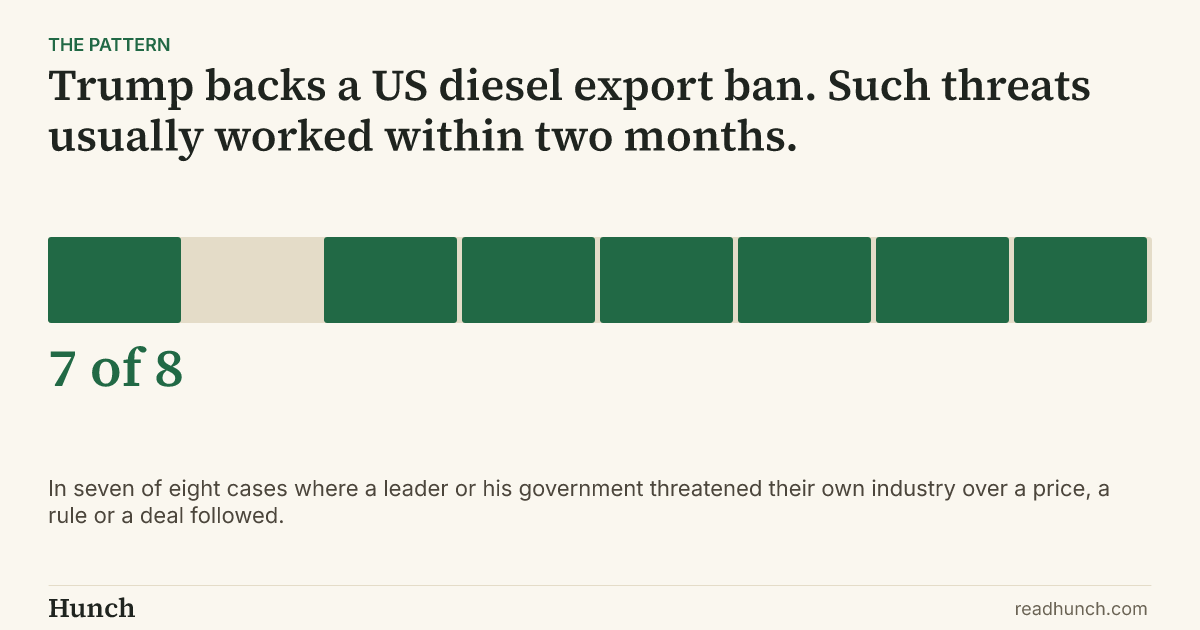
We looked for times when a leader, or ministers speaking for him, publicly threatened a tough step against his own country’s industry to bring a price down at home. In each case no decision had yet been taken, he could act without parliament, and the industry openly opposed him. We counted a result if, within 69 days, the government acted or the industry gave way. We found eight cases since 1962. Only one, Mexico in 2021, is outside the United States, and two are the same president against the same drug makers.
Show the other 6 cases
The Read
History points to a result within weeks. In all six cases where the leader made the threat himself, the government acted or the industry gave way within 61 days, and four of the six came within two weeks. The one case with no result, in 2022, was a letter from an energy minister to refiners. It is also the closest in subject, since it was about fuel exports and the same industry. This time the president has spoken himself, Senator Dan Sullivan and other Republicans want a pause before the elections, and his Treasury Secretary says the idea is being studied.
The doubts start with his own team. Doug Burgum and Chris Wright rejected an export ban in public this year. Refiners also cannot withdraw a world diesel price the way steel makers withdrew their own price rise in 1962. The record is narrow too. Only Mexico in 2021 is outside the United States, and two cases are Donald Trump against drug makers.
If a step comes, history says it is likely to be partial and short. Of the three cases where the government acted, only Mexico’s gas price cap was the full step named in the threat. A signed order or a promise from refiners would settle the main question early. A new public rejection by Burgum or Wright would make a step less likely.
Disclaimer
Hunch works only from sources that are publicly available, and publishes on the basis of analysis of that material. We do not form an editorial opinion or take sides, we give a simpler and wider view of news that already exists. If information in a source we used was inaccurate, distorted, or later disputed but had already entered our analysis, Hunch accepts no liability for that. Predictions are not advice. Phase 1 markets use Hunch Points, not money.
Published by Hunch under the Editorial Code. Complaints and corrections: /contact/.