Trump vows zero tariff on Irish whiskey. Half such vows were signed within a month.
Donald Trump told a golf crowd in Ireland on 13 September that the United States will stop taxing Irish whiskey. Nothing has been signed yet.
What happened
Donald Trump announced at the Irish Open trophy ceremony at his Doonbeg resort on , closing a two-day visit to Ireland, that he will remove all US tariffs on Irish whiskey, with no instrument signed and no date given.
Before handing the Irish Open trophy to Shane Lowry, Trump told the crowd that Taoiseach Micheál Martin, the Irish prime minister, and Lowry had both raised whiskey with him. He said the United States would take the tariff off Irish whiskey.
Whiskey from the Republic of Ireland pays the US tariff on EU goods. BBC News NI puts that rate at 15 per cent. PA and Al Jazeera put it at 10 per cent after a change in July. Whiskey made in Northern Ireland or elsewhere in the UK pays nothing.
Martin said on that he had planted a seed. On the way into their Dublin meeting he told Trump that the Scotch decision had left the two parts of the island on different rates, and Trump raised it again at lunch the next day.
The Irish Whiskey Association welcomed the announcement. It said it would keep working with the EU and the US for a return to zero tariffs on all drinks. The visit itself drew a march of more than 10,000 people in Dublin.
The UK went through the same thing this spring. On Trump posted that he would remove whisky tariffs in honour of the King and Queen, and the UK government said that day this covered Irish whiskey too. The next day the US Trade Representative, the office that runs US trade policy, limited it to whiskey produced in the UK. The zero rate took effect on , 85 days after the post.
That gave Bushmills, the largest Northern Ireland distillery with an estimated 5 to 10 per cent of Irish whiskey sales in the US, an advantage over Jameson and other brands from the Republic.
Newer Northern Ireland distilleries that bottle spirit from the Great Northern Distillery in Dundalk were counted as EU producers and got nothing. A zero rate for the Republic would end the Bushmills advantage and the head start Scotch has over Irish whiskey on US shelves, and would bring the Dundalk-supplied distilleries in.
Sources: BBC (2), Al Jazeera, Independent, BBC News NI, GOV.UK
The Pattern
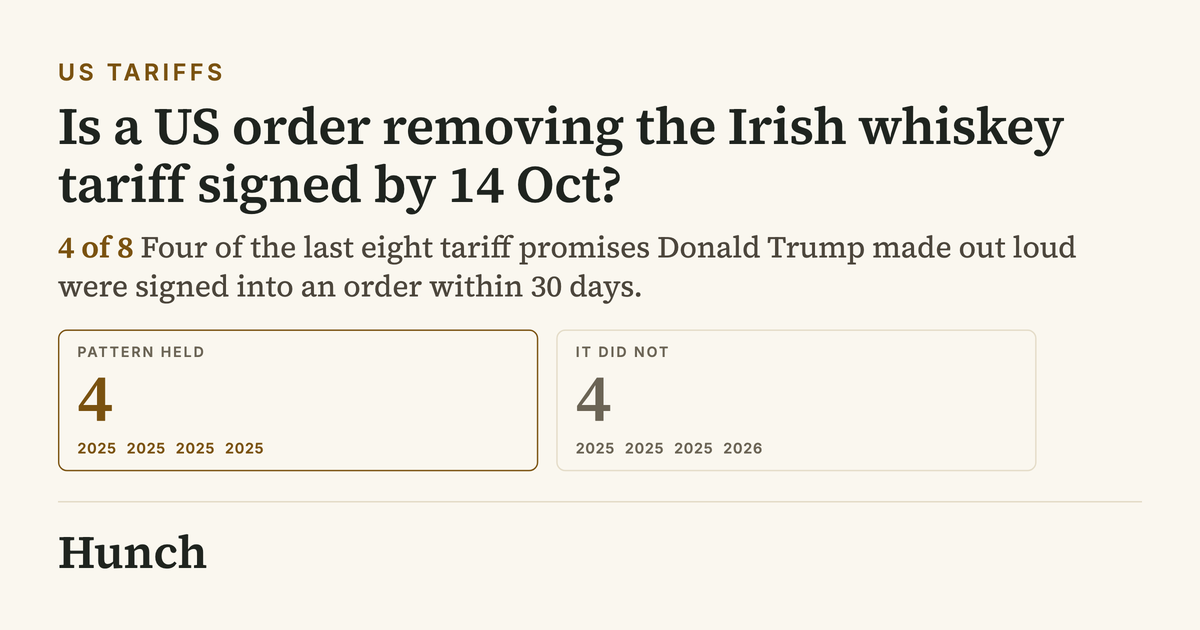
We looked at every time in Donald Trump’s second term when he promised out loud, on Truth Social, at a podium or to reporters, to cut tariffs on a named product or country, with nothing signed that day. We checked whether an executive order, proclamation or Federal Register notice made the cut official within 30 days. We found nine such promises since and show the last eight.
Show the other 6 cases
The Read
History points to an order, but probably not within a month. Four of the last eight spoken promises were signed within 30 days, and all four were cuts for one product or one country made in Washington. The four that took longer were deals announced abroad or gifts to a visitor. The Scotch promise is the closest case in product, people and setting, and it took 85 days and came out narrower than the UK government first said. Irish whiskey is also harder to separate out. It pays the rate on all EU goods, so an order has to take one member state’s product out of a tariff for the whole bloc.
The doubt comes from gold. It took 25 days from Trump’s post to a signed order that listed gold as exempt. A one-line order adding Irish whiskey to the exempt list would work the same way, and Trump has a midterm campaign and Irish-American voters to please before . The prediction fails if such an order appears before . It also fails the other way if USTR treats the promise as an EU matter and leaves it to the spirits talks, and then the Bushmills advantage and the Scotch head start would last into 2027.
For Trump the whiskey line was a cheap gift at the end of a visit that went badly after his remarks about a united Ireland. It cost him nothing on the day and answered, in his words, everyone who had been bugging him. Martin needed something to show for a visit 10,000 people marched against, and had prepared the ground with a distillery visit in Lowry’s home county. Before the moves belong to USTR and the Commerce Department, which write or delay the order as they did with Scotch, to the European Commission, which could fold the cut into a spirits deal it would claim, and to the UK government, whose Scotch deal is the model Dublin cited.
Sources: BBC (2), BBC News NI, GOV.UK, Guardian, Independent
Disclaimer
Hunch works only from sources that are publicly available, and publishes on the basis of analysis of that material. We do not form an editorial opinion or take sides, we give a simpler and wider view of news that already exists. If information in a source we used was inaccurate, distorted, or later disputed but had already entered our analysis, Hunch accepts no liability for that. Predictions are not advice. Phase 1 markets use Hunch Points, not money.
Published by Hunch under the Editorial Code. Complaints and corrections: /contact/.