If Trump Media's bondholders ask for cash on 30 November, will it take a new loan?
Holders of $883.5m of Trump Media bonds can ask for cash on 30 November. It had $393.4m in cash and short-term investments on 30 September.
What happened
we intend to use available cash and credit to clean up our capital structure, without issuing any additional equity
On Trump Media & Technology Group bought back $100m of its convertible bonds below face value, paying with its own cash. About $883.5m of the bonds are left.
Each holder of the Notes has the right at its option, to require us to repurchase its Notes for cash on November 30, 2026
Trump Media & Technology Group, quarterly report to the US Securities and Exchange Commission, 9 November 2026
The bonds can be swapped for shares at about $34.70 a share, but the shares are near record lows. So swapping makes little sense, and holders can ask for cash at full face value instead. If the company does not pay bonds handed in on that day, that is a default under the bond terms.
On the company had $182.3m in cash and $211.1m in short-term investments, together $393.4m. It also held bitcoin and shares in other companies, and part of them backs the bonds as security. In its quarterly report it says it may take a new credit line to pay for the bonds, but “there can be no assurance” that it will.
On interim chief executive Kevin McGurn said the company would use “available cash and credit” and issue no new shares. Its filings to show no new loan.
Sources: SEC (2, 3, 4), Reuters
The Pattern
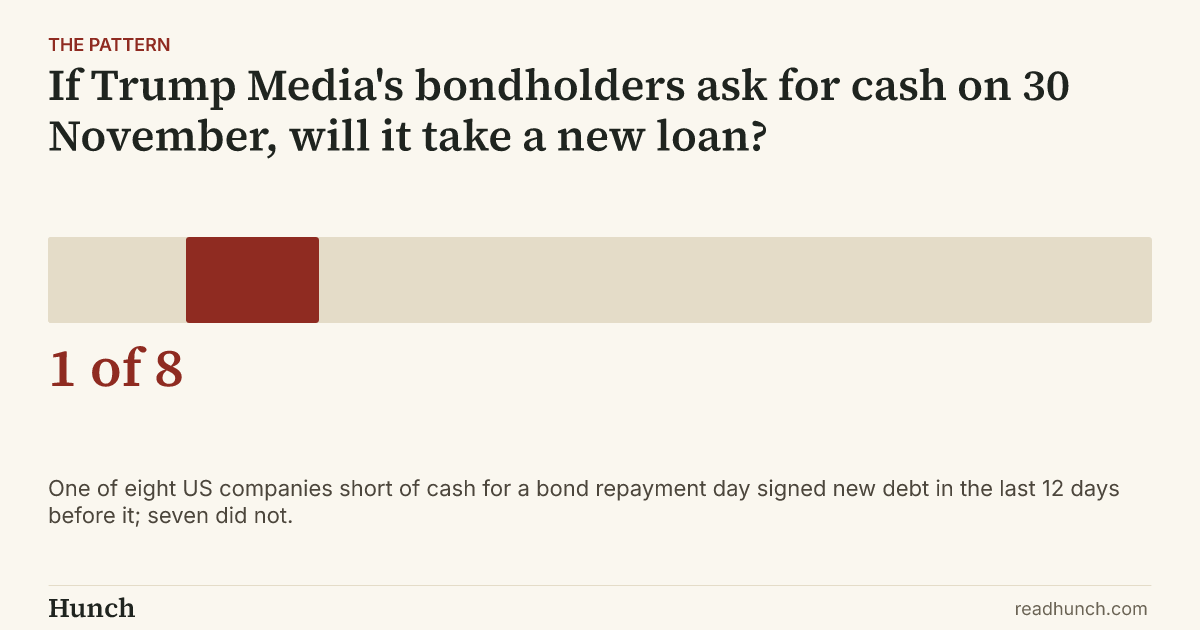
We looked for cases where holders of convertible bonds could ask a company for cash on a set day, its shares were below the swap price, and it had less cash than it might have to pay. We found eight such companies in the US, with repayment days from 2009 to 2018. The largest amount was about $294m.
Show the other 6 cases
The Read
Only one of eight companies signed new debt in the last 12 days: LifePoint Hospitals in 2013, nine days before its repayment day, by adding to a credit deal it already had. Trump Media had no debt other than these bonds on . Four others had signed new debt two to twelve months earlier, and three signed none: two paid with asset sales and cash, and Empire Resorts did not pay. Seven of the companies paid without a default. Conseco is counted as no new debt, although on its repayment day, , it gave $18.0m of new bonds at 7.0% to the holders who asked for cash, under a deal it had signed a year earlier.
There are reasons for doubt. All eight companies were in the US, and four of them faced their repayment day in 2009 or 2010, after the financial crisis. The largest amount was about $294m, a third of what Trump Media may owe. None had a head of state as a big shareholder or bonds backed by bitcoin. In 2022 China YuHua Education in Hong Kong did not pay on its repayment day, though it reported more cash than the bonds were worth.
Disclaimer
Hunch works only from sources that are publicly available, and publishes on the basis of analysis of that material. We do not form an editorial opinion or take sides, we give a simpler and wider view of news that already exists. If information in a source we used was inaccurate, distorted, or later disputed but had already entered our analysis, Hunch accepts no liability for that. Predictions are not advice. Phase 1 markets use Hunch Points, not money.
Published by Hunch under the Editorial Code. Complaints and corrections: /contact/.