UBS talks of leaving Switzerland. Will MPs still pass the tough new bank law?
A Swiss law would make UBS hold more of its own money, about $15bn more by the bank's own count. MPs start on it on 23 November.
What happened
The economic affairs committee of the Swiss National Council will go through the UBS capital law line by line on 23 and .
Switzerland wants UBS to hold much more of its own money behind its foreign banks. Credit Suisse could not save itself in 2023, and UBS took it over with help from the state. In the Swiss government proposed that big banks must back the banks they own abroad in full with hard capital: the bank’s own money, which takes the first losses in a crisis. On the upper chamber of parliament, the Council of States, chose 90% instead of 100%, by 29 votes to 16. By the bank’s own count, that means about $15bn of extra capital.
UBS is to underpin its foreign subsidiaries with 90% hard capital.
swissinfo, 23 September 2026
The law now goes to the lower chamber, the National Council. Its economic affairs committee heard UBS, the Swiss National Bank and the financial regulator in October, and goes through the text line by line on 23 and . Members are split. Some say a rule this strict will hurt UBS and raise prices for its clients. Others say the government’s plan is already a compromise. The winter session of parliament runs from to .
UBS is pushing back. On its chief executive, Sergio Ermotti, said the bank is assessing whether it can still compete from Switzerland, and that “a passport is not enough nowadays”. Two large shareholders, Artisan Partners and Cevian, have urged the bank to look abroad. The head of the Zurich regional government said a departure would be catastrophic. Finance minister Karin Keller-Sutter says leaving would be “much more expensive and legally very complex” for UBS.
On a member of the National Council proposed a gentler way to value UBS’s foreign banks, which could lower the extra capital without changing the 90%. UBS partly supports the idea. The government says it would not fully protect the Swiss parent bank. It is not clear how many MPs back it.
Sources: Swiss Parliament, swissinfo (2, 3, 4), Swiss Parliament, Reuters
The Pattern
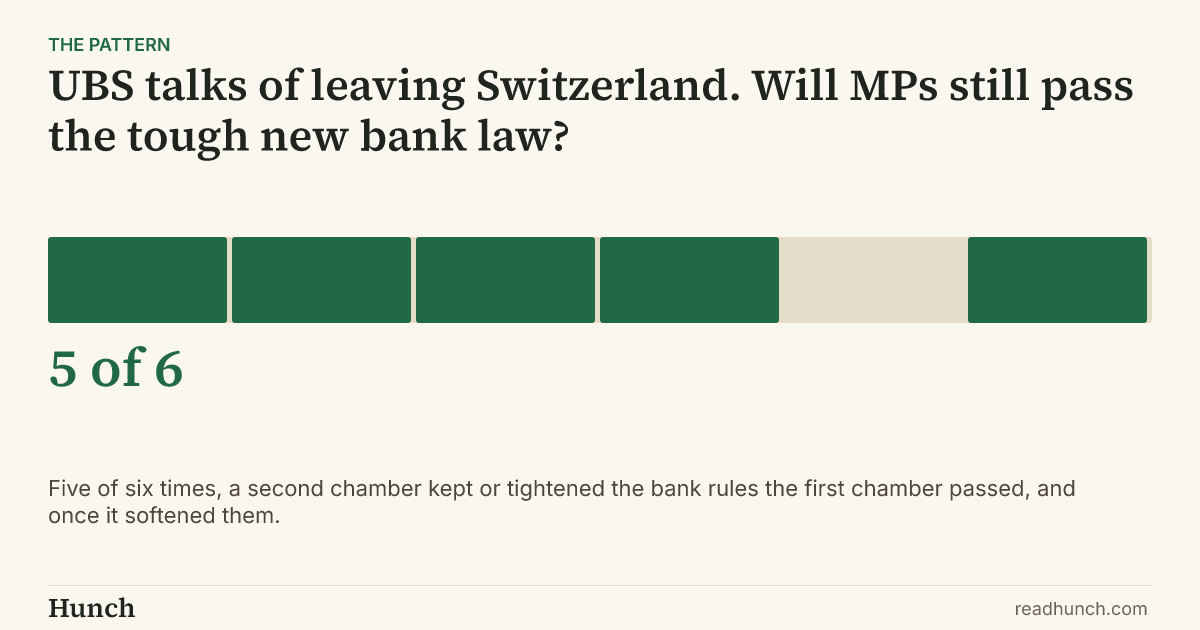
We looked for cases where one chamber of a national parliament passed tougher rules for big banks, on their capital or on how they are organised, and the second chamber then voted on that text. We found six such votes from 2010 to 2013, in Switzerland, the US, the UK, France and Germany. All six laws passed in the end. Five times the second chamber kept the rules or made them tougher. Once, in Switzerland in 2011, it softened them.
Show the other 4 cases
The Read
All six earlier votes came between 2010 and 2013, after the 2008 crisis. In the press of the time, no bank threatened to move its head office during any of them. In 2011 UBS itself said “There are no easy solutions to circumvent tough Swiss regulation”. Today the rule hits one bank, which took over a failing rival in 2023, and its boss talks openly about leaving. In January the Swiss People’s Party, which holds 67 of the 200 National Council seats, called the rule out of proportion and backed a softer plan. The Liberals, with 27 seats, were open to that plan. Together they are still short of the 101 votes needed. The new valuation idea of gives MPs one more way to lower the demand.
The other side has weight too. In 2011 the National Council did soften the rules after its committee asked for it, but the Council of States removed the change two days later. In all six earlier laws, the final text kept the main level of the first vote or went further. In the Council of States rejected a softer option by 29 to 16, after lobbying that the Swiss news agency SDA said had rarely been so intense. Time is short as well: the committee finishes six days before the winter session starts, and the session programme comes out on . In 2011 the two chambers passed the law in final votes 11 days after the second chamber’s vote. If this winter is too short, parliament meets again from 1 to and from to .
Sources: The Guardian, swissinfo (2, 3, 4), Swiss Parliament (2, 3, 4), Swiss Parliament
Disclaimer
Hunch works only from sources that are publicly available, and publishes on the basis of analysis of that material. We do not form an editorial opinion or take sides, we give a simpler and wider view of news that already exists. If information in a source we used was inaccurate, distorted, or later disputed but had already entered our analysis, Hunch accepts no liability for that. Predictions are not advice. Phase 1 markets use Hunch Points, not money.
Published by Hunch under the Editorial Code. Complaints and corrections: /contact/.