Trump wants Britain's tax on big tech gone. Will the Budget on 28 October drop it?
Donald Trump has threatened a 100% tariff over Britain's 2% tax on big tech firms. The Budget on 28 October is the next date the tax could change.
What happened
Andy Burnham and Donald Trump held their first face-to-face meeting at the United Nations in New York on .
Britain takes 2% of what big tech platforms earn from UK users. The Digital Services Tax covers search engines, social media sites and online marketplaces with more than £500m of such revenue worldwide and £25m in the UK. It raised about £800m in 2024-25. The government calls it a temporary tax until there is a global deal on taxing these firms.
In April Donald Trump said Britain faced “a big tariff” over the tax. On he wrote that any country with such a tax “will immediately be met with a 100% TARIFF” on all its goods sent to the US, and that this would override trade deals.
On the US trade representative, Jamieson Greer, told The Times the threat was “not a bluff”. He also said: “I don’t set artificial timelines.” A UK government spokesperson answered: “We remain open to discussing U.S. concerns and working with partners internationally.” The government says it will remove the tax “once a global solution is in place”.
No formal step has followed so far. The US has published no trade investigation of the British tax since 2021. The UK-US trade deal signed in 2025 did not mention the tax. In July the US ambassador in London warned of tariffs if Britain taxed American tech firms more.
Andy Burnham met Trump for the first time on . Trump called the new prime minister “a natural businessperson” and said they talked about “everything from Rolls-Royce to energy to immigration”. The Guardian’s reports of the meeting do not mention the tax.
The next fixed date is the Budget on . The government borrowed £18.3bn in August, more than its forecaster expected, and some economists say tax rises are now likely. Dropping the digital tax would mean finding about £800m a year somewhere else.
Sources: The Guardian (2, 3), HM Treasury (2), BBC, The Independent, Politico (2), Federal Register
The Pattern
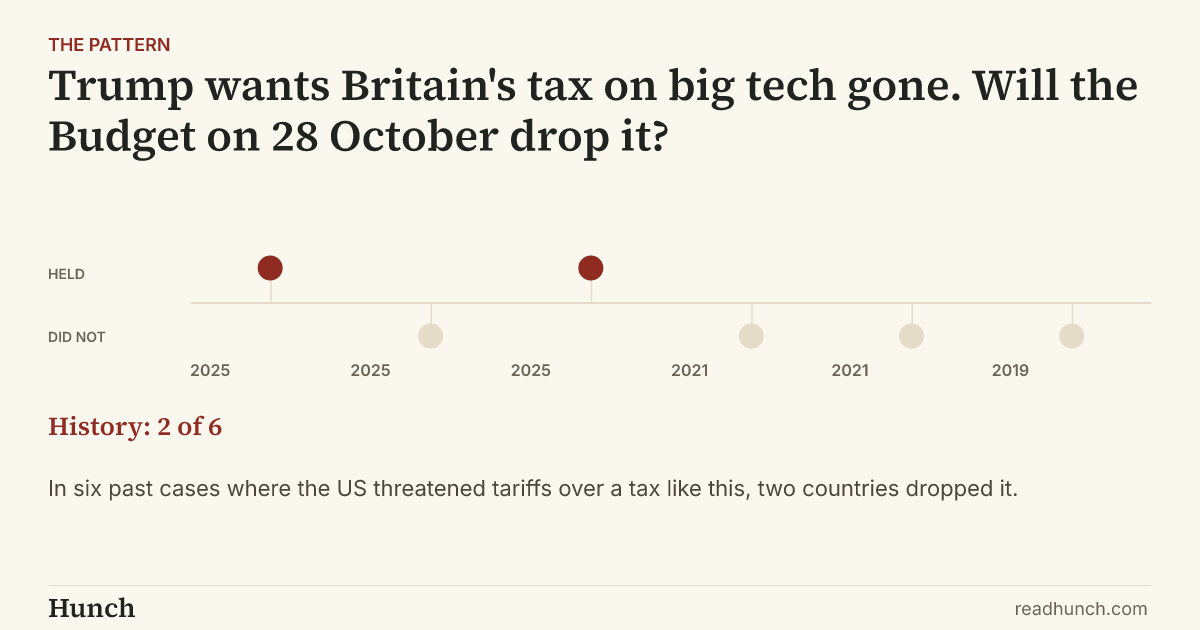
We looked for cases where the US named a trade punishment to make a country drop a tax that falls mostly on American tech firms, and that country’s government had to decide. We found six since 2019, two of them British. Canada and India dropped their taxes, both within five weeks of the threat. Britain twice, France and five other countries kept theirs. Where the US announced tariffs over such a tax, it suspended them at once.
Show the other 4 cases
The Read
History points to Britain keeping the tax. Only Canada and India dropped theirs, both within five weeks of the threat and both during trade talks with the US. Britain was also in talks in 2025 and kept its tax, as it did in 2021. Where the US announced tariffs over such a tax, it suspended them at once, and none came into force.
The record is small, and the US made every threat. Three of the six cases ended in the same 2021 compromise, when countries agreed to drop the taxes only under a global deal. There is a case for change now: a new prime minister, and a threat of 100% tariffs where the 2021 tariffs were 25%. Against it, the tax brings in about £800m a year while borrowing is above forecast. The Budget on will show the government’s choice.
Disclaimer
Hunch works only from sources that are publicly available, and publishes on the basis of analysis of that material. We do not form an editorial opinion or take sides, we give a simpler and wider view of news that already exists. If information in a source we used was inaccurate, distorted, or later disputed but had already entered our analysis, Hunch accepts no liability for that. Predictions are not advice. Phase 1 markets use Hunch Points, not money.
Published by Hunch under the Editorial Code. Complaints and corrections: /contact/.