The UK economy grew 0.7% from July to September. Will it slow to 0.2% or 0.3% next?
Official figures show the fastest growth in more than two years. The first figure for October to December comes out on 12 February.
What happened
The UK economy grew at its fastest rate for more than two years in the three months to September.
The UK economy grew 0.7% from July to September, the fastest rate in more than two years. The Office for National Statistics (ONS) published its first figure for gross domestic product (GDP), the value of everything the economy produces, on . Services led the rise, above all computer programming, helped by spending on cloud computing and artificial intelligence (AI).
Most forecasters had expected almost no growth. When John Healey became chancellor in July, a Treasury note showed the most hopeful City analyst expected 0.3%, and most expected close to zero. Healey said the new figures showed “remarkable resilience”.
Most of the growth inside the quarter came in July. The economy grew 0.4% in July, did not grow in August and grew 0.2% in September. The ONS publishes its figure for October on and for November on , before the first figure for the fourth quarter (Q4), October to December.
GDP first quarterly estimate, UK: October to . Release date: 7:00am
Office for National Statistics, release calendar
Energy bills are expected to rise by about a quarter in January. Jake Finney, an economist at the consultancy PwC, said growth was likely to slow “unless energy markets stabilise”. The Bank of England raised its main interest rate to 4% in November, and on its chief economist, Huw Pill, said it will probably need to raise rates again next month.
Sources: BBC, ONS (2, 3), The Guardian (2), Bank of England
The Pattern
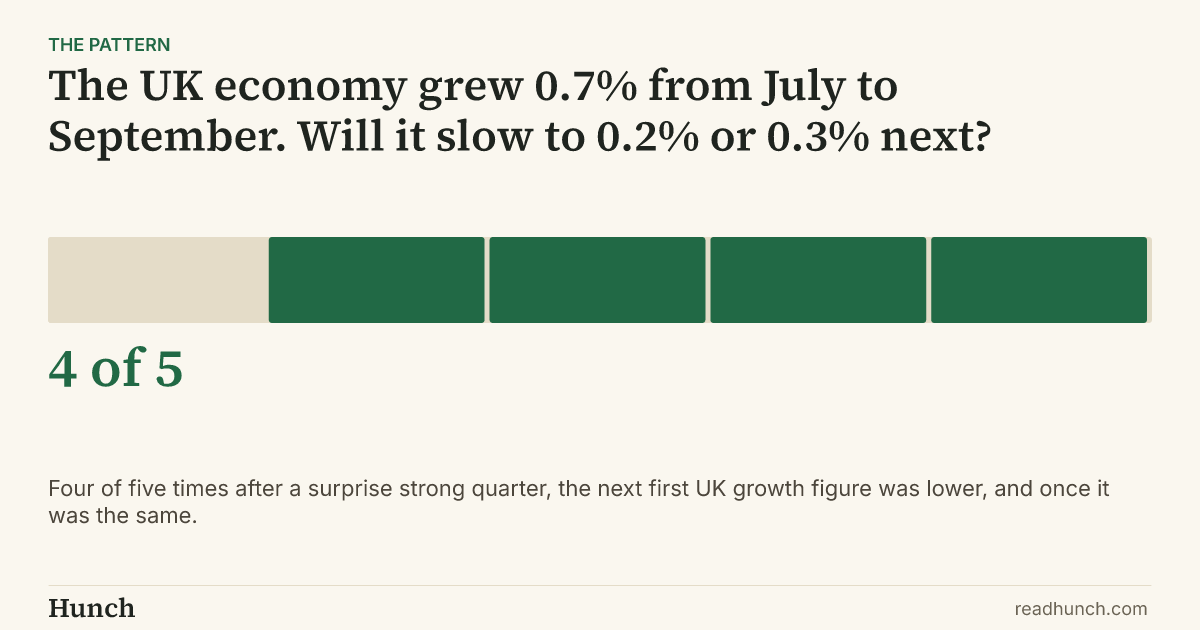
We looked for cases where the ONS first figure for a quarter was the highest in at least two years, and economists said on the day that it beat their forecasts. We found five such quarters in ONS figures since 1992. For each we compared the first figure for the next quarter with the first figure for the strong one.
Show the other 3 cases
The Read
From 0.7%, a result of 0.2% or 0.3% means a fall of 0.4 or 0.5 points. In the five earlier quarters the fall was 0.3 points three times and 1.3 points once, in late 2012, and in 2024 there was no fall. The months now point lower than the headline: if output stayed at September’s level until December, the quarter would grow about 0.1%, by a simple sum from the ONS monthly figures. Monthly figures only began in 2018, so in four of the five earlier quarters nobody could see the months in advance.
There are reasons for doubt. All five quarters come from the UK and the same statistics office. In two of them a one-off event had lifted the strong quarter: the London Olympics in 2012, and a comparison with the Jubilee holidays in 2002. The economy has also grown about 0.2% a month on average this year, and the services survey for October was the strongest in eight months.
Disclaimer
Hunch works only from sources that are publicly available, and publishes on the basis of analysis of that material. We do not form an editorial opinion or take sides, we give a simpler and wider view of news that already exists. If information in a source we used was inaccurate, distorted, or later disputed but had already entered our analysis, Hunch accepts no liability for that. Predictions are not advice. Phase 1 markets use Hunch Points, not money.
Published by Hunch under the Editorial Code. Complaints and corrections: /contact/.