Five of six times, shop sales fell after people stocked up. Will UK sales fall too?
UK shop sales rose 0.7% in October after a government campaign told people to keep food at home. November's figure is due on 18 December.
What happened
UK retail sales rose 0.7% in October, and supermarkets linked higher sales of tinned food and long-life milk to the government’s Be Ready campaign.
UK retail sales rose 0.7% in October, after a fall of 0.6% in September, the Office for National Statistics (ONS) said on . The figure measures the amount of goods sold in Great Britain, including fuel, compared with the month before. The BBC reported that some economists had expected a small fall.
Food shops gave the rise. Supermarkets told the ONS that sales of tinned food and long-life milk went up after the government’s Be Ready campaign began on . The campaign advises people to keep three days of food and water at home.
Three years is the planned length of the campaign. The government called the launch the first stage of a campaign that “will build gradually over time”, with adverts on social media and radio “over the coming weeks and months”. Security Minister Dan Jarvis said: “Those who can follow this advice should follow this advice.”
40% more tinned food was sold at the shop chain Iceland after the weekend of 24 and , the company said, adding: “Our supplies of these products remain healthy.” The research firm Worldpanel counted 37% more tinned and jarred food and 67% more bottled water sold in the ten days after the launch. The typical purchase of tinned meat stayed at 500g.
Paul Dales, an analyst at Capital Economics, said on : “The cupboards only need to be stocked once.” He said the growth in food sales may slow. The ONS publishes the figure for November on at 07:00.
Release date: 7:00am (confirmed)
GOV.UK, Retail sales, Great Britain: November 2026
Sources: BBC (2, 3), ONS, GOV.UK, The Guardian
The Pattern
We looked for cases where shoppers rushed to stock up, the country’s official monthly sales figure rose, and the statistics office or the press linked the rise to that rush. We found six such months from 1997 to 2025: three in Japan and one each in the UK, Australia and the US. Each time we checked the sales figure for the next month.
Show the other 4 cases
The Read
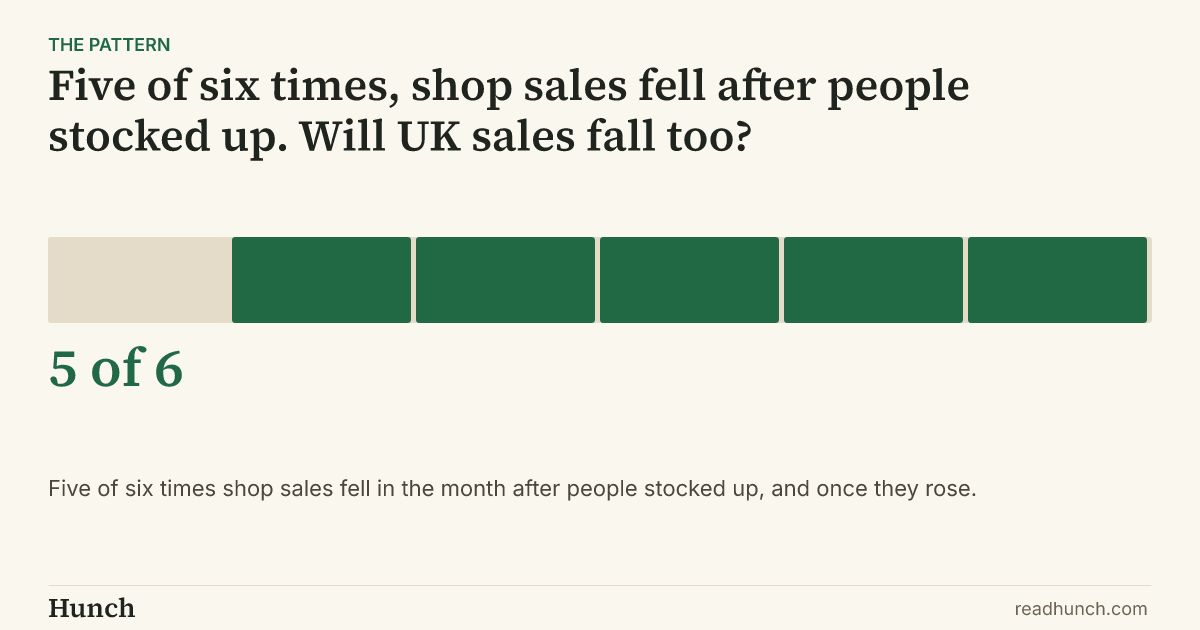
Five of the six rushes were followed by a fall in sales in the next month. Measured against the month before, sales fell 2.3% in the UK in 2012, 14.4% in Japan in 2019 and 17.9% in Australia in 2020. For Japan in 1997 and 2014 the official figure compares with a year before, and both times it went from a rise in the month of the rush to a fall in the next one. In the US, sales rose 0.1% in after the rush to buy before new import taxes.
in the UK is the nearest to this year. A minister advised drivers to fill up, the buying came late in the month, and the ONS named it as a reason for the rise. Sales rose 1.8% in March and fell 2.3% in April. Petrol sales fell 13.2%, and sales without petrol fell 1%. That advice was given once, before a possible strike, and the product was petrol. This year it is tinned food and long-life milk.
Four of the six rushes came before a fixed date: a sales tax rise in Japan in , on and on , and new US import taxes at the start of . In Australia the buying at supermarkets peaked in the middle of , and limits on trade were in force in April. This year the government plans adverts for the weeks and months after . October’s rise of 0.7% is smaller than the rise in each rush measured against the month before: 1.4% in the US, 1.8% in the UK and 8.2% in Australia. The Be Ready campaign began ten days before the end of October.
Sources: The Guardian (2), Al Jazeera, ABC News (2), RTÉ, PBS, ONS, The Japan Times, NPR, GOV.UK
Disclaimer
Hunch works only from sources that are publicly available, and publishes on the basis of analysis of that material. We do not form an editorial opinion or take sides, we give a simpler and wider view of news that already exists. If information in a source we used was inaccurate, distorted, or later disputed but had already entered our analysis, Hunch accepts no liability for that. Predictions are not advice. Phase 1 markets use Hunch Points, not money.
Published by Hunch under the Editorial Code. Complaints and corrections: /contact/.