US doubled its bond buybacks as borrowing costs climbed. Most past rescues worked.
With 10-, 20- and 30-year US bond yields at or near 20-year highs, the US Treasury doubled its debt buybacks on Wednesday. The relief lasted a day.
What happened
The US Treasury announced on Wednesday morning that it is doubling its buyback programme for government debt, framing the move as liquidity support for the long-term bond market after 10- and 20-year yields hit 20-year highs and the 30-year its highest since 2007.
The relief lasted one day. Yields, the interest rate investors demand to lend to the US government, dipped on the announcement, and share prices rose a little. By Thursday yields were rising again, and the step taken by Treasury Secretary Scott Bessent was judged to have bought a single day of trading.
The sell-off is global. The 30-year Treasury yield closed at 5.33% on Monday, its highest since . UK 10-year gilts, the government’s bonds, reached 5.18%, near their highest since 2008, and 30-year gilts were around levels last seen in 1998. Japan’s 10-year yield hit 2.95%, a 30-year high. German yields are at 2011 levels and French yields at a 16-year peak.
Analysts name several causes. Talks between the US and Iran over the Strait of Hormuz collapsed, and Brent crude oil is above $91 a barrel. US national debt has doubled in ten years to $40tn. Technology companies are borrowing heavily to build data centres, and the government’s tax and spending plans are hard to predict.
The Federal Reserve, the US central bank, added its own pressure the same day. Minutes of its July meeting, released on , showed it held rates at 3.5% to 3.75%, while three members argued for rises if inflation does not move towards the 2% target.
Inflation was 3.4% in July, after 4.2% in May. Chair Kevin Warsh has stopped giving guidance on future rates, and markets expect no change at the meeting on 15 and .
Sources: The Guardian (2, 3, 4), Federal Reserve
The Pattern
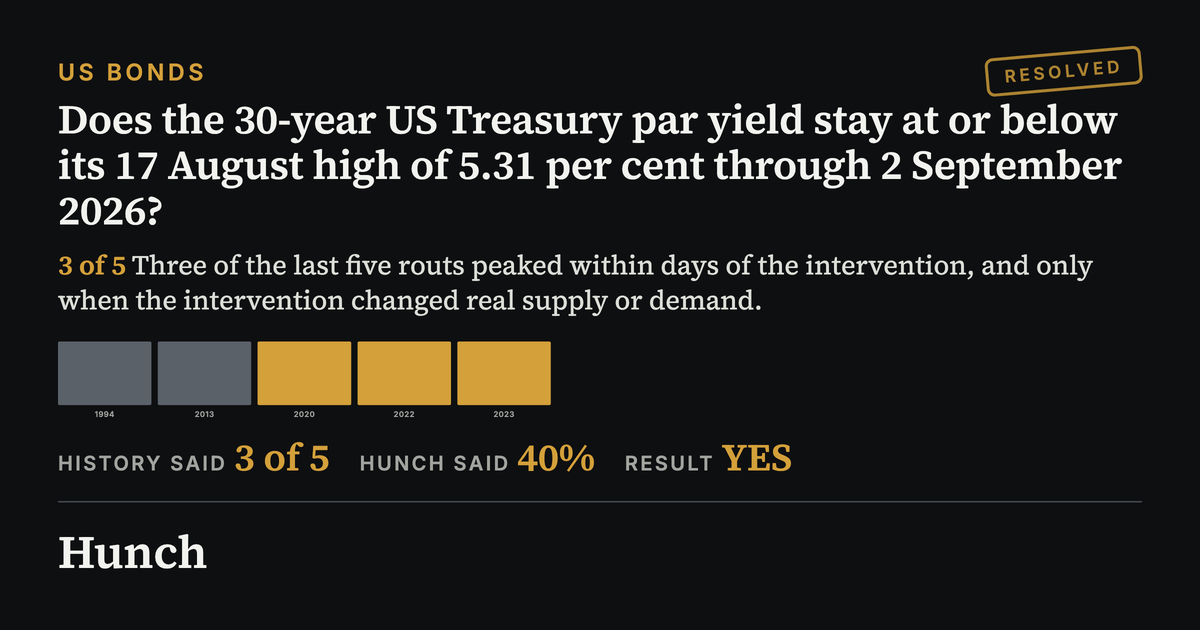
We looked at every major government bond sell-off since 1994 in which a central bank or a finance ministry stepped in while yields were still climbing, as on . We asked one question: did yields stay below their high from before the rescue for the next ten trading days? Five cases fit, and all five are shown. The rescues that worked changed how many bonds were really bought or sold.
Show the other 3 cases
The Read
History is not kind to this rescue. In a buyback the Treasury replaces old debt with new, so the amount of bonds on sale does not fall. That puts it closer to the weak steps of 1994 and 2013 than to the three rescues that worked, and its effect, gone by Thursday, looks like the failures. With oil above $91, three Fed members arguing for rises and a chair who gives no guidance, yields have mostly gone up. In the failures, yields did not pass the old high within days. They passed it within weeks.
The main doubt is that the rescues of 2022 and 2023 both came as second steps, once the pain was bad enough: a central bank buying bonds outright, or the Treasury selling fewer long-term bonds at its next sale. Either is still possible before . The Fed members who want higher rates could also cause a fear of slower growth, and that would pull long-term yields down.
The forecasts on the first two markets fail if Washington follows the buyback with a real cut in the long-term bonds it sells. The market on a fall below 5% depends on the Iran conflict and on the August US inflation figure, due around the resolution date.
Disclaimer
Hunch works only from sources that are publicly available, and publishes on the basis of analysis of that material. We do not form an editorial opinion or take sides, we give a simpler and wider view of news that already exists. If information in a source we used was inaccurate, distorted, or later disputed but had already entered our analysis, Hunch accepts no liability for that. Predictions are not advice. Phase 1 markets use Hunch Points, not money.
Published by Hunch under the Editorial Code. Complaints and corrections: /contact/.