US petrol is under $4 again. Will it pull November inflation below the core rate?
Core inflation leaves out food and energy prices. The US reports November's figures on 10 December, after oil and petrol prices fell.
What happened
Oil prices have fallen to the lowest level since late August while stock markets climbed higher, as markets reacted with relief to Donald Trump saying that the war on Iran is “effectively over”.
Oil fell to its lowest price since August. On Brent crude, the world’s main oil price, fell nearly 3% to $89.66 a barrel after President Donald Trump said the war with Iran was “effectively over”. It had dropped nearly 6% the day before. Trump also told reporters that the US was “locked and loaded, ready to go for any reason”.
US petrol fell below $4 a gallon on . It was the first time since July, according to the motoring group AAA. Its national average was $3.94 on , against $4.36 a month earlier. Prices often fall in autumn, CBS News reports, because after petrol stations may sell a cheaper winter blend of fuel.
Prices rose 0.4% in October. The US Bureau of Labor Statistics (BLS), the government office that measures prices, said on that prices without food and energy rose 0.3%, as in August and September. Food rose 0.5% and energy 0.7%. Pump prices fell in October from $4.41 to $4.22 a gallon, but in the BLS figures petrol still rose 1.0%. The BLS takes out the usual change for each time of year, so a normal autumn fall does not count.
The index for all items less food and energy rose 0.3 percent in October, as it did in September and August.
US Bureau of Labor Statistics, Consumer Price Index – October 2026
The November figures come out on at 8:30 am. That is Eastern time in the US. The Federal Reserve, the US central bank, raised interest rates in September for the first time since 2023 and meets again on 8 and . Its chair, Kevin Warsh, said on that its job is “to ensure that relative price changes in some sectors do not broaden across the economy”.
Sources: The Guardian (2), CBS News, AAA, US Bureau of Labor Statistics (2), Federal Reserve
The Pattern
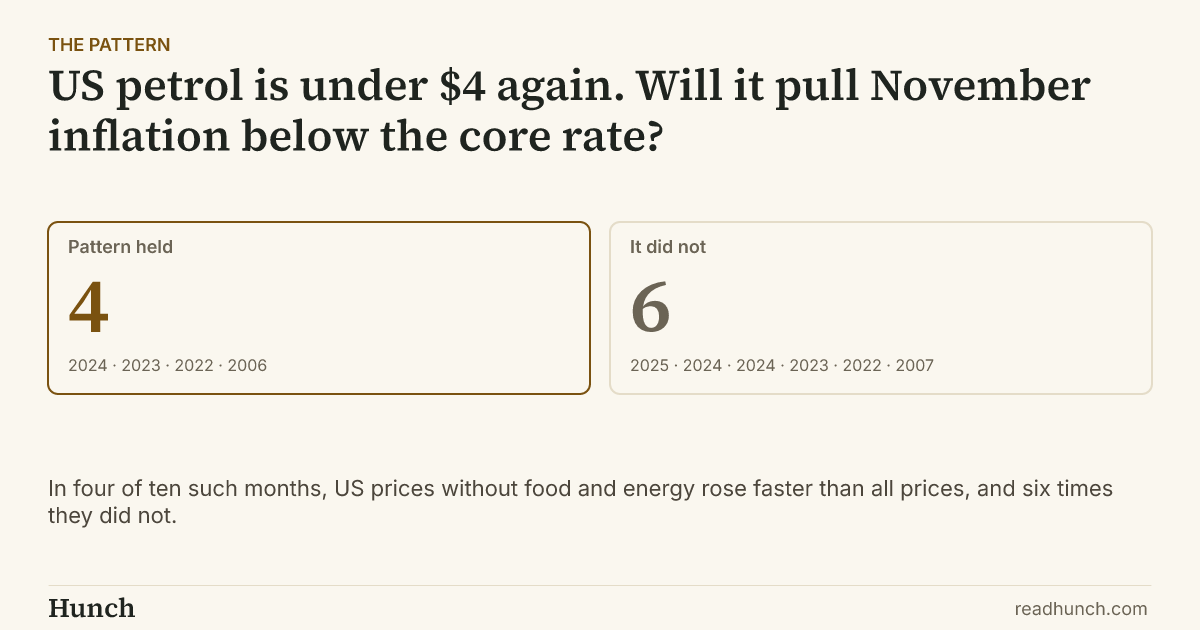
We looked for cases where the BLS reported prices for a month between October and December after prices without food and energy had risen at least 0.2% in each of the three months before. Pump prices had also fallen the month before, while food had risen. We found 15 such months since 1997 and took the ten most recent, from 2006 to 2025. We read the first figures the BLS published, rounded to one decimal, and a tie counts as no.
Show the other 8 cases
The Read
November already looks like those ten months. Prices without food and energy rose 0.3% in each of the last three months, food rose 0.5% in October and pump prices fell. What decided the ten months was energy. In the four months when energy fell or did not change, prices without food and energy rose faster. In the six when energy rose, they did not. Petrol cost $3.94 a gallon on , against $4.36 a month earlier. On the Federal Reserve Bank of Cleveland, which publishes its own daily estimate, put November at 0.135% for all prices and 0.211% without food and energy. Rounded, that is 0.1 against 0.2.
All ten months come from one office’s figures. From 1998 to 2004 there were five more such months, and in four of them prices without food and energy rose faster. The energy figure for November comes out only on , and electricity rose 0.9% in October. A tie counts as no, and two of the ten months were ties. The Cleveland estimate puts the gap at 0.08 points before rounding.
Sources: US Bureau of Labor Statistics (2, 3), AAA, Federal Reserve Bank of Cleveland, Federal Reserve Bank of St. Louis
Disclaimer
Hunch works only from sources that are publicly available, and publishes on the basis of analysis of that material. We do not form an editorial opinion or take sides, we give a simpler and wider view of news that already exists. If information in a source we used was inaccurate, distorted, or later disputed but had already entered our analysis, Hunch accepts no liability for that. Predictions are not advice. Phase 1 markets use Hunch Points, not money.
Published by Hunch under the Editorial Code. Complaints and corrections: /contact/.