US power prices dip after summer. Will November stay above 18.8 cents?
The average US electricity price fell to 19.0 cents per kilowatt-hour in October. The figure for November comes out on 10 December.
What happened
A new study finds that in 2025, the rising energy costs associated with AI data centers landed hardest on lower-income, rural households, which bore disproportionate shares of the financial burdens compared with the data centers themselves.
US electricity got cheaper in October. On the US Bureau of Labor Statistics (BLS) said the average price was 19.0 cents per kilowatt-hour in October, down from 19.6 cents in August and September. It is still higher than a year ago: in it was 18.8 cents. There is no figure, because the BLS did not publish it during the 2025 government shutdown.
Electricity prices are collected for the BLS for the same 75 areas on a monthly basis by the Department of Energy using mail questionnaires.
US Bureau of Labor Statistics, Average Price Data, series APU000072610, notes on FRED
The same day, a study asked who pays for new power lines. Researchers at Cornell University wrote in the journal Nature Energy that spending on power lines across four large US grids rose from $2bn in 2020 to $34.2bn in 2025. Households were billed more than $16bn of it, and data centres, the large computer buildings that run artificial intelligence (AI), about $3bn. One author, Fengqi You, told CBS News: “you do not have to live next to a data center to help pay for its power infrastructure”.
Politicians promise lower bills, but none of their steps is in force yet. In July President Donald Trump said “Electricity bills for American families will actually come down”, as power companies and 23 Republican governors joined his voluntary pledge to protect households from data centre costs. On the Senate voted 73 to 25 to start debating a bill to speed up energy projects, and the office of Hakeem Jeffries, who leads the Democrats in the lower chamber of Congress, said it “falls short”.
The November price comes out on at 8:30 am Eastern time, with the monthly consumer price figures. It will show how far the autumn fall goes.
Sources: CBS News, US Bureau of Labor Statistics, PBS NewsHour, The Guardian, US Bureau of Labor Statistics, FRED
The Pattern
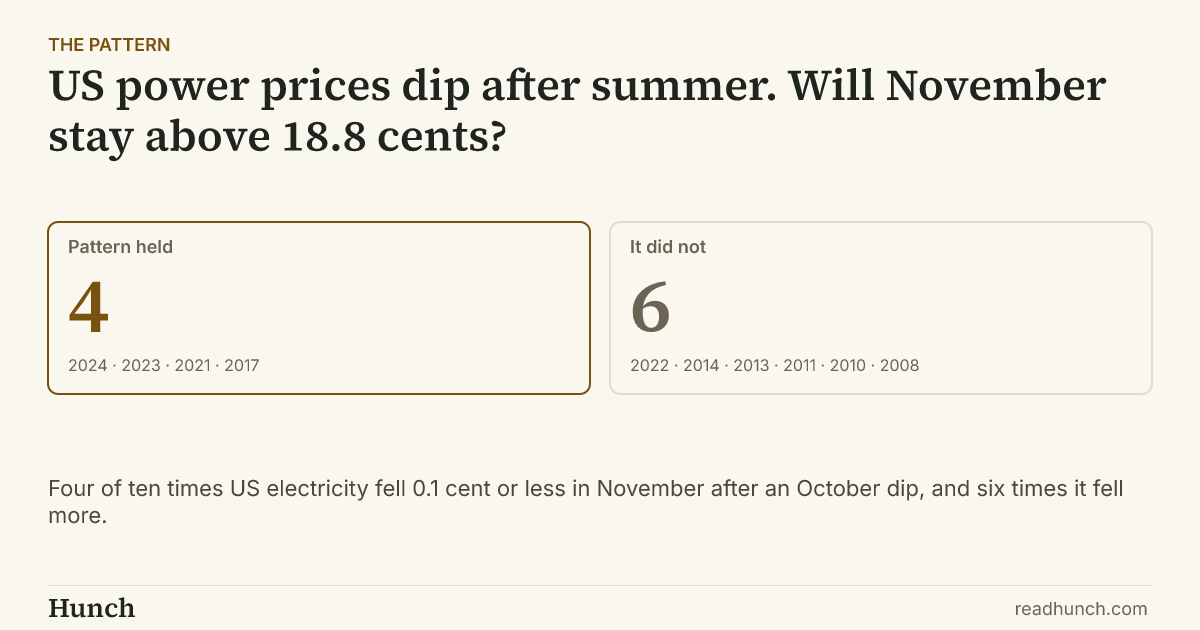
We looked for cases where the average US electricity price had already fallen from September to October, while October’s price was higher than a year earlier. We found 33 such years since 1980, and took the ten most recent, from 2008 to 2024. Each time, we compared the first November price with October’s.
Show the other 8 cases
The Read
In all ten years November was no higher than October, and the fall was never more than 0.3 cent. From today’s 19.0 cents, that means somewhere between 18.7 and 19.0 cents. October prices have fallen 0.6 cent four times before, in 1986, 1987, 1997 and 2006, and November then fell 0.1 or 0.2 cent. Underneath the autumn swing, prices are still rising: the BLS electricity index, adjusted for the time of year, went up 0.9% in October.
There are reasons for doubt. All four years when November fell 0.1 cent or less, or not at all, were recent: 2017, 2021, 2023 and 2024. Across all 33 such years since 1980, November fell 0.1 cent or less only nine times. This year prices have also moved at unusual times: they fell 0.3 cent in February and rose 0.4 cent in April, the biggest April rise in BLS figures going back to 1979. In the 1980s a unit cost 6 to 8 cents, so a fall in cents meant more then. The only rise, 0.1 cent in 2020, came in a year when prices were lower than the year before.
Sources: US Bureau of Labor Statistics (2, 3, 4, 5, 6, 7), FRED
Disclaimer
Hunch works only from sources that are publicly available, and publishes on the basis of analysis of that material. We do not form an editorial opinion or take sides, we give a simpler and wider view of news that already exists. If information in a source we used was inaccurate, distorted, or later disputed but had already entered our analysis, Hunch accepts no liability for that. Predictions are not advice. Phase 1 markets use Hunch Points, not money.
Published by Hunch under the Editorial Code. Complaints and corrections: /contact/.