US petrol costs $4.36 a gallon. Releasing emergency oil often failed to cool it.
President Donald Trump blames Democrats and Ukraine for high US petrol prices. On 2 October the G7 agreed to release oil from emergency stocks.
What happened
The average price for a gallon of petrol in the US is $4.36, up from $4.14 a month ago and from $2.98 on , when the US and Israel first struck Iran, according to the AAA motoring group.
US petrol costs $4.36 a gallon on average, up from $4.14 a month ago and $2.98 on , when the US and Israel first struck Iran, the AAA motoring group says. Daily oil exports through the Strait of Hormuz have fallen by 97% since the war began.
President Donald Trump now blames other causes. On he wrote that “What’s driving up Gasoline is no longer the Strait of Hormuz”, but refineries hit by Ukraine in Russia and closed in Democratic states such as California. Two refineries closed there in the past year.
On the G7 group of rich countries agreed to release 100 million barrels of diesel and crude oil from emergency stocks, under pressure from the Trump administration. The US Strategic Petroleum Reserve, the government’s own emergency stock, is at its lowest level since 1982. Patrick DeHaan of GasBuddy said petrol and diesel futures fell “strongly lower” after the US pushed European countries to act.
Weekly U.S. Regular All Formulations Retail Gasoline Prices (Dollars per Gallon)
US Energy Information Administration
The government’s own weekly price fell from $4.465 on to $4.354 on . The midterm elections are on , and an AP-NORC poll found that 65% of Americans blame Trump’s policies for higher prices.
Sources: Al Jazeera, US Energy Information Administration
The Pattern
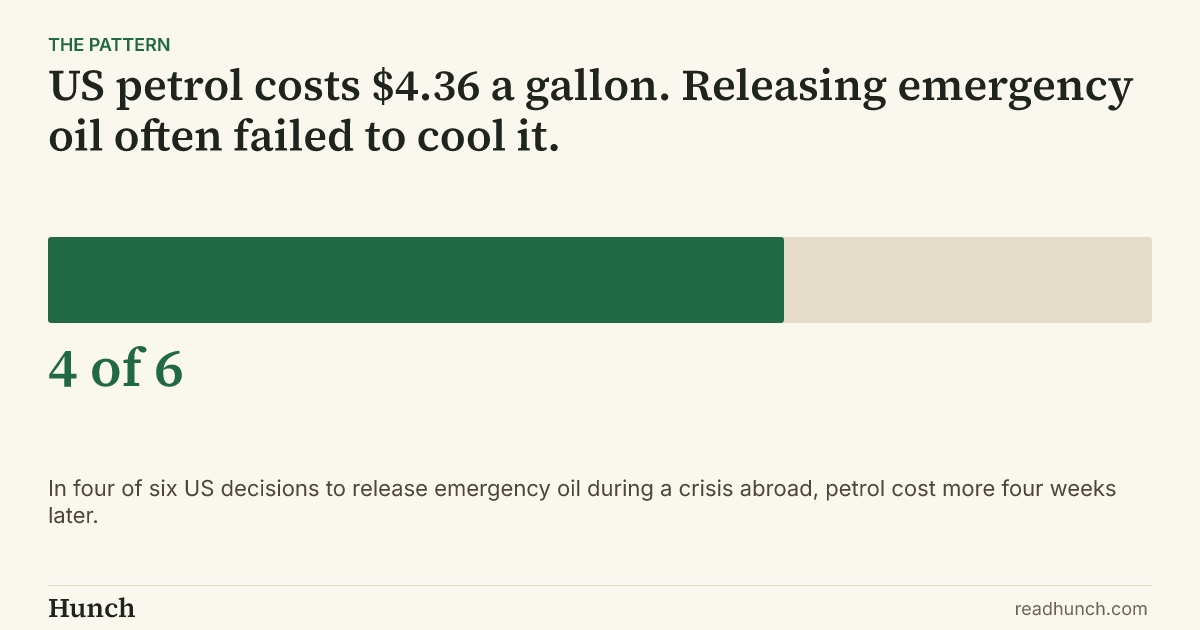
We looked for cases where the US government decided to release oil from its emergency reserve because a war, embargo or blockade abroad had cut supply. We found six decisions since 1990, one of them carried out in two steps, so seven releases in all. We then compared the weekly petrol price before each decision with the price four weeks later.
Show the other 5 cases
The Read
Releases of emergency oil often did not bring prices down within a month. In four of six past decisions, petrol cost more four weeks later. But the three big rises came when prices were at a new high for the crisis. This decision came after the peak, and the government’s weekly price has already fallen to $4.354.
There are reasons for doubt. The same government made every decision, and only six count. The AAA price that drivers see is not the same as the government’s weekly price, which settles this question. In the largest release on record still saw prices rise for six months, because the blockade took more oil off the market than the release put back.
Disclaimer
Hunch works only from sources that are publicly available, and publishes on the basis of analysis of that material. We do not form an editorial opinion or take sides, we give a simpler and wider view of news that already exists. If information in a source we used was inaccurate, distorted, or later disputed but had already entered our analysis, Hunch accepts no liability for that. Predictions are not advice. Phase 1 markets use Hunch Points, not money.
Published by Hunch under the Editorial Code. Complaints and corrections: /contact/.