US bans Canadian dairy and alcohol. Such targets often hit back within a month.
The US will ban Canadian dairy, most alcohol and motorcycles from 29 September, hours after Canada's tariffs on $20bn of US goods took effect.
What happened
The White House said on Tuesday that the United States is banning dairy products, most alcoholic beverages and motorcycles from Canada, with the ban taking effect in three weeks, and directed the General Services Administration to make Canadian products ineligible for large long-term federal contracts until Canada allows full reciprocity for American goods.
The US ban starts on . The General Services Administration, which buys for the federal government, will work with the US Trade Representative to remove Canadian products from federal buying lists. That lasts until Canada gives what the order calls full and fair reciprocity. The fight has moved from taxing Canadian goods to keeping them out, and from trade into government buying.
Canada’s tariffs on nearly $20bn of US goods began on , a few hours before the US order. They range from 15% to 50% and cover more than 700 products, including steel, appliances, farm equipment and dairy. They took effect at 12.01am Eastern time, together with a $5.42bn support package for affected firms and workers.
Those tariffs were Canada’s answer to 50% US tariffs on about 5% of Canadian imports. The US imposed them on , the day after talks collapsed.
Canada has not yet answered the ban with a new measure. Before the ban was announced, a Canadian official said the government did not plan to change course whatever Washington did. Mark Carney described the plan as building at home and trading more with other countries.
A spokesman for trade minister Dominic LeBlanc said officials on both sides were still in contact, although formal talks have not restarted. The next Canadian move is open: another counter-measure, or silence.
Sources: Guardian, Al Jazeera
The Pattern
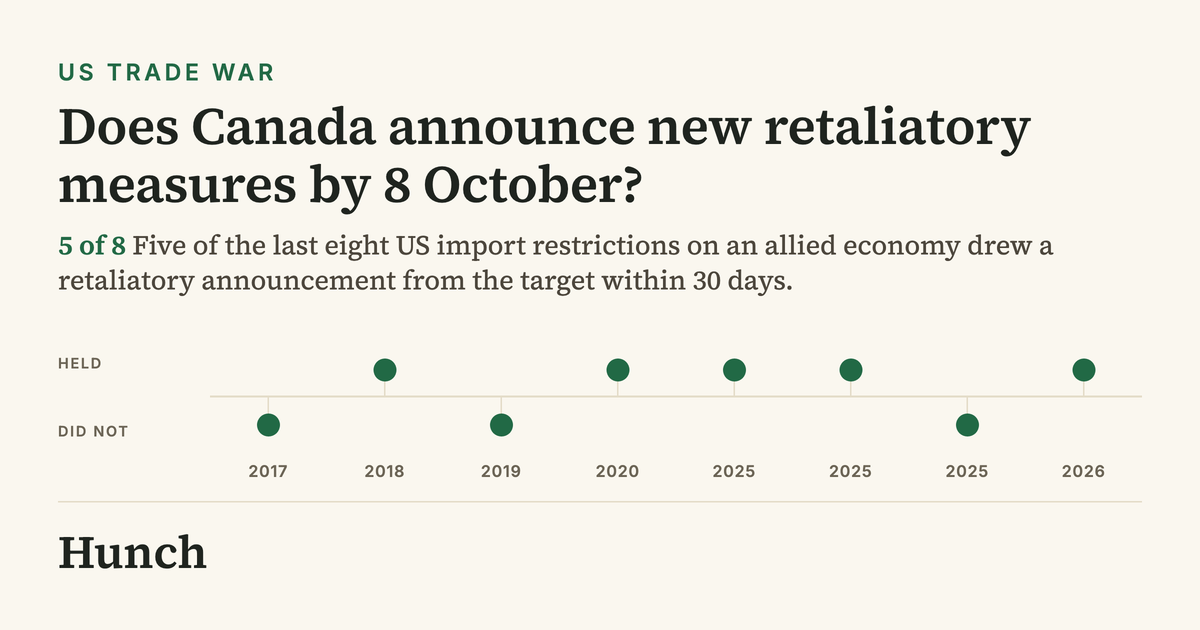
We looked at every time since 2017 that the US government put a new import limit on a treaty ally or close trading partner, and at what the target government did in the next 30 days. We found eight. Canada is the target in five of them.
Show the other 6 cases
The Read
History points to a Canadian answer, and Canada’s own record is the main reason. It hit back in four of its five cases, twice within a day, and it has now done so three times in eighteen months. The ban also falls on goods where Canada has obvious ways to reply. US alcohol is already off provincial shelves, and Ottawa has long protected dairy and government buying. The three weeks before give Canada a natural moment to answer before the ban starts.
The doubt is that Canada has just acted. Its $20bn package started on the morning of , and an official said the plan would not change whatever Washington did. Carney’s stated plan is to build at home and trade more widely. The two cases that broke the pattern most clearly, Mexico in 2025 and Canada in 2017, show governments choosing a deal or a court case over new tariffs.
The prediction fails if Ottawa spends the next month on support packages, legal challenges at the WTO and under USMCA, the North American trade agreement, and trade trips to Europe and Asia. None of these counts as a new measure against the United States.
Disclaimer
Hunch works only from sources that are publicly available, and publishes on the basis of analysis of that material. We do not form an editorial opinion or take sides, we give a simpler and wider view of news that already exists. If information in a source we used was inaccurate, distorted, or later disputed but had already entered our analysis, Hunch accepts no liability for that. Predictions are not advice. Phase 1 markets use Hunch Points, not money.
Published by Hunch under the Editorial Code. Complaints and corrections: /contact/.