UK job vacancies hit a post-pandemic low. Such times rarely brought a rate rise.
Job vacancies fell to 707,000, the lowest since 2014 outside the pandemic. Markets still expect a Bank of England rate rise to 4% by year-end.
What happened
UK pay growth slowed in the three months to June as vacancies fell to a post-pandemic low, with economists at ING and Jefferies arguing the cooling jobs market undercuts the case for further Bank of England rate rises despite war-driven energy inflation.
UK job vacancies were 707,000 in May to July, the lowest estimate outside the pandemic since 2014 and 6,000 fewer than in the previous three months. The number of employees on payrolls fell by 13,000 in July, the same fall as in June. Unemployment stayed at 4.9%, 0.2 points higher than a year ago.
Regular pay in the private sector, without bonuses, grew 2.8%, the weakest since . Pay across the whole economy grew 3.5%, held up by 6.1% growth in the public sector that the timing of the NHS pay award made look higher. Total pay growth slowed to 4.1% from 4.4%. Pay after inflation is growing at 1.3%, and that margin shrinks as energy costs push inflation up.
The next Bank of England decision comes on . Bank Rate, its main interest rate, is 3.75% after a 6 to 3 vote to hold in July. Markets still expect one rise to 4% by the end of 2026, because the Iran war keeps energy costs and inflation high. The committee announces its decision at noon.
Some economists disagree with the markets. James Smith of ING sees a high bar for a rise this year unless energy prices jump sharply. Modupe Adegbembo of Jefferies finds little sign that the jobs market is pushing inflation up.
Sources: The Guardian, ONS, Bank of England
The Pattern
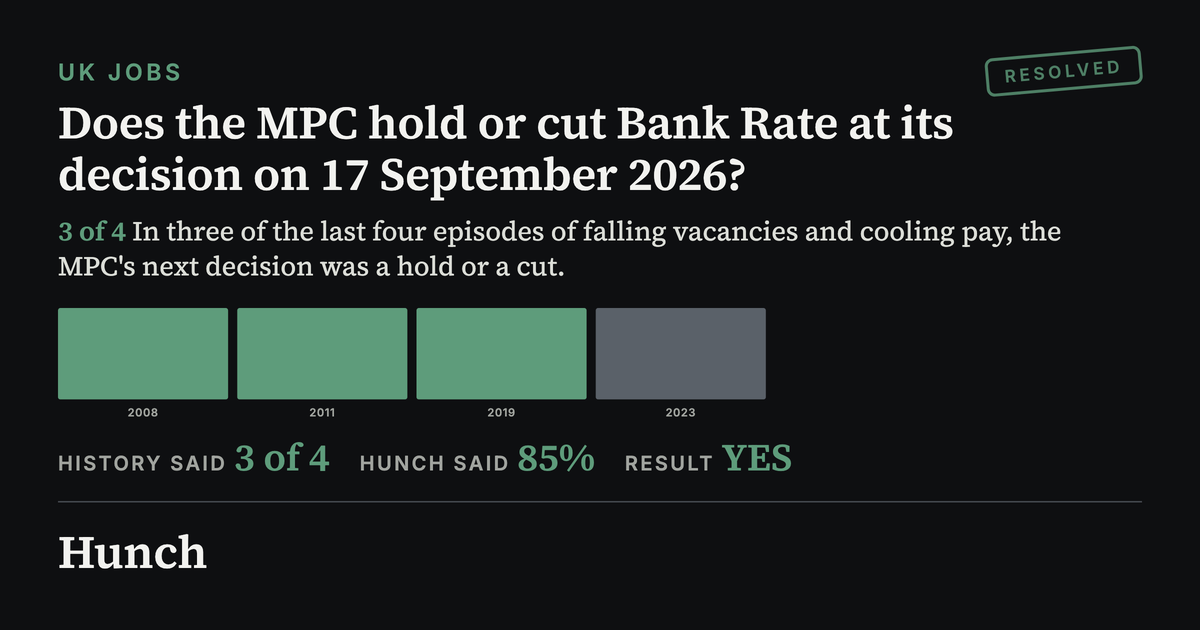
We looked at every period since 2008 when UK job vacancies were falling and pay growth was slowing while inflation was at or above the 2% target, as in the May to July figures. We asked one question: did the Bank of England’s rate committee hold or cut rates at its next scheduled decision? Four periods fit, and all four are shown. The current period is the one being tested and is not counted.
Show the other 2 cases
The Read
History points to no rise in September. In three of the last four periods like this, the Bank did not raise rates at its next decision. Two bank economists read the new data as closing the door, and after July’s 6 to 3 vote to hold, three members would need to change their minds in five weeks with little new data.
The main doubt is that markets still expect one rise this year, because the exception in the record is live. The Iran war is doing to energy costs what no vacancy count can offset, and 2023 showed the Bank will raise rates into a cooling jobs market when inflation frightens it. The September call fails if energy prices jump hard enough to pull pay deals up, if the pay data is revised up, or if public-sector pay growth of 6.1% proves stickier than the NHS timing suggests. Any of those would also put a rise back on the table for the meetings after September, which fall outside the dates this Echo covers.
The vacancies market is a cleaner short-term question. At a fall of 6,000 a quarter from 707,000, a figure below 700,000 on is close to a coin toss, and it comes two days before the rate decision it would inform.
Disclaimer
Hunch works only from sources that are publicly available, and publishes on the basis of analysis of that material. We do not form an editorial opinion or take sides, we give a simpler and wider view of news that already exists. If information in a source we used was inaccurate, distorted, or later disputed but had already entered our analysis, Hunch accepts no liability for that. Predictions are not advice. Phase 1 markets use Hunch Points, not money.
Published by Hunch under the Editorial Code. Complaints and corrections: /contact/.