Vodafone's German service income fell. Will it grow again by 3 February?
Vodafone's money from services in Germany, its biggest market, fell 0.5% in July to September. The next figure comes on 3 February.
What happened
Vodafone revealed plans for a further 2,300 job cuts in Germany to help revive performance in the country.
Vodafone’s service revenue in Germany fell 0.5% in July to September. Service revenue is the money customers pay for mobile, broadband and TV services, without phone sales. Germany is Vodafone’s biggest market and brings 30% of the group’s service revenue. In April to June it had grown 1.2%. Vodafone gives these figures without the effect of buying or selling businesses and of exchange rates.
Vodafone says the fall came from a strong quarter a year ago. Then, customers of 1&1, another German provider, were moving onto Vodafone’s network, and 1&1 paid Vodafone for this. Mobile service revenue fell 1.9% in the quarter. Vodafone says rivals competed hard for customers, and a year ago it also had more money from 1&1 and a different timing of payments to service providers. Fixed-line service revenue grew 0.9%.
Service revenue increased 1.1%, and on an organic basis service revenue grew 0.4% (Q1: 1.2%, Q2: -0.5%) ... The quarterly slowdown was primarily driven by higher wholesale revenue in the prior year period.
Vodafone Group Plc, H1 FY27 results, Germany, . Organic means without deals and exchange rate changes
A court case also takes money away. In September the Court of Justice of the European Union ruled that EU law does not by itself let a company change a customer’s contract on its own. After this ruling Vodafone stopped counting a €5 monthly price rise paid by 2.5 million broadband customers on old contracts. A higher court in Düsseldorf heard a case by the German consumer federation on and has signalled it will rule against Vodafone on .
The group as a whole is doing better. On Vodafone raised its forecast for yearly earnings to €13.2bn to €13.4bn, from €13bn to €13.3bn in July. It also cut the value of its German business on its books by €4.85bn, and on it announced 2,300 more job cuts there. Chief executive Margherita Della Valle said “Germany is not yet where it needs to be”. The next figure comes in Vodafone’s trading update on .
Sources: The Independent, Vodafone (2)
The Pattern
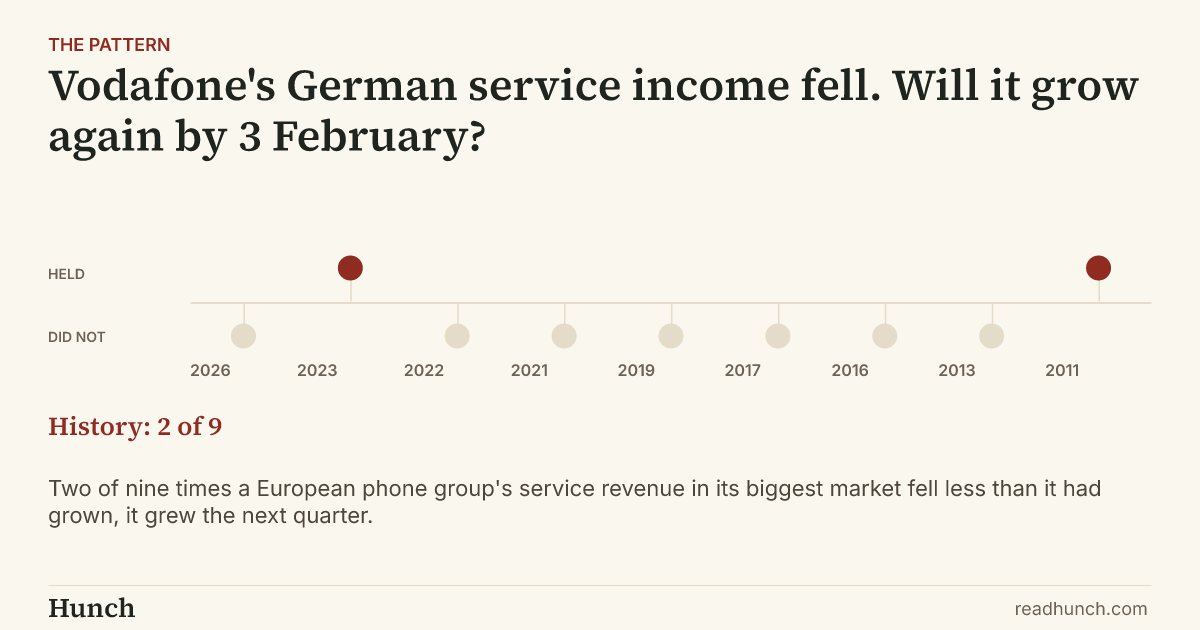
We looked for cases where a phone company working in several countries said that its service revenue in its biggest market fell for a quarter, after growing the quarter before, and fell by less than it had grown. We found nine such quarters since 2011. Four were at Vodafone in Germany, and five at phone groups in the Nordic countries and Spain. Each figure is the company’s own, without the effect of deals and exchange rates. (Vodafone; Vodafone; Telia; Telenor; Telefónica)
Show the other 7 cases
The Read
October to December is the first full quarter without the €5 price rise. By our count from Vodafone’s reports, €5 a month from 2.5 million customers comes to up to €37.5m a quarter. That is up to 1.4 points of growth, set against the €2,726m Vodafone made from services in Germany in the same quarter a year earlier. Vodafone stopped counting this money after the court ruling in September, so July to September lost at most one month of it. Money from 1&1 was also still rising a year ago, so the comparison is harder than in July to September. To grow again, the rest of the German business must make up both the 0.5% fall and the rest of the lost price rise.
There are reasons for doubt. Four of the nine quarters were at Vodafone in Germany, and they were also the four smallest falls, from 0.2% to 0.5%, like this one. After those four, growth came back the next quarter once, and the next figure was no worse than the fall twice. After the five deeper falls, the next quarter was never worse than the fall. Each company measures service revenue in its own way, and all nine come from European phone groups. Twice the next quarter was exactly 0.0%, which counts as no growth. If falls larger than the growth before are added, growth came back three times in fourteen.
Disclaimer
Hunch works only from sources that are publicly available, and publishes on the basis of analysis of that material. We do not form an editorial opinion or take sides, we give a simpler and wider view of news that already exists. If information in a source we used was inaccurate, distorted, or later disputed but had already entered our analysis, Hunch accepts no liability for that. Predictions are not advice. Phase 1 markets use Hunch Points, not money.
Published by Hunch under the Editorial Code. Complaints and corrections: /contact/.