Kevin Warsh's Fed is split on raising rates. New chairs under pressure did not cut.
Kevin Warsh goes to his first Jackson Hole meeting as chair of the US Federal Reserve, with 3 colleagues pushing for rate rises and inflation at 3.4%.
What happened
Minutes of the Fed’s July meeting, released on , revealed internal disagreement: the committee held rates at 3.5–3.75% on a 9–3 vote, with three members — Hammack, Kashkari and Logan — formally dissenting in favour of an immediate quarter-point rise, while the minutes noted that tightening would likely be necessary if it persists.
Minutes of the Fed’s July meeting came out on . Rates stayed at 3.5 to 3.75%, and three members wanted increases if inflation does not move back towards the 2% target. Inflation was 3.4% in July, down from 4.2% in May.
The minutes came out as prices of US government bonds were falling fast. The yields on 10- and 20-year Treasury bonds, the interest the US pays to borrow, reached 20-year highs. The 30-year yield reached its highest level since 2007.
Kevin Warsh has been chair since May and says little about where rates are going. He scrapped the dot plot, the chart of members’ rate forecasts, and stopped saying in advance where rates are likely to go. He also set up a 15-member panel, including former Bank of England governor Mervyn King, to review how the Fed talks to the public.
Charlie Bean, a former Bank of England deputy governor, said Warsh gives neither a path for rates nor a clear rule for how he will react. As bond yields rose around the world this week, critics said the chair was wrong to give no guidance.
The first real test comes at the Fed meeting on 15 and . Markets expect rates to stay where they are, and do not expect a rise to 4 to 4.25% before 2027. Before that, from 27 to , Warsh makes his first appearance as chair at Jackson Hole, the Kansas City Fed’s yearly meeting on the economy.
Sources: The Guardian (2, 3), Federal Reserve, Federal Reserve Bank of Kansas City
The Pattern
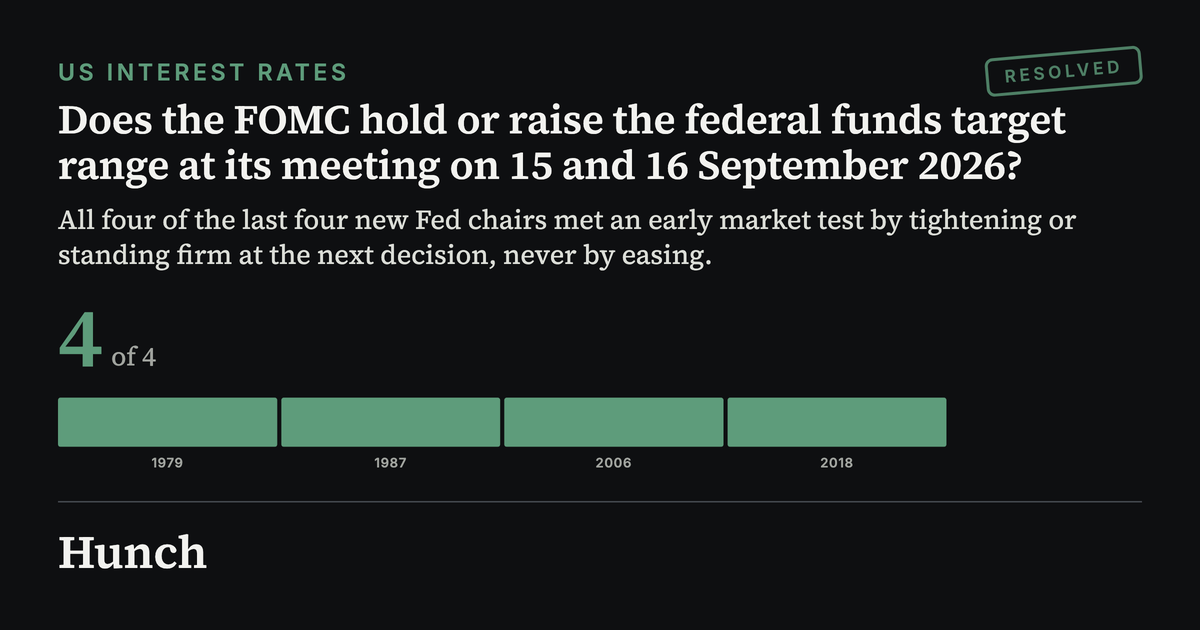
We looked at every Fed chair since 1979 who faced pressure from markets in his first year, as Warsh does now, with three members against him and bond prices falling. We asked one thing: at the next planned rate decision, did he raise rates or keep them where they were, rather than cut? Four chairs fit, and none of them cut. Chairs who started in calm markets never faced this test and are not included.
Show the other 2 cases
The Read
History points to no cut. Two of the four chairs, Alan Greenspan in 1987 and Jerome Powell in 2018, only had to keep rates steady. Paul Volcker and Ben Bernanke raised them, and both faced inflation much further above target than today’s 3.4%. Warsh has spent three months refusing to promise anything, so a surprise rise at his first split meeting looks unlikely. That is why we give 84% that the Fed keeps or raises rates, but only 30% that it raises them. With three members already voting against, another vote against is the most likely single feature of the September meeting.
The record is small, only four chairs, and for most of the past ten years Fed votes have usually had no one voting against. A rise becomes more likely if oil above $91 pushes the August inflation figure, due days before the meeting, back towards 4%. Warsh’s test would then look more like Volcker’s in 1979 than Greenspan’s in 1987. The main market fails only if Warsh does what no new chair in this record has done: cuts rates at his first split meeting because falling bond prices have hurt growth.
Disclaimer
Hunch works only from sources that are publicly available, and publishes on the basis of analysis of that material. We do not form an editorial opinion or take sides, we give a simpler and wider view of news that already exists. If information in a source we used was inaccurate, distorted, or later disputed but had already entered our analysis, Hunch accepts no liability for that. Predictions are not advice. Phase 1 markets use Hunch Points, not money.
Published by Hunch under the Editorial Code. Complaints and corrections: /contact/.