Distilleries pause as Scotch piles up, and GlenWyvis calls in administrators
Distilleries across Scotland have stopped making whisky as sales fall. GlenWyvis in Dingwall has filed notice that it will appoint administrators.
What happened
On The Guardian reported that distilleries across Scotland have paused production as world demand for Scotch falls after a 15-year boom.
Distilleries across Scotland have paused production as demand for Scotch falls around the world. The fall follows a 15-year boom that grew faster in the pandemic. Makers have stopped so they do not add to the unsold spirit, known as a whisky loch.
Rob Carpenter, co-founder of Holyrood Distillery in Edinburgh, has stopped its stills and does not know when they will start again. He said the industry “might be producing around a third of its normal level right now”. Tours bring in about half of Holyrood’s money.
GlenWyvis, a distillery in Dingwall owned by its community since 2016, filed a notice at the Court of Session on that it intends to appoint administrators. Interpath Advisory spent months looking for investors and did not find the money the distillery needed. Two Interpath partners are named as administrators. The notice gives protection from creditors for up to ten working days and does not itself appoint anyone.
Diageo makes about one in three bottles of Scotch. It plans to cut hundreds of jobs in Scotland, and on workers at Cameronbridge, its largest distillery, went on strike against the cuts. Near Kirkcaldy it is finishing stores for almost 3m casks. Dozens of Scotland’s 156 working distilleries are said to be for sale.
By law Scotch must age for at least three years in an oak cask in Scotland, so makers cannot quickly match what they make to what they sell. US duties from cut exports to the US by 15%, according to the Scotch Whisky Association. Donald Trump has since removed the duties, and the industry grew again in the first half of 2026. In the 1980s weak demand and too much stock led to many closures.
Sources: The Guardian, The Scotsman, The Spirits Business, The National
The Pattern
We looked for cases where a product takes at least two years to make, by law or by its nature, and a long boom ended with too much stock and falling sales. Large groups and small independents worked side by side, and at least one company went into a formal insolvency process under a court or its lenders. We counted every later failure in the same slump and the months between them. We found five since 1901. Four are drinks: Scotch in the 1980s, and Irish whiskey, American whiskey and cognac now. One is London offices in 1989 to 1992.
Show the other 3 cases
The Read
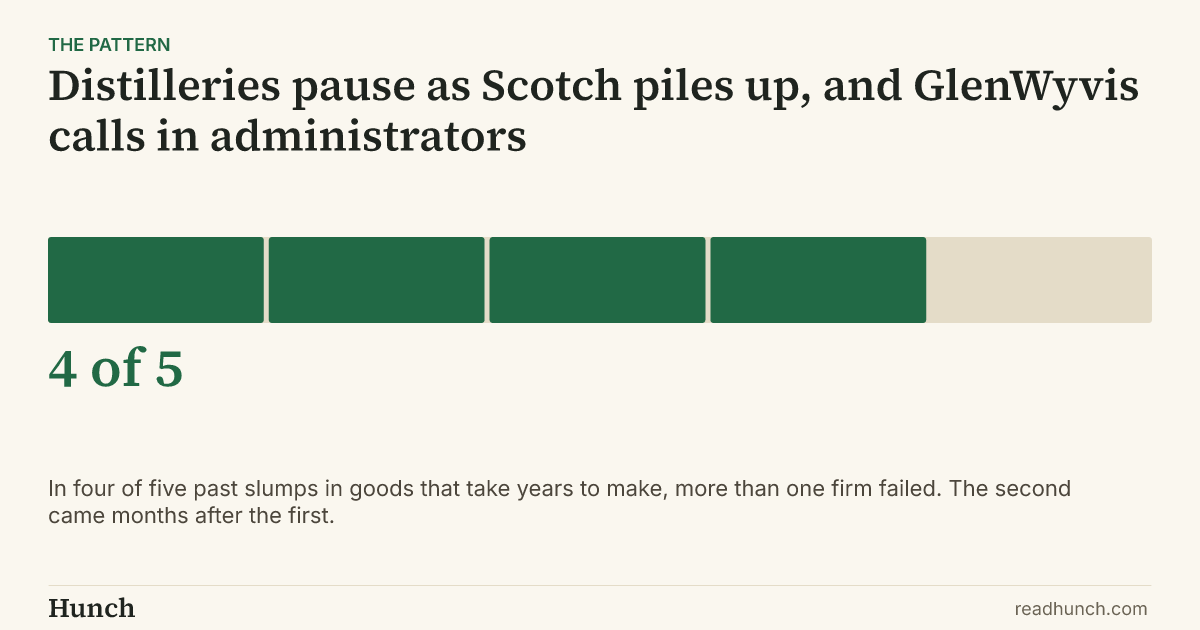
History says a slump like this rarely ends with one failure. In four of five, more than one company went under. GlenWyvis also fits the usual first to fail: in four of five slumps it was a company that grew or started in the boom, and GlenWyvis was founded in 2015. The biggest company, here Diageo, did not fail in four of five; it cut jobs and waited.
The record is weaker than five cases sound. Three of the five, in Ireland, the US and cognac, run at the same time as today, under the same background of a glut after the pandemic and US duties, and they are not finished. The London offices case is not drinks. The 1980s Scotch slump had only one formal failure, and the big closures then came from the largest group.
History also says the next failure comes slowly. Counting only from the first failure to the second, none of the five came within 92 days: it took about 4, 4.5, 9 and 25 months, or never. Two of eight gaps between any two failures were shorter. A new notice of intent from another distillery would make a second failure before Christmas more likely. Signs of a sale without insolvency would make it less likely.
Disclaimer
Hunch works only from sources that are publicly available, and publishes on the basis of analysis of that material. We do not form an editorial opinion or take sides, we give a simpler and wider view of news that already exists. If information in a source we used was inaccurate, distorted, or later disputed but had already entered our analysis, Hunch accepts no liability for that. Predictions are not advice. Phase 1 markets use Hunch Points, not money.
Published by Hunch under the Editorial Code. Complaints and corrections: /contact/.