Alberta votes on starting to leave Canada. Polls say most want to stay.
Albertans vote on 19 October on whether to remain a province of Canada or start the legal steps towards a vote on leaving.
What happened
Alberta holds a referendum with ten questions on ; question 10 asks voters to choose between Alberta remaining a province of Canada and the Alberta government starting the legal process towards a binding vote on leaving, and its result is not binding.
Albertans vote on on ten questions on one ballot. Question 10 offers two choices. One is that Alberta should remain a province of Canada. The other is that the Alberta government should start the legal process in the Canadian constitution for a binding referendum on leaving Canada. The provincial cabinet set this question by order on , and its result is not binding.
Advance voting runs from 13 to . Because there are so many questions, the unofficial count may take up to 48 hours after polls close. Elections Alberta announces the official results on at 10:00.
The latest published poll we found puts staying well ahead. In a survey of 800 Alberta adults on 22 to , the Angus Reid Institute found 60% for remaining and 35% for starting the process. Asked the simpler question of leaving or staying, 67% chose staying and 30% leaving. Bloomberg reported on that polls still show a large majority for staying.
Premier Danielle Smith said the wording was written to satisfy both sides of the debate. Voters for her United Conservative Party chose starting the process by 64% to 30% in the May poll. In the same poll 58% of Albertans said she called the vote mainly to calm the separatists in her party. Smith has promised to accept the result, while 69% think the separatists would not accept a vote to stay.
Sources: Elections Alberta (2), Angus Reid Institute, Bloomberg
The Pattern
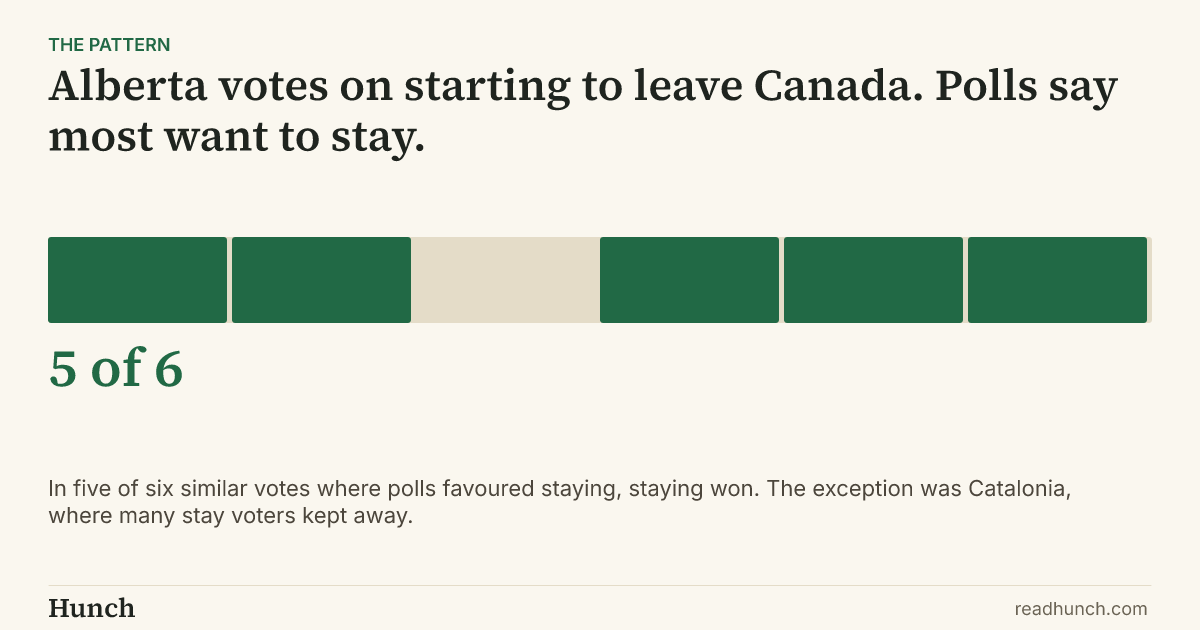
We looked for cases where all the voters of a region were asked one question, to stay in their country or to leave or start leaving, and the last published polls before the vote put staying ahead. We count each vote by its official result. We found six since 1980. In five the stay side won. None was called by a government that was itself against leaving, as Alberta’s is.
Show the other 4 cases
The Read
History points to a vote to stay. In five of the six votes the stay side won. The one loss, Catalonia in 2017, came when many on the stay side did not vote, and the sources we read show no such call in Alberta. The size of the win is less certain. In four of five votes with a poll figure, staying got less than the poll said, by 3.7 to 41 points. Scotland in 2014 was the exception.
The record has a gap. In none of the six did a government call the vote while being against leaving itself. In four the regional leader campaigned to leave, and in New Caledonia a treaty with Paris set the dates. Alberta’s vote is also one question of ten on a single ballot, and nothing in the six looks like that. The poll figures we use are from May.
Some read the vote as a way to win money and powers from Ottawa. Question 8 on the same ballot asks for a mandate to leave federal programmes while keeping their federal funding. The six cases give little support to that reading. The centre gave new powers within three years once, after Scotland in 2014, and there the regional government had campaigned to leave.
Disclaimer
Hunch works only from sources that are publicly available, and publishes on the basis of analysis of that material. We do not form an editorial opinion or take sides, we give a simpler and wider view of news that already exists. If information in a source we used was inaccurate, distorted, or later disputed but had already entered our analysis, Hunch accepts no liability for that. Predictions are not advice. Phase 1 markets use Hunch Points, not money.
Published by Hunch under the Editorial Code. Complaints and corrections: /contact/.