Assisted dying loses by 16 votes. Few past defeats led to a new plan in a month.
MPs rejected Lauren Edwards's assisted dying bill by 286 to 270 on 11 September. Supporters say they will be back but have not named a new bill.
What happened
The House of Commons voted 286 to 270 on Friday against giving a second reading to Lauren Edwards’s Terminally Ill Adults (End of Life) Bill, ending the latest attempt to legalise assisted dying in England and Wales, with the government neutral and MPs on a free vote.
The bill would have let adults with less than six months to live ask for help to die, with the approval of two doctors and an expert panel. It now goes no further. A new attempt could not use a ballot slot, the draw that gives backbench MPs time for their own bills, until the next session of Parliament.
The bill’s sponsor said Parliament had dropped the ball, and that it would be picked up again because the current law is too cruel to stand.
Supporters promise to return but have not said how. Kim Leadbeater told the BBC another attempt could come as soon as next year, but said she did not know when. Liz Kendall told the Observer that MPs and peers are considering a new private member’s bill or a change to a government bill. All options are open, she said, and extra safeguards are likely.
Lord Falconer told the BBC it was not the end of the road. The head of the campaign group Dignity in Dying called a change in the law inevitable. On the Parliament bills record showed no assisted dying bill in either House for the 2026-27 session. Lord Falconer’s last bill in the Lords ended with the previous session.
The bill lost mainly because fewer supporters turned up. The no side had 286 votes, close to the 291 who voted against the Leadbeater bill in . Support fell by 45 to 270, and the Observer counted 43 earlier supporters who did not vote.
Andy Burnham did not vote. He had said the debate should wait until social care improves, and the health minister who closed the debate raised the same concern.
Care Not Killing, which campaigns against the bill, called the result decisive and asked MPs to turn to funding for palliative care, the care of people who are dying. Three Labour MPs who voted no said the NHS, social care and palliative care must be fixed before assisted dying comes back.
Sources: BBC (2), Guardian (2), Independent, Observer, Parliament, Bill 3741
The Pattern
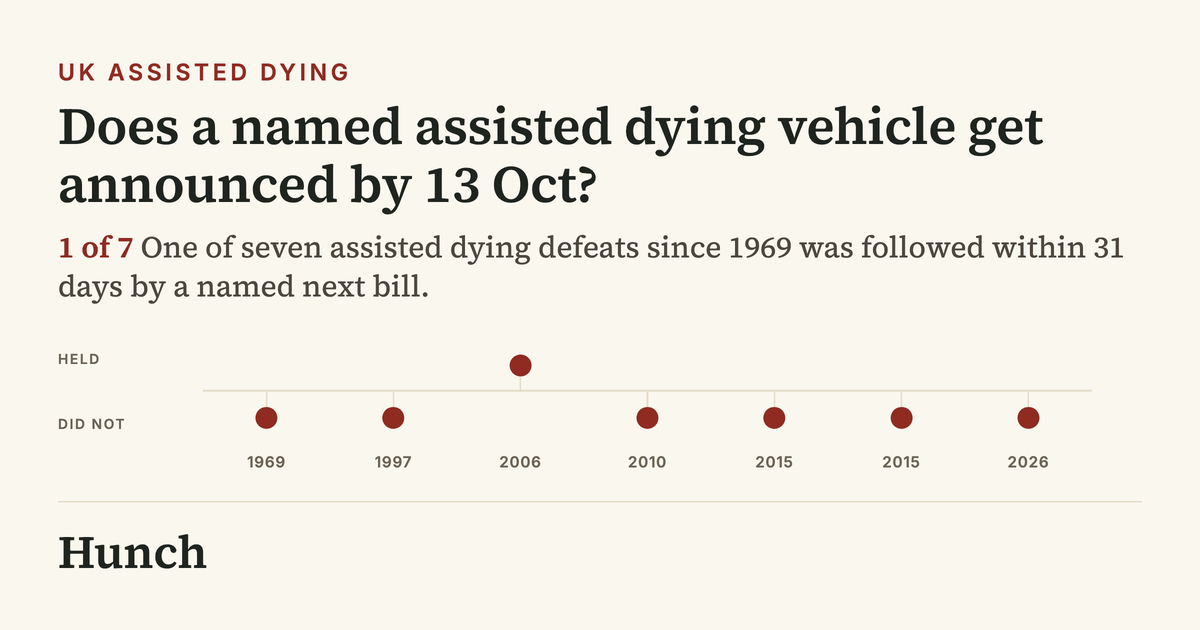
We looked at every assisted dying bill voted down in the Commons, the Lords or the Scottish Parliament since 1969. There are seven. For each, we checked whether the sponsor or the main campaign named its next step within 31 days: a new bill, a Lords bill, a promise to enter the ballot, or an inquiry by a committee. Bills that ran out of time without a vote are left out. Only one of the seven named a next step within the month.
Show the other 5 cases
The Read
History points to no named plan within the month. Six of the seven defeats brought promises but no next step. After the 330 to 118 defeat in 2015 the next bill was Lord Hayward’s, nine months later, and after each defeat in the Scottish Parliament the next bill took years. We start at 30% rather than 14% because this campaign moved fast when its bill ran out of time in April. Supporters named the ballot route that same day, and Edwards’s bill was introduced 54 days later. The Lords market is lower, because Lord Falconer’s five Lords bills since 2013 were all introduced at the start of a session, never four months in.
The other players are pulling in different directions. Burnham did not vote, told ministers to call it a matter for Parliament, and has linked any return to social care. Within hours, Care Not Killing, three Labour MPs who voted no and the Catholic archbishop of Liverpool asked for more money for palliative care. Some could still act before . Peers can bring in a Lords bill at any point in a session. The Ministry of Justice holds the decision on Royal Assent for the Isle of Man’s bill. In Scotland, McArthur has handed the cause on, and the Scottish Lib Dem leader wants it back in the new parliament.
The case against history is 2006, when Lord Joffe named his next step on the day peers stopped his bill. This campaign also has more than one route. A peer can bring in a Lords bill without a ballot, and Kendall’s route only needs a government bill to attach a change to. If BBC News or the Guardian reports Falconer, Leadbeater or Edwards naming a bill or a House before , the first market resolves YES, and one in seven will have been too low. The Isle of Man market fails if the Ministry of Justice stays as silent as the bill’s sponsor described in July, until the Manx election.
Sources: BBC (2), Parliament, Bill 1818 (2, 3), BBC (2), Observer, Guardian, Scotsman, BBC
Disclaimer
Hunch works only from sources that are publicly available, and publishes on the basis of analysis of that material. We do not form an editorial opinion or take sides, we give a simpler and wider view of news that already exists. If information in a source we used was inaccurate, distorted, or later disputed but had already entered our analysis, Hunch accepts no liability for that. Predictions are not advice. Phase 1 markets use Hunch Points, not money.
Published by Hunch under the Editorial Code. Complaints and corrections: /contact/.