Andy Burnham sits out the assisted dying vote. Most such bills since 1964 passed.
Andy Burnham has freed ministers to vote as they wish on the Terminally Ill Adults (End of Life) Bill. MPs vote on it on Friday 11 September.
What happened
The Prime Minister writes to all ministers on the Terminally Ill Adults (End of Life) Bill, setting aside collective responsibility, declaring the government neutral and asking ministers to stay out of the public debate.
Downing Street published the Prime Minister’s note to all ministers on . It lifts collective responsibility, the rule that all ministers back the government’s position, both on the bill and on whether assisted dying should be allowed. The government will stay neutral on both.
Ministers should say in Parliament and in the media that this is a question for Parliament. They may repeat views they have already given, but should not join the public debate or say what the bill would mean for their departments.
In a separate letter to Labour MPs, Andy Burnham said he would not vote at second reading, the first main vote on a bill, so that colleagues know the vote is truly free. Keir Starmer, by contrast, voted for the earlier bill at second and third reading.
MPs vote on the bill on Friday . It is the earlier bill brought back. Lauren Edwards, second in the ballot for backbench bills this session, brought it in on .
The earlier version passed the Commons on by 314 votes to 291. It was still being examined in the Lords when the session ended. Supporters of the sponsor say the new text is almost the same: adults with less than six months to live, two doctors and an expert panel.
The Friday sitting makes this vote different from a normal government bill. A backbench bill has to reach a vote before the House stops for the day, so how many MPs turn up and how long the debate runs matter as much as the numbers for and against. By staying out, the Prime Minister removes the government from the campaign on both sides.
Sources: GOV.UK, Guardian, Parliament Bill 4157 (2), Parliament Commons division
The Pattern
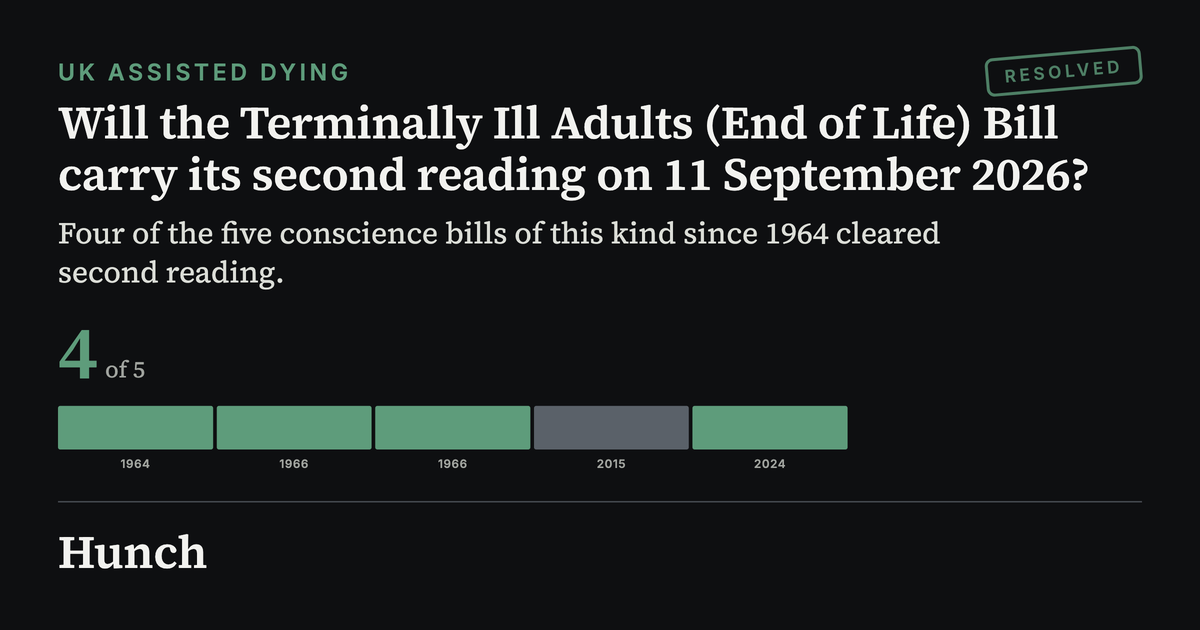
We looked at every Commons second reading since 1964 of a backbench bill that would remove or narrow a criminal ban on a matter of conscience, on a free vote where neither main party told its MPs how to vote. Government bills, bills that create a new crime and Lords bills are left out. We asked one thing: did the bill pass its second reading? Five bills fit, and four of them passed. That is one fewer than the six we need before we show History.
Show the other 3 cases
The Read
History leans towards the bill passing. The same bill won a Commons majority twice in eighteen months, by 330 to 275 and then 314 to 291, and the same MPs sit in the House now. With the government neutral, ministers and their aides are not organised to vote it down, which is the usual way a bill like this fails. The sponsor also drew a high ballot place, which secures a Friday slot. Four of the five earlier bills passed.
The risk lies in who turns up and in the clock. The third reading passed by 23 votes, close enough that normal Friday absences could reverse it, and the bill must reach a vote before time runs out. In 2015 MPs rejected this same subject by a large margin, the only defeat in the record. With the Prime Minister staying out and ministers asked to keep quiet, last year’s result may not simply repeat.
Disclaimer
Hunch works only from sources that are publicly available, and publishes on the basis of analysis of that material. We do not form an editorial opinion or take sides, we give a simpler and wider view of news that already exists. If information in a source we used was inaccurate, distorted, or later disputed but had already entered our analysis, Hunch accepts no liability for that. Predictions are not advice. Phase 1 markets use Hunch Points, not money.
Published by Hunch under the Editorial Code. Complaints and corrections: /contact/.