Why most big US bills taken up before Congress changes hands become law
On 18 November the US Senate voted 65 to 31 to end debate on a law to speed up energy projects. Can it become law before 1 January?
What happened
The upper chamber advanced the Bipartisan American Affordability and Jobs Act (BAAJA) 65-31 in a procedural vote known as a cloture vote
The US Senate is close to a final vote on a law to build energy projects faster. The Bipartisan American Affordability and Jobs Act would make it easier to build large projects, from gas pipelines and data centres to wind farms and power lines. In return it cuts back environmental protections and the right to challenge projects in court. Republicans and Democrats wrote it together, and President Donald Trump supports it.
On the Senate voted 65 to 31 to end debate on the bill. That moves it toward a final Senate vote. Two days earlier senators voted 70 to 27 to end debate on a new version of the text, and votes to take the bill up passed 73 to 25 on and 62 to 21 on . The House of Representatives passed a different version on , so after the Senate the text has to go back to the House.
the terms of Senators and Representatives at noon on the 3d day of January
US Constitution, 20th Amendment
Democrats won control of both the Senate and the House on . They take over in January, and a bill that has not passed both by noon on has to start again in the new Congress. Former Vice-President Al Gore said on that passing it now would be “a very, very serious mistake”. Supporters say Trump and Republicans would likely drop their support next year.
Sources: The Hill, The Guardian (2), govinfo.gov, Congress.gov
The Pattern
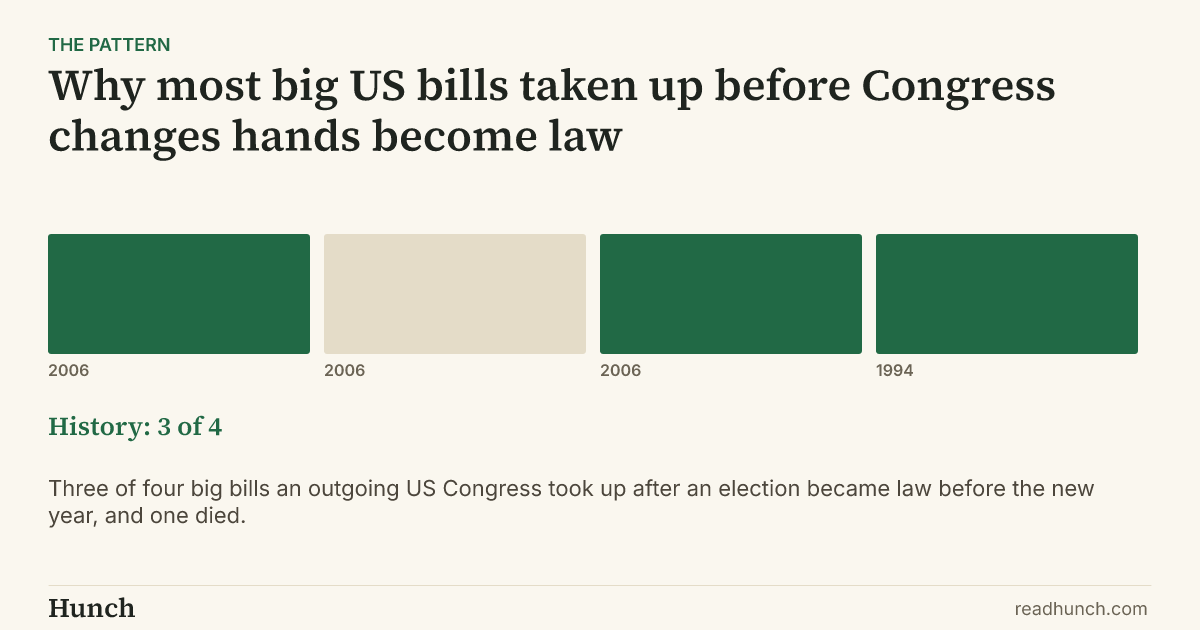
We looked for cases where the US Congress, in the weeks between an election and the start of a new Congress run by the other party in both the Senate and the House, voted on a big bill that the two had not yet passed in the same form. We found four such bills since 1901, one from 1994 and three from 2006. None of the four was about building energy projects.
Show the other 2 cases
The Read
In three of the four past bills, the president signed the law before the new year: on , and on 18 and . Each time the Senate took a recorded vote on the bill itself, more than three in five senators backed it and it became law. This year’s first recorded Senate vote was on , 53 days before , and all four votes so far, the latest on , passed by that margin.
There are reasons for doubt. Three of the four bills came in the same few weeks of 2006, and the latest is 20 years old. This bill has split Democrats, the party about to take over, and 31 senators voted against ending debate on . After the Senate the House must pass it too, while government funding runs out on , and Speaker Mike Johnson is leaving his post as Republican leader.
Sources: govinfo.gov (2, 3, 4, 5), The Hill, The Guardian, NPR, CBS News
Disclaimer
Hunch works only from sources that are publicly available, and publishes on the basis of analysis of that material. We do not form an editorial opinion or take sides, we give a simpler and wider view of news that already exists. If information in a source we used was inaccurate, distorted, or later disputed but had already entered our analysis, Hunch accepts no liability for that. Predictions are not advice. Phase 1 markets use Hunch Points, not money.
Published by Hunch under the Editorial Code. Complaints and corrections: /contact/.