Die Linke came first in Berlin. In 3 of 8 such cases the winner led the government.
Die Linke won the most votes in Berlin on 20 September but has no majority. To lead the city it needs both the SPD and the Greens.
What happened
It is not a given that Die Linke will take control of Berlin’s towering Rotes Rathaus, or red city hall.
Die Linke, the Left party, came first in the Berlin state election on . In the provisional official result it has 25.7% of the vote. The Christian Democrats (CDU) have 18.8%, the Alternative for Germany (AfD) 16.3%, the Greens 14.3% and the Social Democrats (SPD) 12.1%.
The new Berlin parliament has 158 seats, so a majority is 80. Die Linke has 47 seats, the CDU 34, the AfD 29, the Greens 26 and the SPD 22. Three groups of parties reach 80 without the AfD: Die Linke with the SPD and the Greens (95 seats), the CDU with the SPD and the Greens (82), and Die Linke with the CDU (81).
Berlin is run by Kai Wegner of the CDU, Governing Mayor since , with the SPD as partner. The two parties now have 56 seats together. Wegner gave up his bid for re-election in July, and Stefan Evers ran for the CDU in his place.
Die Linke’s candidate is Elif Eralp, a 45-year-old lawyer. The Guardian reports that the SPD and the Greens want answers on claims of antisemitism in Die Linke before they agree to work with it, and that Die Linke suspended one of its Berlin members of parliament on . Chancellor Friedrich Merz has said he will push for laws to stop her plan to take more than 200,000 flats from large landlords.
The parliament elects the Governing Mayor. It must meet within six weeks of the election, so by . A candidate needs 80 votes in the first two rounds; in a third round the person with most votes wins. The constitution sets no deadline for the vote, and Wegner stays in office until a successor is elected.
Sources: The Guardian (2), Berlin state returning officer, provisional seats, Article 56 (2, 3, 4)
The Pattern
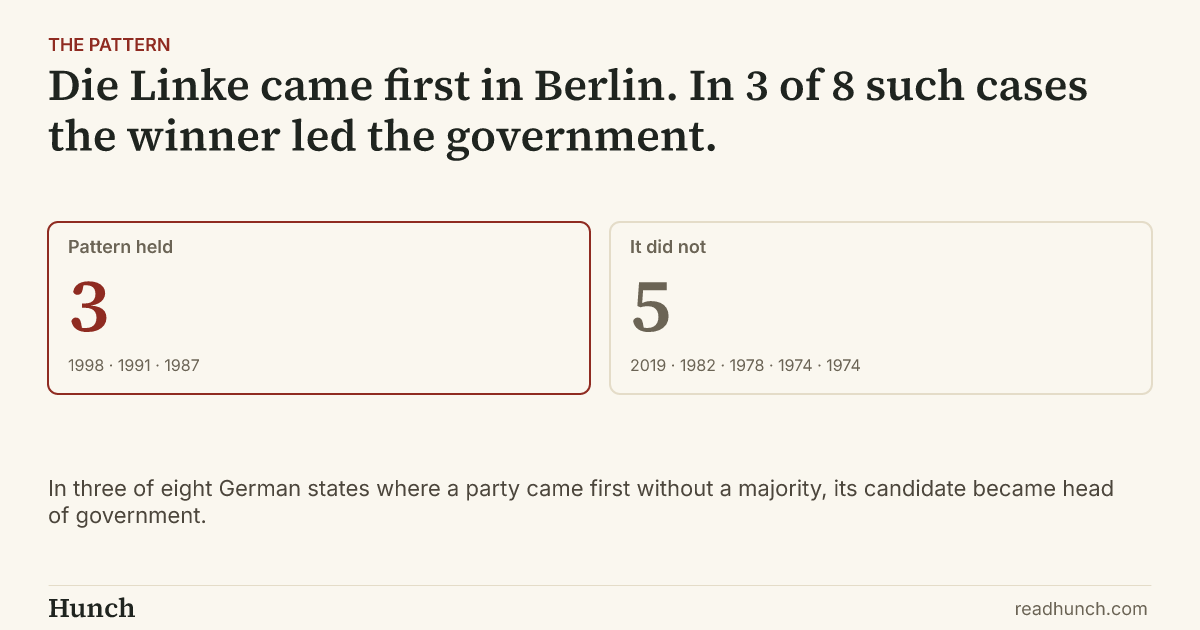
We looked for cases where a party that had never led a German state came first in a state election without a majority, while a majority without it was also possible. We checked every state election since 1946 in the official results and found eight such cases, from 1974 to 2019. In each we asked whether the first party’s candidate became head of government, and how long the state parliament took to elect one.
Show the other 6 cases
The Read
History says the first party is more likely to miss out than to lead. In eight past cases its candidate became head of government three times, each within 37 days of the election. In seven of the eight a head of government was elected within 81 days.
Where the old government kept its majority, it stayed in office each time. Where the old majority was gone, as in Berlin now, the result turned on the partner both sides needed. In Rhineland-Palatinate in 1991 the FDP moved to the first party; in Bremen in 2019 the Greens stayed with the SPD. In Berlin both possible majorities need the same two parties, the SPD and the Greens.
The record is small, and four of the eight cases come from Hesse. Berlin has also been slower than most: its parliament took 86 days to elect a mayor after the 2021 election and 74 days after the 2023 one.
Disclaimer
Hunch works only from sources that are publicly available, and publishes on the basis of analysis of that material. We do not form an editorial opinion or take sides, we give a simpler and wider view of news that already exists. If information in a source we used was inaccurate, distorted, or later disputed but had already entered our analysis, Hunch accepts no liability for that. Predictions are not advice. Phase 1 markets use Hunch Points, not money.
Published by Hunch under the Editorial Code. Complaints and corrections: /contact/.