UK borrowing is £7.7bn above forecast. Since 2012, such gaps lasted another month.
The UK borrowed £5.6 billion more in May than the OBR, the official forecaster, expected. Two months into the financial year the gap is £7.7 billion.
What happened
May borrowing hits £23.3bn, £5.6bn above the OBR forecast; debt interest is the highest for any May on record.
May borrowing was £5.4 billion higher than in . The Office for Budget Responsibility (OBR), the official forecaster, had expected £17.7 billion. Interest on central government debt reached £11.7 billion, 54.4% more than a year before. Total public debt is 95.1% of GDP, the value of everything the UK produces in a year. It was last this high in the early 1960s.
After two months of the financial year, the gap is £7.7 billion. The government borrowed £46.3 billion from April to May, against an OBR forecast of £38.6 billion. That is 23.9% more than a year earlier. The causes are debt interest, more spending on services and benefits, and tax income that has not kept up.
Chancellor Rachel Reeves raised taxes by £26 billion last November to rebuild her fiscal headroom, the room she leaves under her own borrowing rules. The figures show that room shrinking from the first months of the year.
The next test comes on , when the ONS publishes June borrowing. It is the first firm sign of whether the spring gap is a one-off or a trend. Before that, on , the OBR publishes a report on long-term risks from debt interest, the triple lock on pensions and an ageing population.
The autumn Budget has no date yet. Until the Treasury sets one, the argument about taxes and spending has no fixed moment to aim at.
The Pattern
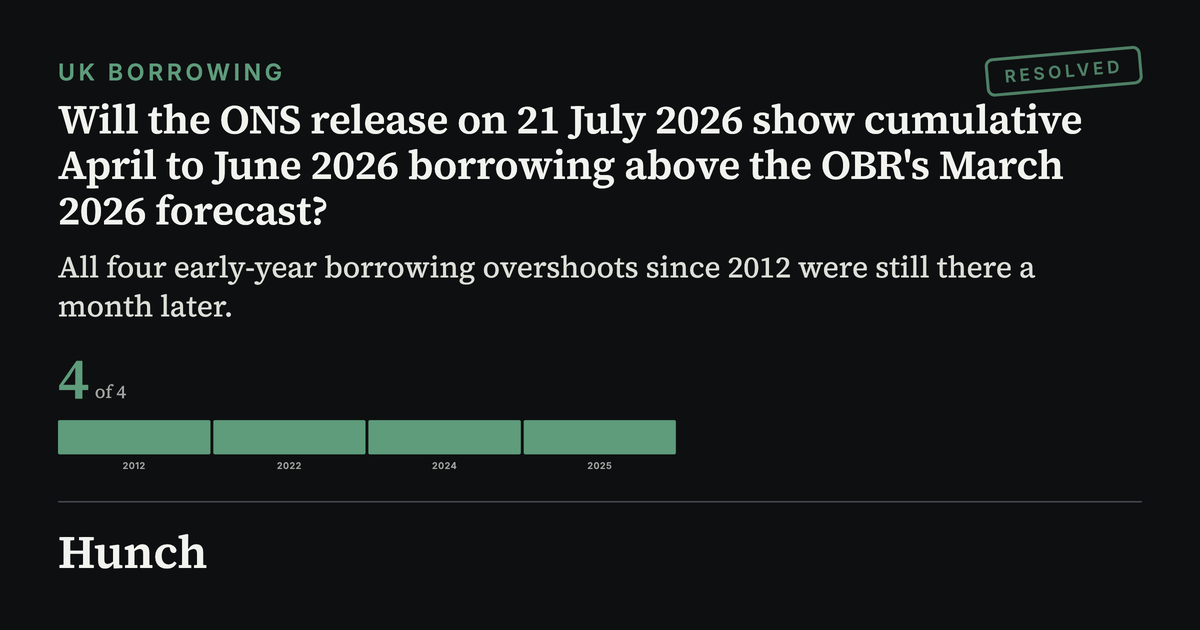
We looked at every year since 2012 when UK borrowing in the first months of the financial year ran above the official forecast, as it does now by £7.7 billion. We asked one thing: was the gap still there when the ONS published the next month’s figures, or did it disappear? We found four such years, and each time the gap lasted. The case notes also show what each chancellor did months later.
Show the other 2 cases
The Read
History points to the gap lasting. Every month of this financial year has come in above the OBR forecast, and the causes do not change quickly. Debt interest follows high interest rates and index-linked gilts, government bonds whose payments rise with inflation. Spending follows pay deals already signed, including for the NHS. That is why the first market sits at 80%. In all four years since 2012 the gap was still there a month later, and none of this year’s causes has turned. A high figure on , two weeks after the OBR report on debt risks, would shape the story of the autumn Budget before August.
The doubts are about timing and later corrections. Early-year borrowing figures are the least reliable of the year. Tax money arrives unevenly, and the ONS has often revised first figures down by billions once self-assessment and corporation tax data come in. June also carries less debt interest cost than May, because the inflation uplift on index-linked gilts falls differently across months. That is why the June-only market sits at 63%. On the Budget date, history suggests patience. Recent dates were confirmed in late summer, not in June, so 55% is close to even on the Treasury moving early.
Disclaimer
Hunch works only from sources that are publicly available, and publishes on the basis of analysis of that material. We do not form an editorial opinion or take sides, we give a simpler and wider view of news that already exists. If information in a source we used was inaccurate, distorted, or later disputed but had already entered our analysis, Hunch accepts no liability for that. Predictions are not advice. Phase 1 markets use Hunch Points, not money.
Published by Hunch under the Editorial Code. Complaints and corrections: /contact/.