Lula leads Brazil's polls by 3 points. The real count usually comes in closer.
Brazil votes on 4 October. Luiz Inacio Lula da Silva is three points ahead of Flavio Bolsonaro, and has just raised the main welfare payment.
What happened
Brazil’s president, Luiz Inacio Lula da Silva, announced a 15% rise in the Bolsa Familia cash payment and free weight-loss injections on the public health service, two weeks before the presidential vote on .
The higher payment starts on , after the first round on and just before the likely runoff on . Bolsa Familia is the monthly cash payment for poor families, and the 15% rise takes it from about £98 to about £113.
About 50 million people get the payment, and roughly 27 million of them can vote. So the rise reaches between 15% and 20% of voters. Lula says it only makes up for four years of inflation with no increase.
His opponent, the senator Flavio Bolsonaro, says the timing shows Lula is desperate. A third candidate has asked the electoral court to stop the increase.
The last published poll puts Lula three points ahead. The Datafolha survey, reported on , has Lula on 39% and Flavio Bolsonaro on 36% in the first round, and 46% to 44% in a runoff. The margin of error is 2 points, so both leads are within it.
Something similar happened in 2022. Just before that election Jair Bolsonaro, then president, raised the same payment by 50% and added temporary payments for taxi and lorry drivers. Lula’s campaign took that package to the electoral court at the time.
Brazil elects its president in two rounds. If nobody wins more than half the valid votes on , the top two meet again on . Jair Bolsonaro cannot stand, so his son Flavio is running instead.
Sources: The Guardian, Reuters, Al Jazeera
The Pattern
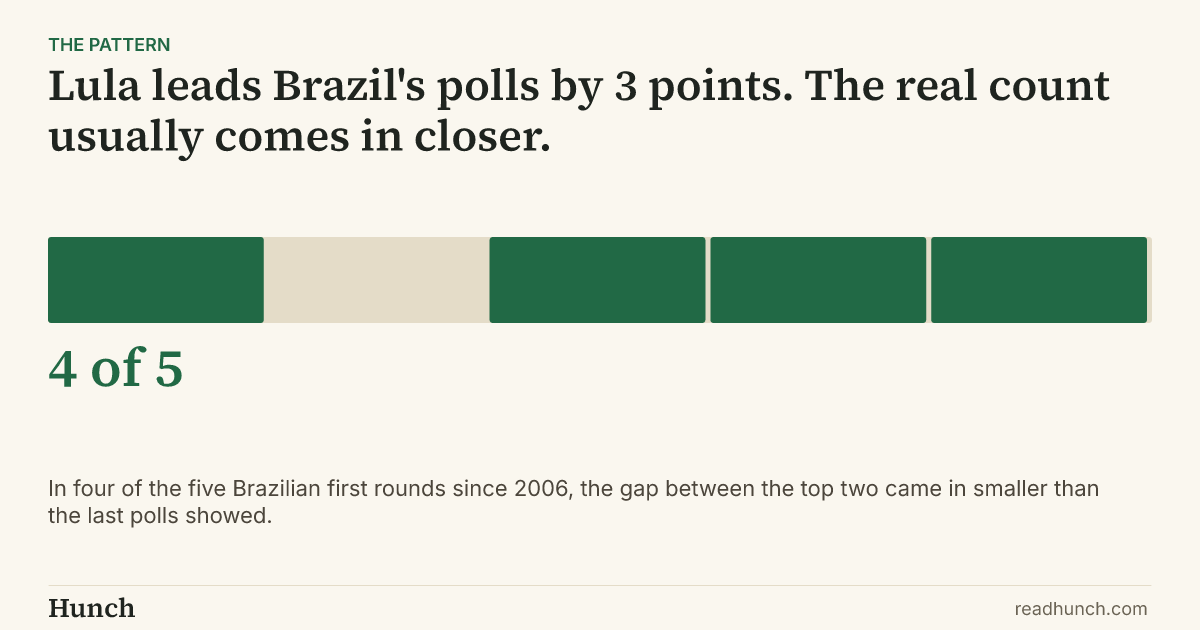
We looked at every Brazilian first round since Bolsa Familia became a national programme in 2003. That gives five elections, from 2006 to 2022. In each, we compared the gap between the top two in the last polls with the gap in the count. In four of the five, the count was closer than the polls.
Show the other 3 cases
The Read
History points to a closer count. In 2006, 2010, 2014 and 2022 the gap between the top two came in smaller than the last polls showed. Only 2018 went the other way. Late money, late scandals and late surges come after the last poll, and the candidate behind is usually the one who gains. In 2022 the polls missed Jair Bolsonaro’s vote by seven points.
This time there is less room for the gap to shrink. It starts at three points, while in 2022 it was fourteen, so our estimate sits well below the record. A three-point gap can also grow. And Lula’s payment rise reaches families on , after the first round and before the likely runoff.
The record has weak spots too. The final poll numbers in all five past elections come from the same two firms, Datafolha and Ibope, now called Ipec, so they are five elections but one way of polling. Brazil changed its rules on campaign adverts after 2018 and gave the electoral court a role against false information online, so the newest cases sit under different rules from the oldest. The past cases use polls from the last days of each race, while today’s poll was taken 17 days before the vote, which leaves more time for the race to move. Datafolha and Quaest are not on our source list, so every poll figure here is quoted as Reuters, the Guardian or Al Jazeera reported it.
History would be wrong if late voters move towards Lula. If the welfare rise and the crime operation in Rio de Janeiro pull undecided voters to him in the final two weeks, the gap grows and both markets go the same way. It would also be wrong if the last polls before show a gap far wider than three points. That would mean the race has already moved.
Disclaimer
Hunch works only from sources that are publicly available, and publishes on the basis of analysis of that material. We do not form an editorial opinion or take sides, we give a simpler and wider view of news that already exists. If information in a source we used was inaccurate, distorted, or later disputed but had already entered our analysis, Hunch accepts no liability for that. Predictions are not advice. Phase 1 markets use Hunch Points, not money.
Published by Hunch under the Editorial Code. Complaints and corrections: /contact/.