Flávio Bolsonaro leads Lula into the runoff. Sides a big power backed won 3 of 5.
Flávio Bolsonaro took 47% in Brazil's first round to 45.2% for Lula. They meet again on 25 October, and Donald Trump says he is watching closely.
What happened
Brazil’s presidential election goes to a second round on after Flávio Bolsonaro finished the first round on ahead of President Luiz Inácio Lula da Silva.
Flávio Bolsonaro won the first round on with 47.03% of valid votes to 45.16% for President Luiz Inácio Lula da Silva, with 99.99% counted. Neither passed 50%, so the two meet in a runoff on .
Most polls had Lula finishing first, so the result surprised both camps. Lula said he had been sure he would win in the first round. Two other right-wing candidates, Ronaldo Caiado and Renan Santos, took about 4% between them and have said they will back neither man.
Flávio is the eldest son of former president Jair Bolsonaro, who is in prison for trying to overturn his 2022 defeat. He met Donald Trump at the White House in May. Trump has not formally endorsed him, but on said he was watching Brazil’s election “very closely”.
The US already presses Brazil with tariffs. It put a 50% tariff on Brazilian goods in , partly linked to Jair Bolsonaro’s conviction, and a new 25% tariff in . Before the vote the State Department suspended consular services in Brazil, citing security.
Lula presents the vote as a question of Brazil’s independence. He said: “I have already told President Trump it is very important that the U.S. do not interfere in Brazil’s elections.” US Democrats wrote to Secretary of State Marco Rubio accusing the government of interference; the White House said conservatives win elections “on their own merit”.
Sources: The Guardian, Agência Brasil, Al Jazeera (2), TIME
The Pattern
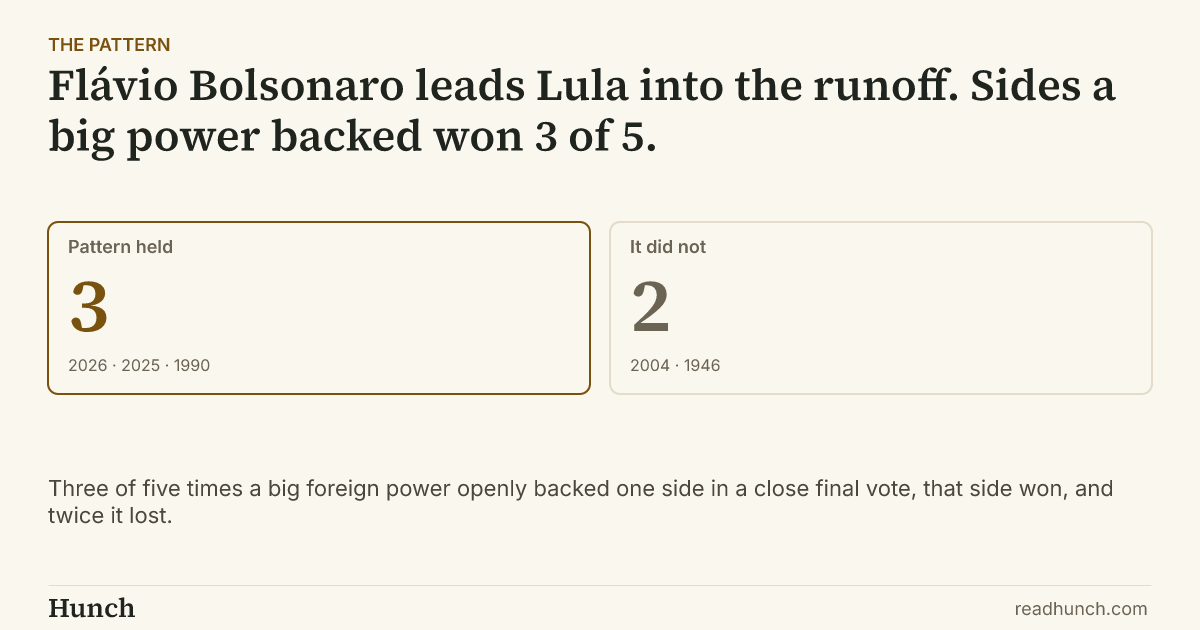
We looked for cases where a close final vote between two candidates came while a foreign power that the country depends on openly acted for one side, with official reports, sanctions or words from its leader, and the other side called it meddling. We found five since 1946: in Argentina, Nicaragua, Ukraine, Poland and Colombia. The US was the foreign power four times and Russia once.
Show the other 3 cases
The Read
History gives the side a big power backs a small edge, not a sure win. It won in Nicaragua, Poland and Colombia and lost in Argentina and Ukraine. In the three wins the backed candidate was in opposition to the government at home, as Flávio is; in Ukraine the backed candidate was the government’s own. In two of the cases the result moved towards the backed side late: polls in Nicaragua and the first exit poll in Poland had the rival ahead.
The record is thin. Five votes over 80 years, with two different powers doing the pushing, and in Poland and Colombia it was the candidate’s camp, not the candidate, who called it meddling. Here Flávio starts the runoff ahead after the first round, which none of the past cases could show in the same way.
A public endorsement from Trump or a new tariff before would follow the usual timing, since in four of five cases the loudest step came in the last two weeks. A clear swing of the other right-wing votes to one side would decide how close the result is.
Disclaimer
Hunch works only from sources that are publicly available, and publishes on the basis of analysis of that material. We do not form an editorial opinion or take sides, we give a simpler and wider view of news that already exists. If information in a source we used was inaccurate, distorted, or later disputed but had already entered our analysis, Hunch accepts no liability for that. Predictions are not advice. Phase 1 markets use Hunch Points, not money.
Published by Hunch under the Editorial Code. Complaints and corrections: /contact/.