Brazil's largest Senate party runs against Davi Alcolumbre. Will he keep his job?
Davi Alcolumbre wants a new term as head of Brazil's Senate. The Liberal Party, soon the largest in the Senate, runs Rogério Marinho against him.
What happened
The Liberal Party named Rogério Marinho as its candidate to lead Brazil’s Senate, against the re-election of Davi Alcolumbre in the vote on .
Brazil’s Senate chooses its head on . The 81 senators vote, and a winner needs 41 votes if all of them take part. The head decides which bills come to a vote and gives senators offices and jobs. Davi Alcolumbre of the União Brasil party, elected head in 2025, is running again.
The Liberal Party (PL), the party of former president Jair Bolsonaro, will have the most senators from February. On its senators chose Rogério Marinho, leader of the opposition in the Senate, to run against Alcolumbre, and the party planned to launch him on . Reports give the party 28 or 29 of the 81 seats. With the three senators of the Novo party, Marinho starts from 31 or 32 votes.
A second right-wing senator also wants the job. Tereza Cristina of the Progressistas party (PP), agriculture minister under Bolsonaro, says she wants to be the first woman to lead the Senate. On Marinho said the two had agreed not to run against each other. Folha reported the plan: in January, the one seen as less likely to win steps aside. Neither has done so yet.
The leaders of most big parties back Alcolumbre. União Brasil and the Progressistas announced their support in a letter, and so did the leaders of the Brazilian Democratic Movement (MDB), the Social Democratic Party (PSD) and the Workers’ Party of President Luiz Inácio Lula da Silva, who has just won a new term. The vote is secret, so senators can go against their party. Marinho’s side is pushing right-wing senators to say in public how they will vote. In 2019 senators showing their ballots helped Alcolumbre himself win.
A eleição dos membros da Mesa será feita em escrutínio secreto, exigida maioria de votos, presente a maioria da composição do Senado…
Senate of Brazil, internal rules, Article 60: the Senate board, led by its head, is elected by secret ballot, by a majority of votes, with most senators present
Sources: O Globo (2, 3), g1 (2), Folha de S.Paulo, Estadão
The Pattern
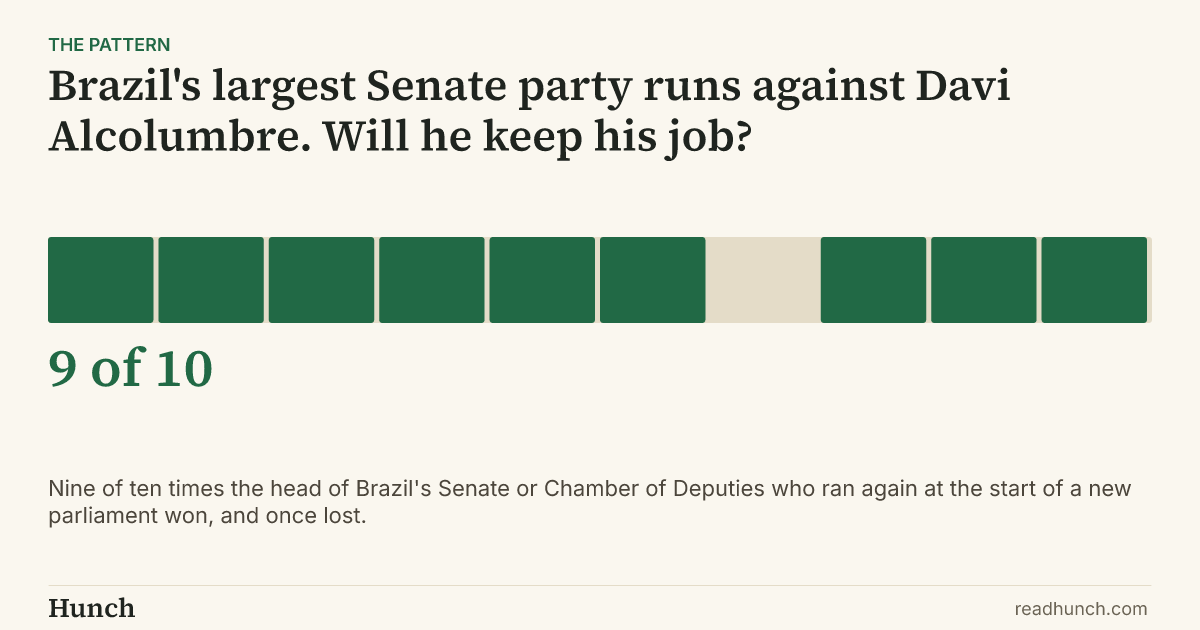
We looked for cases where the elected head of Brazil’s Senate or of the Chamber of Deputies, the lower chamber of Congress, ran for a new term at the first sitting of a new parliament, when members vote in secret. We found ten such elections from 1987 to 2023. Nine times the head won a new term on the day of the vote. The one loss came in the Chamber of Deputies in 2007, in a second round. In the Senate the head won all five times.
Show the other 8 cases
The Read
Nine of the ten heads who ran again kept their post, and all five in the Senate did. The leaders of most big parties and Lula’s government back Alcolumbre, and in 2023 the same kind of support kept the head in his post when Marinho lost 49 to 32. In 2007 the opposition block had 30 senators, and its candidate got 28 votes to the head’s 51. The two right-wing candidates have promised not to split their votes. In both past elections where the side against the head had two candidates, one of them stepped aside, and in 2023 that happened at the sitting itself.
There are reasons for doubt. All ten elections were in Brazil, and only five were in the Senate. The closest match is 2023, when Marinho’s party was already the largest in the Senate, with 15 seats. Now it will have 28 or 29, so with Novo the right already has about as many seats as Marinho won votes in 2023, and Folha de S.Paulo reports that right-wing parties will hold most seats in the new Senate. Alcolumbre could also drop out before the vote, and no past election shows that.
Sources: O Globo (2, 3), Estadão, Folha de S.Paulo (2), Senate of Brazil (2), g1 (2)
Disclaimer
Hunch works only from sources that are publicly available, and publishes on the basis of analysis of that material. We do not form an editorial opinion or take sides, we give a simpler and wider view of news that already exists. If information in a source we used was inaccurate, distorted, or later disputed but had already entered our analysis, Hunch accepts no liability for that. Predictions are not advice. Phase 1 markets use Hunch Points, not money.
Published by Hunch under the Editorial Code. Complaints and corrections: /contact/.