Bulgaria votes for a president on 25 October. It has never chosen one in round one.
Bulgaria elects a president on 25 October. To win on the day, a candidate needs over half the votes, and over half of all voters must take part.
What happened
Bulgaria’s Central Election Commission adopted the timetable for the election of the president and vice-president set for .
Bulgaria elects its president on . The Central Election Commission adopted the timetable for the vote on . The president is head of state. Executive power lies mainly with the prime minister and the cabinet.
Article 93 of the constitution sets two tests, and a candidate must pass both on the same day:
To be elected, a candidate shall require more than one half of the valid ballots, provided that more than half of all eligible voters have cast their ballots in the election.
Constitution of the Republic of Bulgaria, Article 93
If nobody passes both tests, the top two meet again within seven days, which would be . In that second round the higher vote wins and there is no turnout test.
The vote comes after a year of change at the top. Rumen Radev, president since 2017, resigned in January to run in a snap parliamentary election. His vice-president, Iliana Iotova, took over as head of state on .
Radev’s new party, Progressive Bulgaria, won the April election with 44.7% of the vote, far ahead of GERB on 13.4%, and he became prime minister. The next president will serve alongside his government.
27 pairs of candidates are on the ballot. Iliana Iotova is running as an independent with Kiril Valchev, put forward by a nomination committee. Andrey Gurov, a former caretaker prime minister, is running with Georgi Kandev and has the backing of Democrats for a Strong Bulgaria.
GERB, the largest opposition party, decided on not to field a candidate, for the first time since it was founded almost 20 years ago. Its leader Boyko Borissov had said a GERB candidate would be “the greatest favour it could do for Iliana Iotova”. A sociologist at the polling firm Alpha Research told bTV she expects Iotova and Gurov to remain the main contenders.
Sources: Central Election Commission, Al Jazeera (2), Constitution of Bulgaria, Art. 93, Presidency of Bulgaria, The Guardian, BTA (2, 3, 4, 5)
The Pattern
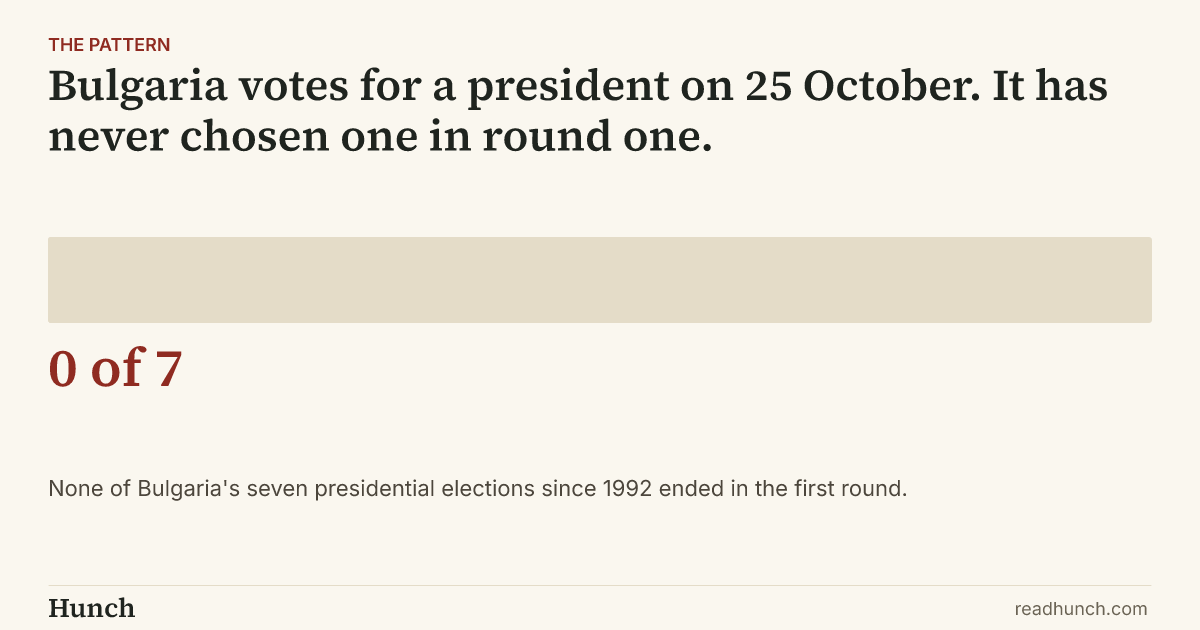
We looked for cases where Bulgaria chose its president by direct vote under the same rule. There are seven, from 1992 to 2021. In each we checked how many voters took part and what share of the votes the leader won. No election ended on the first day. Six times nobody had half the votes. In 2006 the leader had 64%, but too few people voted. The first-round leader won the second round every time.
Show the other 5 cases
The Read
History says the vote on is unlikely to be the last one. In seven elections nobody passed both tests. Turnout has been the harder test lately: it was below half in 2001, 2006 and 2021. In 2006 a candidate with 64% of the votes still had to face a second round.
The record is small and comes from one country, and 2026 is unusual. The former president’s party won 44.7% in April, far ahead of the next party on 13.4%. If turnout rises above half and the vote gathers behind one candidate, the first round could decide it. The Commission’s count after will answer that, and if it does not, the second round on will.
Disclaimer
Hunch works only from sources that are publicly available, and publishes on the basis of analysis of that material. We do not form an editorial opinion or take sides, we give a simpler and wider view of news that already exists. If information in a source we used was inaccurate, distorted, or later disputed but had already entered our analysis, Hunch accepts no liability for that. Predictions are not advice. Phase 1 markets use Hunch Points, not money.
Published by Hunch under the Editorial Code. Complaints and corrections: /contact/.