Keir Starmer quits as prime minister. Will anyone stand against Andy Burnham?
Keir Starmer quit as prime minister on 22 June, four days after Andy Burnham easily won the Makerfield by-election. Labour nominations close 16 July.
What happened
Labour opens leadership nominations on and closes them on . A sole qualifier becomes prime minister on ; a contested race pushes the result to .
Keir Starmer said on that he would resign as Labour leader and prime minister. It ended weeks of open revolt, which began after Labour’s poor local election results in May and grew as ministers resigned in June. He stays on as caretaker until a successor is chosen.
The trigger was a by-election in Makerfield on . A by-election fills one empty seat in Parliament. Andy Burnham, until then Mayor of Greater Manchester, won with 24,937 votes, or 54.8%. He beat Reform UK’s Robert Kenyon by 9,241 votes, and turnout was 58.75%.
The sitting MP, Josh Simons, had resigned the seat so that Burnham could stand. Within days of the result, Labour MPs were calling in public for an immediate change of leader.
The likeliest rival, Wes Streeting, has backed Burnham. Labour MPs nominate candidates from 9 to , and affiliated organisations on 15 and . If a rival also qualifies, members vote from 6 to , and Britain has a caretaker prime minister for the whole summer.
Sources: LabourList (2), Al Jazeera, UK Parliament
The Pattern
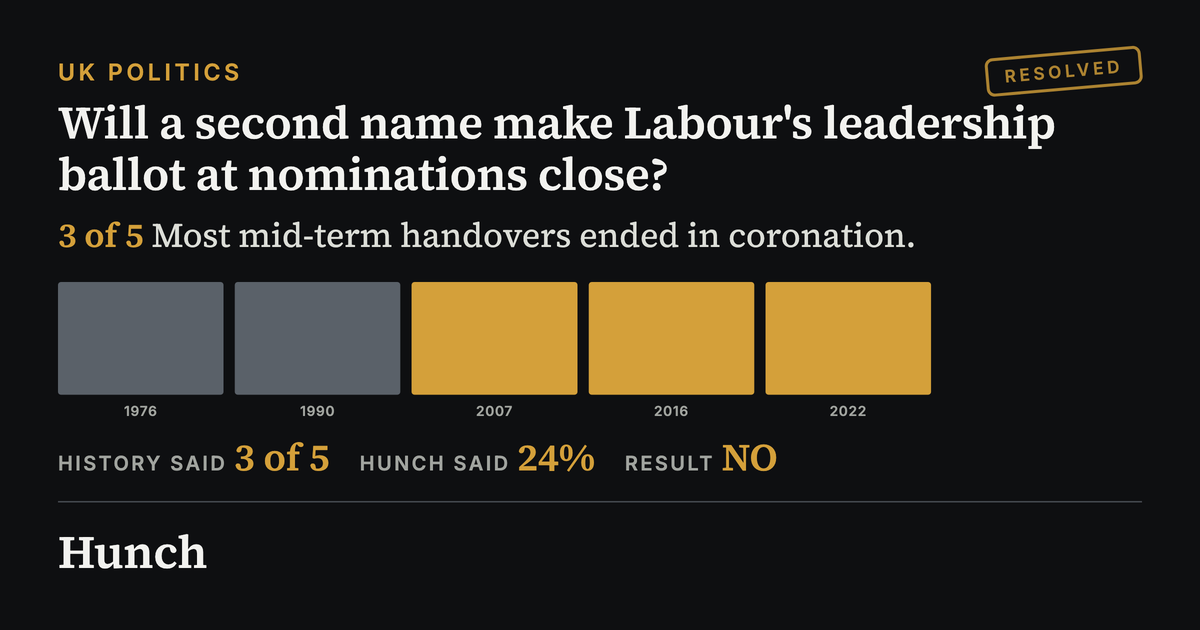
Five times in the last fifty years a British prime minister has resigned mid-term and the governing party chose the successor. The record is split. Three ended with one candidate taking over unopposed. Two went to a full vote.
Show the other 3 cases
The Read
History leans towards Burnham taking over unopposed. He arrives with a by-election win by 9,241 votes and the backing of Wes Streeting, the one rival with a campaign ready to go. Labour MPs have just watched a leader fall after a long drift and want the question settled before September. The three recent handovers without a contest, in 2007, 2016 and 2022, came when the party quickly agreed on one name, and that is already happening.
The doubt is the nomination rule. A candidate needs the backing of a fifth of Labour MPs, and Labour has many MPs, bruised and from across the party. The soft left of the party has no clear candidate, but it has strong reasons to make a mayor who has been outside Westminster for nearly ten years face a summer of questions. In 1976 and 1990 the party in government chose a real contest. If about 80 MPs decide Burnham should be tested, a second name reaches the ballot in a single afternoon.
Disclaimer
Hunch works only from sources that are publicly available, and publishes on the basis of analysis of that material. We do not form an editorial opinion or take sides, we give a simpler and wider view of news that already exists. If information in a source we used was inaccurate, distorted, or later disputed but had already entered our analysis, Hunch accepts no liability for that. Predictions are not advice. Phase 1 markets use Hunch Points, not money.
Published by Hunch under the Editorial Code. Complaints and corrections: /contact/.