Burnham wants to change how Britain votes. Will his commission have a chair soon?
Andy Burnham told Labour's conference on 29 September that the party will go into the next election promising to change the voting system.
What happened
On , in his first conference speech as prime minister, Andy Burnham announced a national commission on changing the voting system for the House of Commons.
Andy Burnham used his first Labour conference speech as prime minister, on , to promise a change to the voting system. Labour will fight the next election on that promise, and a national commission will look at the options. He did not say who will lead the commission or when it will start work.
The change will not come soon. There will be at least one more general election under the current system, and the commission’s advice will go into Labour’s next manifesto. Officials said the new system will not be purely proportional, because Burnham wants to keep the link between MPs and their constituencies.
Burnham argued that keeping the current system could hand power to a divisive government with less than 30% of the vote. Last year, as mayor of Greater Manchester, he told the conference that the time had come for proportional representation.
About 100 Labour MPs recently backed an amendment in Parliament calling for such a commission. The Liberal Democrats want a new system before the next election, which must be held by 2029, and the Greens want the commission started at once.
Not everyone agrees. Labour’s deputy leader, Lucy Powell, said that parts of the party oppose a change, and the Conservatives are likely to resist it.
Sources: BBC, The Guardian
The Pattern
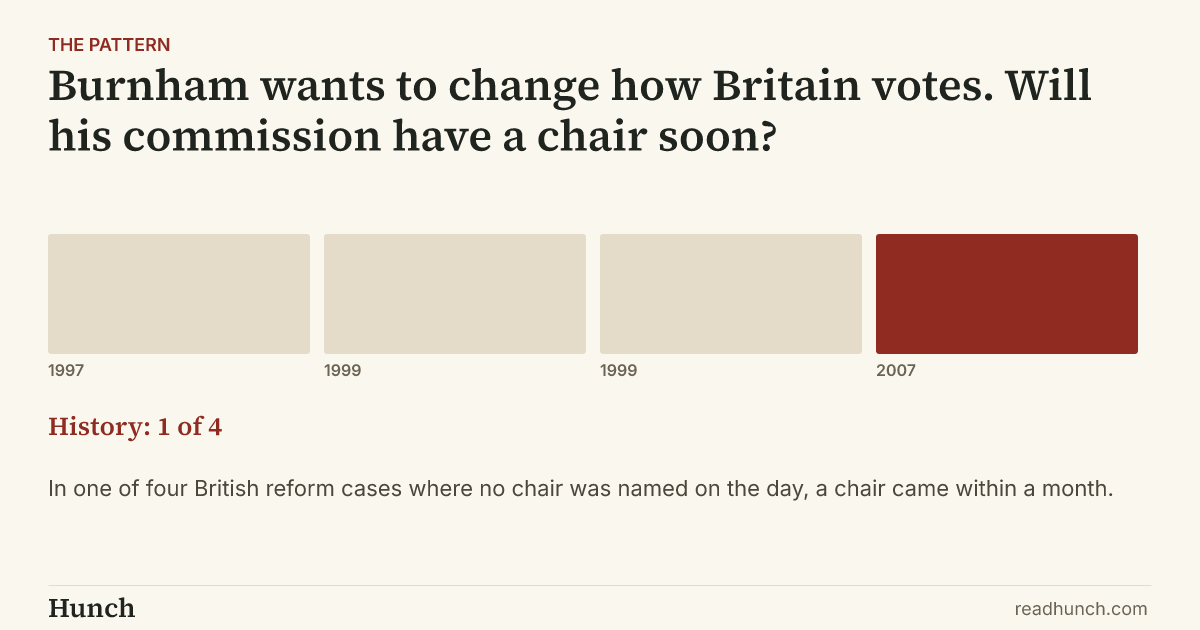
We looked for cases where a British leader whose party held power under a set of rules (voting system, the Lords, devolved powers) promised to change them, then handed the choice to a commission or a public vote, with no change in law before the next election. We found six, from 1997 to 2016. Only three are about the voting system; the others are about the House of Lords and Scotland’s powers. The Jenkins and Wakeham commissions came from one 1997 Labour manifesto, so they count once. In the four where no chair was named on the day, as with Burnham, one had a chair within 30 days.
Show the other 4 cases
The Read
History gives a slow start. In the four British cases where no chair was named on the day, only one had a chair within 30 days: Lords reform under Gordon Brown in 2007, where a minister already running the talks took charge. Kerley took 49 days, Wakeham 98 and Jenkins 213.
When a chair did come, the terms came with it. All five commissions named both on the same day, so a single announcement could settle both questions.
Over the longer run, no government changed the rules before the next election. Two changes came later, Scotland’s council voting system and Scotland’s new powers, each after one more election. Burnham has already said the change waits for the next manifesto.
The base is small and mixed. Only three of the six cases are about the voting system; the others are about the Lords and Scotland’s powers. Jenkins and Wakeham came from one manifesto, and both Brown cases from the same leader.
Disclaimer
Hunch works only from sources that are publicly available, and publishes on the basis of analysis of that material. We do not form an editorial opinion or take sides, we give a simpler and wider view of news that already exists. If information in a source we used was inaccurate, distorted, or later disputed but had already entered our analysis, Hunch accepts no liability for that. Predictions are not advice. Phase 1 markets use Hunch Points, not money.
Published by Hunch under the Editorial Code. Complaints and corrections: /contact/.