Andy Burnham faces a Labour revolt on oil. Such revolts since 1997 lost at first.
Andy Burnham looks set to back the Rosebank and Jackdaw oil and gas fields. Labour MPs have started the first revolt of his time as prime minister.
What happened
Burnham faces the first backbench revolt of his premiership over signals that ministers will consent to the Rosebank and Jackdaw developments, with opposition spanning ministers, senior backbenchers and the 2024 intake, and consultations closing in mid-August.
The public consultations close in mid-August. After that the government decides whether the Rosebank and Jackdaw oil and gas fields in the North Sea can go ahead. In his first two weeks as prime minister, Andy Burnham has signalled a practical approach. He says the question is where Britain gets its oil and gas, rather than whether Britain uses it.
Several Labour MPs have spoken against the fields. Rachael Maskell urged ministers to keep the carbon in the ground. Clive Lewis said there was no fair case for approving Jackdaw. Chris Murray, the MP for Edinburgh East, said the UK has a duty to lead on net zero, the target to stop adding to carbon in the air.
One party figure warned of a revolt if new drilling licences ever came to a vote in the House of Commons. Some critics would accept the two fields if the government agreed to stop anything further.
The two fields reach Burnham’s desk because of court rulings. Jackdaw was approved in 2022 and Rosebank in 2023. In the Supreme Court ruled in the Finch case that environmental checks must count the emissions from burning the fuel.
In Scotland’s highest civil court, the Court of Session, cancelled both approvals as unlawful. It let work continue until new decisions are made. The previous government had already admitted in court that the Rosebank approval was unlawful.
Both companies have since sent new environmental assessments that count those emissions. As recently as the regulator asked the company behind Rosebank for more information.
The energy secretary, Miatta Fahnbulleh, makes the final decision. The Times reports that Burnham’s team wants it done fast. Approval could come within weeks of the consultation closing, and Jackdaw could start producing by .
The fields already hold licences, so approving them again is a decision ministers take on their own. It needs no vote in the Commons. That shapes how the rebels can fight.
Sources: The Guardian, Institute for Government, BBC, The Times via Energy Pedia
The Pattern
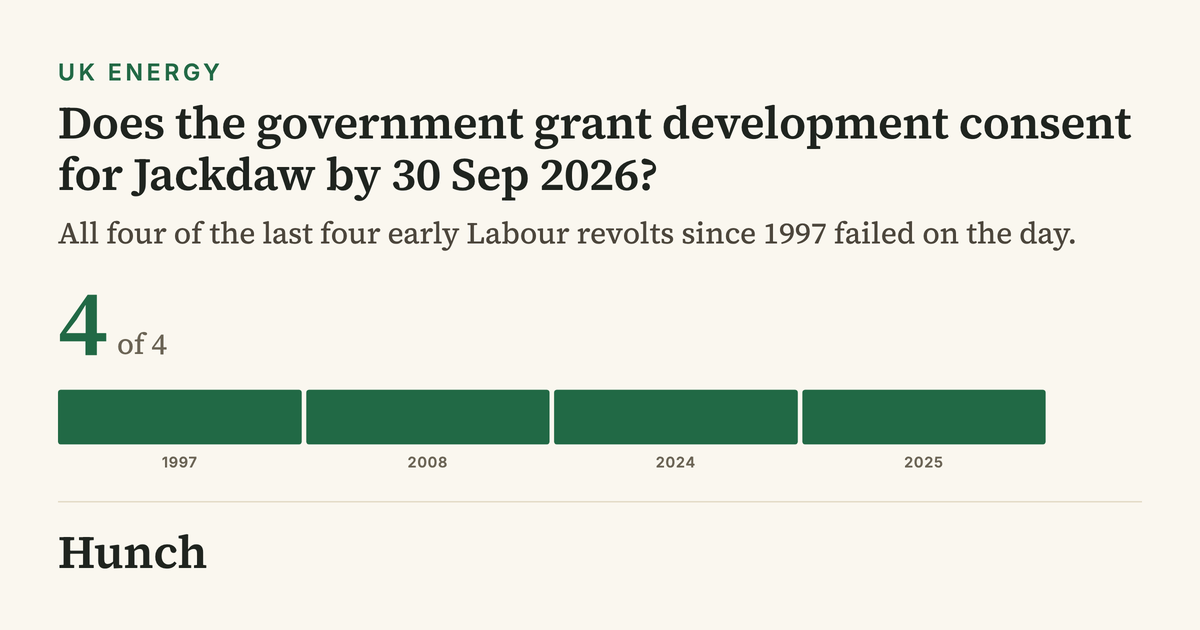
We found four revolts since 1997, and each lost at first. We looked for revolts on a point of principle by Labour MPs against a first-term Labour government with a large majority. Each time the government got its policy through the first fight. In three of the four it later gave the rebels most of what they wanted.
Show the other 2 cases
The Read
History points to Jackdaw going ahead. In all four earlier revolts the government pushed its policy through at first. The consultation closes in mid-August, and The Times reports that ministers are ready to move within weeks after that. The company says it needs Jackdaw for winter supply, which gives a natural target of . This revolt also lacks the tool the others had, a vote in the Commons. A resignation by a minister or aide, as in 1997, is less likely but still possible.
The main risk comes from the courts. Judges have cancelled these approvals once already, and the regulator has twice asked Rosebank’s company for more information. A rushed decision could bring a new court challenge from the same campaigners who won in . Rosebank’s paperwork is also behind Jackdaw’s, so the two fields may not move together. The record itself is small, only four revolts.
Approval could slip past September without any MP changing sides. That would happen if the consultation is extended, or if the offshore environment regulator asks for more information. A letter from lawyers warning of court action before the decision would have the same effect.
Disclaimer
Hunch works only from sources that are publicly available, and publishes on the basis of analysis of that material. We do not form an editorial opinion or take sides, we give a simpler and wider view of news that already exists. If information in a source we used was inaccurate, distorted, or later disputed but had already entered our analysis, Hunch accepts no liability for that. Predictions are not advice. Phase 1 markets use Hunch Points, not money.
Published by Hunch under the Editorial Code. Complaints and corrections: /contact/.