China put its rare-earth rules on hold again. Countries usually extend such pauses.
China has put off its wider rules on selling rare earths abroad until 10 January 2027. The first pause lasted a year. This one lasts two months.
What happened
China on Nov 9 announced a two-month extension of export-control waivers due to expire in November, preserving part of a wide-ranging deal struck after a summit between Presidents Xi Jinping and Donald Trump.
China has again put off its wider rules on selling rare earths abroad. On China’s Ministry of Commerce and its customs agency said the rules would stay on hold from to . If China does nothing more, they take effect on .
With approval, from to , Ministry of Commerce and General Administration of Customs Announcements No. 55, 56, 57 and 58 of 2025, and Ministry of Commerce Announcements No. 61 and 62 of 2025, continue to be suspended.
Ministry of Commerce and General Administration of Customs of China, Announcement No. 58 of 2026, 9 November 2026, our translation from Chinese
China announced these rules in . They widened limits on rare earths, minerals the technology industry needs. China first set those limits in . After Xi Jinping and Donald Trump met in South Korea, China put the October rules on hold for a year. The April limits were never paused and still apply.
The pause is part of a wider truce with the United States. On China also put off other trade measures while it talks with Washington about a lasting deal. The US put off its own steps against China’s shipbuilding industry through , “to allow for further discussion with China”. According to DW, the two sides agreed the January date in September. Kyodo News reports that Beijing and Washington formally extended their truce by two months.
Washington wants more than a pause. On the US Trade Representative, Jamieson Greer, asked China for “concrete actions to fully implement its past commitments”, above all on farm purchases and rare earths. A day later China’s commerce ministry said new US limits on Chinese companies went against what the leaders had agreed. Trump and Xi are due to meet at the Asia-Pacific Economic Cooperation (APEC) summit in Shenzhen on 18 and .
Sources: The Straits Times, Ministry of Commerce of China (2, 3, 4), DW, Kyodo News, Federal Register
The Pattern
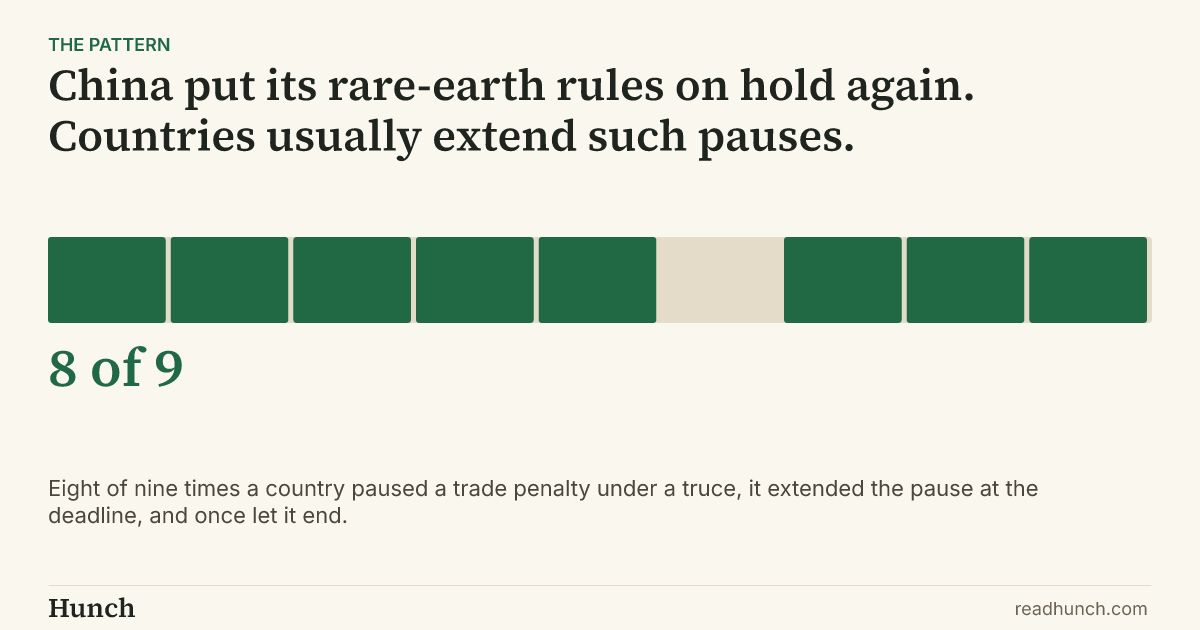
We looked for cases where a country had put its own trade penalty on hold as part of a truce with another country, and the end date was near. We found nine such deadlines from 2019 to 2025, decided by the United States, China and the European Union. Each time, we looked at what the country did before the pause ran out.
Show the other 7 cases
The Read
Five of the nine decisions came on the last day or the day before. Only once did a decision come more than a week early: in 2021 the US extended its Airbus and Boeing pause by five years, weeks ahead. China extended the first pause of these rules on , a day before it ended. The US pause on its steps against China’s shipping now runs through , so both pauses end together. Before Trump and Xi are due to meet in Shenzhen, and another meeting is expected in December in Miami, at the summit of the Group of 20 large economies (G20). After leaders’ deals in 2021 and , the new pause was longer than the old one.
There are reasons for doubt. All nine pauses were tariffs, and none were limits on exports like China’s rules now. In China’s earlier pauses a tariff commission decided, while now the commerce ministry does. The US took six of the nine decisions, five of them under Donald Trump. The only time a pause ended, in , the US had said it was checking whether Canada had done enough, and on China’s commerce ministry said the US was moving away from what the leaders agreed. Outright scrapping also happens: in 2021 the US dropped tariffs on six countries over digital taxes just before their pause ended, after deals with each of them. Those pauses were not part of a truce.
Sources: Federal Register (2, 3, 4, 5, 6, 7), Ministry of Commerce of China (2), The Straits Times, Ministry of Finance of China
Disclaimer
Hunch works only from sources that are publicly available, and publishes on the basis of analysis of that material. We do not form an editorial opinion or take sides, we give a simpler and wider view of news that already exists. If information in a source we used was inaccurate, distorted, or later disputed but had already entered our analysis, Hunch accepts no liability for that. Predictions are not advice. Phase 1 markets use Hunch Points, not money.
Published by Hunch under the Editorial Code. Complaints and corrections: /contact/.