Catholic UK leader may advise on bishops. Most bills reach committee in 90 days.
The government introduced a bill on 15 September to end the rule that stops a Catholic or Jewish prime minister advising the King on bishops.
What happened
The government introduced a bill on to repeal the parts of the Roman Catholic Relief Act 1829 and the Jews Relief Act 1858 that stop a Roman Catholic or Jewish prime minister from advising the King on Church of England appointments.
The government brought in a bill on . It would end old rules that stop a Roman Catholic or Jewish prime minister from advising the King on who becomes a bishop or archbishop. The rules are in the Roman Catholic Relief Act 1829 and the Jews Relief Act 1858.
The bill is called the Church Appointments (Repeal of Discriminatory Provision) Bill. The Cabinet Office is in charge of it, and the minister responsible is Louise Haigh.
Andy Burnham is the first Roman Catholic prime minister. Until this month the two old laws stopped him doing one part of his own job. Earlier in September he gave the task of advising the King on Church appointments to the Lord Chancellor, so that bishops could still be appointed.
Under the 1829 law, a Catholic who gives that advice commits a serious offence, called a high misdemeanour, and is banned for life from any office under the Crown.
So far the bill has had only its first reading, the formal step that brings it into the House of Commons, on . No date is set for the second reading, the first debate. The Commons then broke for the party conferences, and the next sittings for any government bill are listed for .
The bill must pass both the Commons and the House of Lords before the change takes effect.
Sources: BBC, GOV.UK, The Times, The Daily Telegraph, UK Parliament
The Pattern
Most government bills reach committee within ninety days. We looked at every government bill brought into the House of Commons, using Parliament’s own bills record. We checked whether each reached committee stage, when MPs go through a bill line by line, within ninety days of its first reading. Bills whose ninety days are still running are left out. Below are the ten most recent, newest first.
Show the other 8 cases
The Read
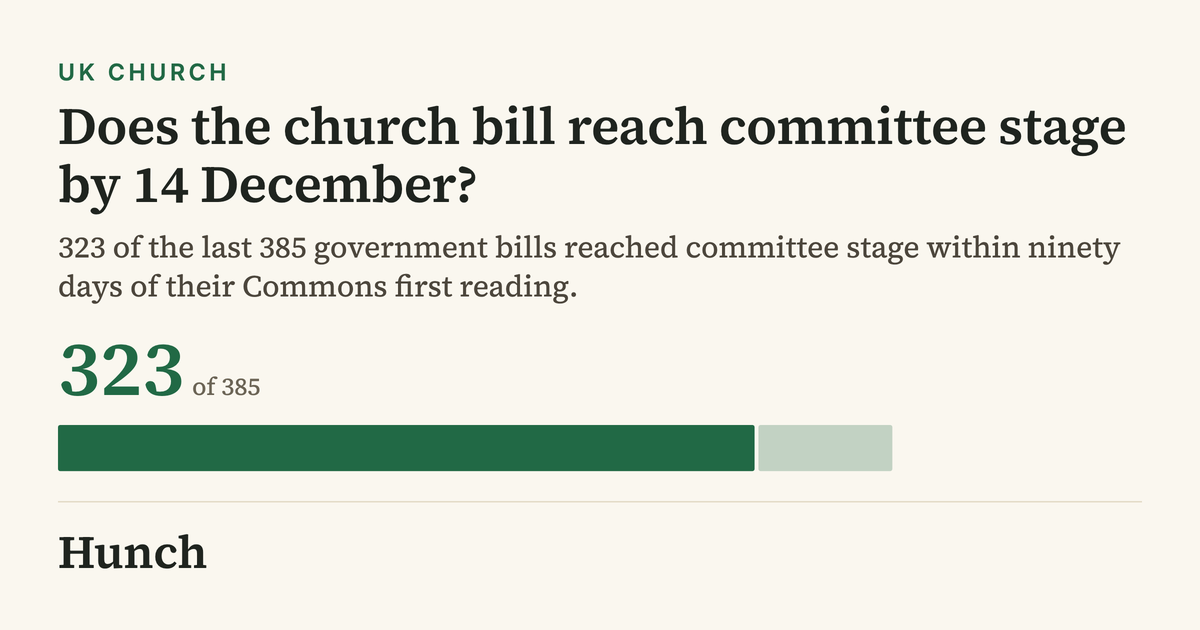
History points to the bill reaching committee in time. Of 385 government bills brought into the Commons, 323 got there within ninety days, and the typical bill took 34 days. The share is about the same in every period: 83 per cent since 2010 and 81 per cent since 2019. The conference break looks like a problem, but the record does not show one. All 28 government bills first read in a September reached committee within ninety days, and all 28 had a second reading within 52 days. September is the start of the year in Parliament, and the break is already in the timetable.
The closest cases took longer than usual. The Public Office (Accountability) Bill, brought in on , reached committee after 72 days. The Biodiversity Beyond National Jurisdiction Bill, brought in on , took 68. Some bills stop altogether. In 2023 the Sentencing Bill had a second reading and then nothing, and the Renters (Reform) Bill waited 181 days. The bills are also a small group, so we use them only to show that the break does not slow bills down.
An early end to the session of Parliament would stop the bill. So would a decision to fold the change into a wider bill on the constitution. On the other side, the stopgap of handing the job to the Lord Chancellor is awkward, which gives ministers a reason to move.
Disclaimer
Hunch works only from sources that are publicly available, and publishes on the basis of analysis of that material. We do not form an editorial opinion or take sides, we give a simpler and wider view of news that already exists. If information in a source we used was inaccurate, distorted, or later disputed but had already entered our analysis, Hunch accepts no liability for that. Predictions are not advice. Phase 1 markets use Hunch Points, not money.
Published by Hunch under the Editorial Code. Complaints and corrections: /contact/.