Colombia's new leader won by 0.96 points. Such narrow winners took office on time.
Abelardo de la Espriella beat Iván Cepeda by 0.96 points in the 21 June runoff, Colombia's closest ever result. The handover is on 7 August.
What happened
President Gustavo Petro announced the start of the formal transition to president-elect Abelardo de la Espriella after Iván Cepeda conceded on — six weeks before the handover.
Colombia’s new president won by 0.96 points. In the runoff, the second round of voting, Abelardo de la Espriella took 49.66% against Iván Cepeda’s 48.70%. The gap was 250,830 votes, the narrowest in the country’s history.
De la Espriella is a right-wing lawyer. With 12.9 million votes, he got more votes than any presidential candidate in Colombia before him. His campaign had already shaken up the race in the first round.
Cepeda first refused to accept the result and said he would wait for the official check. He conceded on , after the official count matched 99.997% of the first quick count. Hours later President Gustavo Petro accepted the result, while claiming fraud and foreign interference, and said the formal handover would begin.
The constitution fixes the handover for Friday . That day de la Espriella is due to take office as Colombia’s 38th president. Petro described the handover in his own words, writing that he felt as though he were handing over the sword of Simón Bolívar, the hero of South American independence.
Sources: The Guardian, Al Jazeera (2)
The Pattern
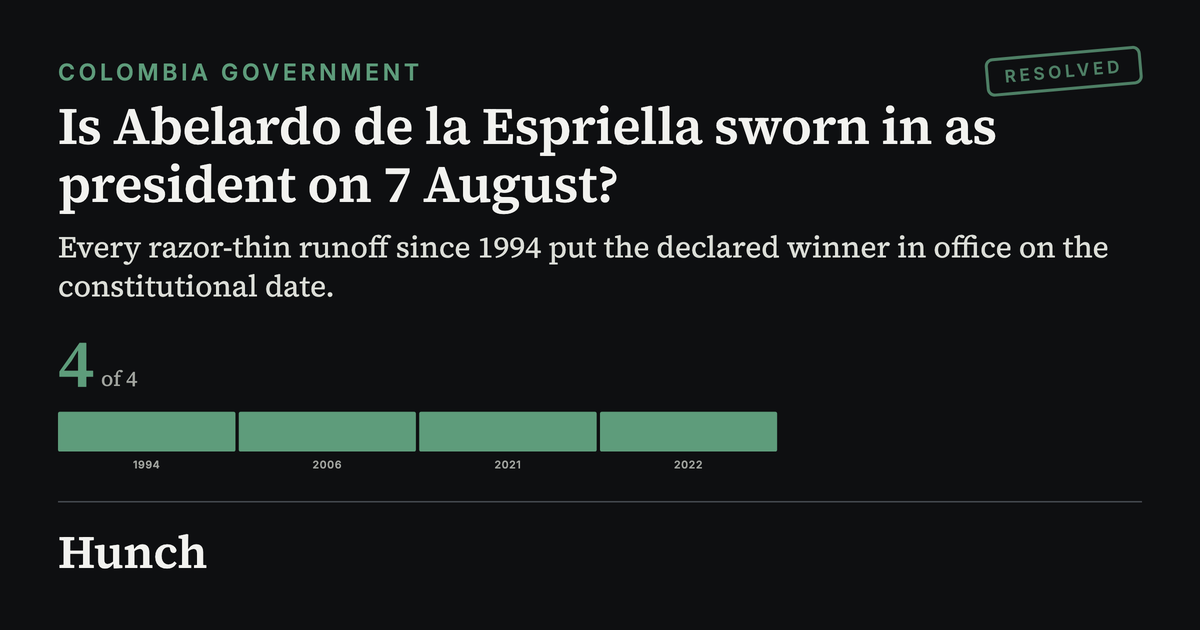
In every close runoff we found, the winner took office on time. We looked for Latin American presidential runoffs since 1994 that were won by a very small margin, and found four. Whatever the losing side claimed, the declared winner took office on the date set by the constitution. One of the four, Mexico in 2006, was a single round of voting rather than a runoff.
Show the other 2 cases
The Read
History points to a handover on . Most formal steps are done. Cepeda conceded, the electoral council gave the winner his official papers, and Petro publicly ordered the handover. The two teams have been sharing files since . In all four earlier cases the winner took office on the set date. In Brazil, Bolsonaro never conceded. In Peru, Fujimori claimed fraud, and in Mexico, López Obrador set up his own rival government. None of this moved the date by a single day.
The weak point is Petro himself. No modern Colombian handover has happened with the outgoing president openly saying the election was stolen. Outgoing presidents usually attend the ceremony, but this handover is breaking with tradition, so his presence is an open question. After such a close result the losing side is large and organised, and the challenges Cepeda’s campaign filed before conceding could still cause trouble in the courts. The record is also small, four cases, and Mexico in 2006 was not a runoff.
Disclaimer
Hunch works only from sources that are publicly available, and publishes on the basis of analysis of that material. We do not form an editorial opinion or take sides, we give a simpler and wider view of news that already exists. If information in a source we used was inaccurate, distorted, or later disputed but had already entered our analysis, Hunch accepts no liability for that. Predictions are not advice. Phase 1 markets use Hunch Points, not money.
Published by Hunch under the Editorial Code. Complaints and corrections: /contact/.